
In Search of Quiet Seowon and Ancient Temples in Yeongju in Gyeongsangbuk-do Yeongju City · schedule Other · distance 36.9km · 5 stops · highlights Sosu…

Take a quiet walk through Sosu Seowon, Korea's first royal-commissioned Seowon (Confucian academy granted a royal plaque), and Sunheung Hyanggyo. While it may lack the lively excitement of experiential activities, it is a great opportunity to fully feel the spirit of the scholars harmonized with the serene nature. Visiting in midsummer, you can forget the heat to the cool sounds of water at Jugye Gugu.
This course is a sample one-day itinerary. Save it as-is or expand it into an AI itinerary.
In 1542 (37th year of King Jungjong), Punggi County Governor Joo Se-bung built a shrine to honor Anhyang, and in 1543 (38th year of King Jungjong), it was called Baekundong Seowon as it began educating students. In 1550 (5th year of King Myeongjong), by the request of Punggi County Governor Yi Hwang, it was granted the title 'Sosu Seowon' and officially recognized and supported by the state. In 1544 (39th year of King Jungjong), Anchuk and Anbo were enshrined, and in 1633 (11th year of King Injo), Joo Se-bung was added to those honored. The buildings of the Seowon are arranged relatively freely, likely because it is an early Seowon before the typical layout was established. Entering through the main gate, there is Myeongnyundang lecture hall, followed by Ilsinjae and Jikbangjae dormitories. Unlike the typical symmetrical east and west dormitories flanking the lecture hall, Sosu Seowon is distinguished by the names on the plaques. The shrine is located in a separate walled area northwest of Myeongnyundang. Originally, the site contained Suksusa temple from the Unified Silla period, with remnants such as the dangganjiju (flagpole supports) and stone foundations surviving. Sosu Seowon is one of the 47 Seowon that survived the nationwide abolishment decree by Daewon-gun in the late Joseon Dynasty and continues to hold ancestral rites every spring and fall.
Sunheung Hyanggyo's exact founding date is unknown, but it is estimated to have been established in the late Goryeo or early Joseon Dynasty. Initially built north of Geumseong in Sunheungbu, it was relocated eastward to Yadong in 1718 (44th year of King Sukjong), then southward to Seokgyo-ri in 1750 (26th year of King Yeongjo), and again moved to its current location in 1770 (46th year of King Yeongjo). It was renovated in 1971 and the pavilion and dancheong were restored in 1975. Originally, Sunheung Hyanggyo served as a Confucian school where local scholars of Sunheung studied, and a site for memorial rites honoring Confucius and other sages. Later, it was used as a local self-governance institution, but from the 16th century onward, due to operational difficulties and socio-economic changes, its educational role diminished, leaving only the memorial rites function. Existing buildings include a 7-room Daeseongjeon, a 6-room Myeongnyundang, 5-room Dongmu and Seomu, 4-room Dongjae, a 7-room gate tower, a Sammun, a Hyepum, and a Jusa. The Daeseongjeon enshrines tablets of the Five Sages and Ten Wise Men; the Dongmu and Seomu enshrine tablets of six Confucian scholars from the Song dynasty and 18 Korean scholars. Additionally, records such as Jipsa-an, Myeonbunryuwonim-an, and Gyojungjaprok, created during the late Joseon period for managing the hyanggyo, are preserved.
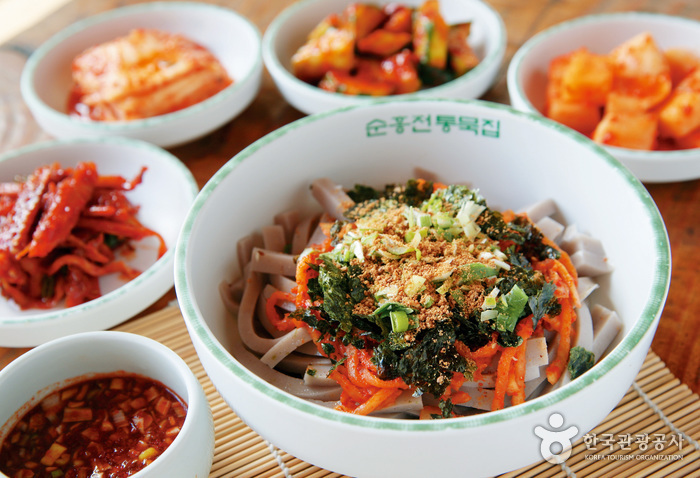
옛날부터 전래되어 내려온 전통적인 방법으로 메밀묵을 제조하여 본래의 맛을 간직한채 묵과 조밥이 함께 어울려 내는 맛은 일품이며, 고향의 맛을 풍기는 메밀묵이다
Buseoksa Temple is a head temple of the Hwaeom Sect, founded in the 16th year of King Munmu’s reign in Silla (676) by the sect’s patriarch Uisang Daesa under royal command. While studying in Tang China, Uisang Daesa heard of the Tang emperor's invasion of Silla, reported this to the king, and returned home to unify the national sentiment and overcome hardships through Hwaeom philosophy, founding this temple as the origin of Korea’s Hwaeom thought. The name Buseoksa comes from a large rock west of the Buddha hall that floats without touching the lower rock, called the “floating rock.” In the Goryeo period, it was called Seondalsa or Heunggyeosa Temple. A manuscript found during restoration in 1916 reveals that Muryangsujeon and others were rebuilt in early Goryeo, but were destroyed by fire in the 7th year of King Gongmin’s reign (1358). Muryangsujeon was rebuilt in the 2nd year of King U’s reign (1376), and Josadang in the 3rd year (1377). The temple grounds contain Unified Silla relics such as the stone lantern in front of Muryangsujeon, stone Buddha statue, three-story stone pagoda, flagpole supports, and stone pedestal, as well as Goryeo relics including Muryangsujeon, Josadang, a clay Buddha statue, Josadang murals, Goryeo woodblocks, and the stele of Wonhyungguksa. Notably, Muryangsujeon is one of Korea’s oldest wooden buildings, and the Josadang murals are the oldest known on wooden structures, now preserved in the artifact museum. The Buddha statue enshrined in Muryangsujeon is the finest clay statue in Korea. The well west of Muryangsujeon is said to be where Uisang Daesa’s guardian dragon lived.
Jukgye Valley is a valley located in Baejeom-ri, Sunheung-myeon, Yeongju-si, Gyeongsangbuk-do, on Sobaeksan Mountain. Jukgye Stream originates from Gungmangbong Peak of Sobaeksan and flows southeast, surrounding Sosu Seowon. The water drops winding around jagged rocks on the Geumdang rock formation resemble scattering crystal beads, creating nine scenic bends called Jukgye Gugok. It was the setting of "Jukgye Byeolgok," a poem by Geunjae An Chuk, a great scholar of the late Goryeo period, and in the mid-Joseon period, scholars such as Sinjae Ju Sebung and Toegye Yi Hwang enjoyed the scenery and composed poetry here. According to Sunheungji, the name Jukgye Gugok was first given by Shin Pil-ha, appointed magistrate of Sunheung in the 4th year of King Yeongjo of Joseon (1728). The distance spans about 2 km from Choaam Geumdang rock (1st bend) to the 9th bend. Currently, only the names of bends 1, 2, 4, 5, and 9 are preserved. Following Jukgye Gugok upward, you can see Choaam Temple, a small temple at the foot of Sobaeksan. This temple originated when Monk Uisang of the Silla period set up a hut here as a temporary residence while choosing a site for Buseoksa Temple and later built the temple where the hut stood, hence named Choaam. The temple fell into ruin during the Korean War but was restored to its current state through the dedicated efforts of Monk I Bowen.
Good places to stop and rest after the course

Booking and payment continue on a partner site.
Check rooms & priceSign up to feature your channel.
(As a member, you can add your Instagram, YouTube, and blog links in My Page, and we’ll show them with every comment you write.)
““Stayed near Hongdae and did a night café tour. Perfect city views and vibes.””
Guest comments do not display social media links or profile cards.
Share a short tip about this place.
Or leave a quick comment as a guest.
Photo attachments are available after login.
No reviews yet. Be the first to share your experience!
![Sosu Seowon [UNESCO World Heritage] 1](https://tong.visitkorea.or.kr/cms/resource/76/3499376_image2_1.JPG)
![Sosu Seowon [UNESCO World Heritage] 2](https://tong.visitkorea.or.kr/cms/resource/77/3499377_image2_1.JPG)
![Sosu Seowon [UNESCO World Heritage] 3](https://tong.visitkorea.or.kr/cms/resource/78/3499378_image2_1.JPG)
![Sosu Seowon [UNESCO World Heritage] 4](https://tong.visitkorea.or.kr/cms/resource/79/3499379_image2_1.JPG)


![Buseoksa Temple [UNESCO World Heritage] 1](https://tong.visitkorea.or.kr/cms/resource/42/3572442_image2_1.JPG)
![Buseoksa Temple [UNESCO World Heritage] 2](https://tong.visitkorea.or.kr/cms/resource/44/3572444_image2_1.JPG)
![Buseoksa Temple [UNESCO World Heritage] 3](https://tong.visitkorea.or.kr/cms/resource/45/3572445_image2_1.JPG)
![Buseoksa Temple [UNESCO World Heritage] 4](https://tong.visitkorea.or.kr/cms/resource/52/3572452_image2_1.jpg)


