
Yeongdeok Cultural Heritage Course 1 in Gyeongsangbuk-do Yeongdeok County · schedule Other · distance 51.6km · 5 stops · highlights 유금사(영덕), 장육사, Yeongd…
Due to its geographical location at the end of the Taebaek and Nakdong mountain ranges, this area is protected from all environmental pollution (the Taebaek and Nakdong mountain ranges act as filters to purify the air by removing metallic substances and dioxins contained in the prevailing westerly winds, which are the main cause of yellow dust originating from China in spring). Visitors can breathe fresh oxygen, enjoy crystal-clear seas, scenic beach drive courses, and parks, all of which naturally inspire admiration.
This course is a sample one-day itinerary. Save it as-is or expand it into an AI itinerary.
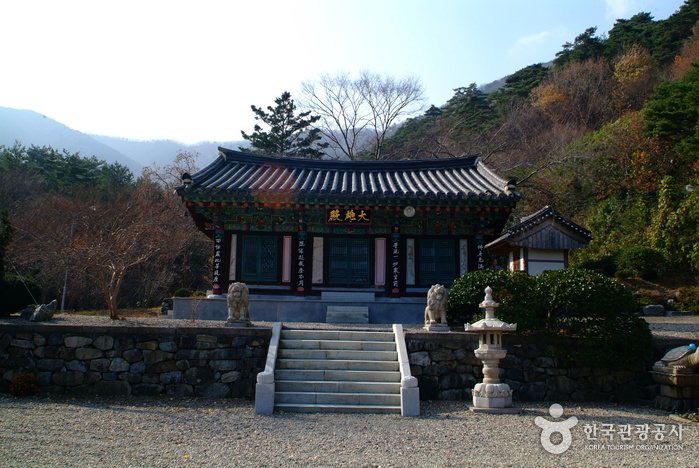
칠보산(해발 810m) 기슭에 자리 잡은 유금사는 신라 선덕 여왕때 왕명에 따라 자장율사가 창건한 사찰이다. 조선 중기 이전까지는 대웅전, 종각, 장화부인 신령각 등을 갖추고 있었고, 승려도 수십명 기거했다. 그런데 어느 날 주지가 불국사 법회를 마치고 돌아오는 도중에 절 앞 용소에서 두 마리 용이 교미하는 것을 보고 고약하게 여겼는데, 절에 도착하기도 전에 폭우가 쏟아져 산사태로 절이 무너졌다고 한다. 그 뒤 여러 차례의 중창을 거쳐 현재에 이르렀다. 이 고장에서는 가장 오래된 고찰로서, 경내에는 3층 석탑과 대웅전, 향로전, 산신각 등의 건물이 있다.
장육사는 고려 말 공민왕 때의 나옹선사가 1355년에 창건한 고찰로서 운서산 기슭에 자리 잡고 있다. 대웅전은 조선 중기 때의 건물로 여겨지는데 정면 3칸, 측면 3칸의 맞배지붕집으로 벽에는 재미있는 벽화들이 많이 그려져 있다. 홍연암, 산신각, 흥원루, 요사채가 있다. 또 장육사에는 보물 제1933호인 건칠보살좌상 (조선 초기)이 모셔져있다. 이 건칠상이라는 것은 기본틀 위에 종이를 여러 겹 덧붙여 형태를 만들고 그 위에 다시 금물을 올린 불상이다.
Also called Hwasuru, this is a two-story pavilion building from the Joseon Dynasty, officially named Okcheon Jae-sa as a cultural heritage. Okcheon Jae-sa was built as a memorial hall for the ancestral rites of Gwon Hui-eon, the great-grandson of Gwon Chaek, the founding ancestor of the Andong Gwon clan in Yeonghae. The pavilion was constructed by his five sons in 1676 (the 2nd year of King Sukjong). Hwasuru is a tiled, two-story pavilion with a gable roof, measuring five kan wide by two kan deep. It is an I-shaped structure with an adjacent ∩-shaped building at the rear, forming an overall 口-shaped floor plan. The lower part of Hwasuru has a door and serves as a passage, while the upper floor features a 6-kan daechung (main hall) centered floor plan with ondol rooms on both sides, and the structure is based on an Oryangga frame. Inside the pavilion, there is a small courtyard. The rear buildings were used as a kitchen and storage. ※ This national heritage site can generally be visited, but access may be restricted due to personal circumstances of the owners.
About 800m northeast from the Yeonghae-myeon office, there is Goesiri Village, the birthplace of the great scholar of the late Goryeo period, Mogeun Lee Saek, and a village surrounded by traditional Joseon Dynasty houses. Its original name was Hojichon, but after Mogeun Lee Saek returned from a mission to China and said his hometown resembled Guishi in China, the name Goesiri was established, though some still call it Hojigol, Hojimaeul, or Hojichon. Goesiri Traditional Village is a Yeongyang Nam clan village where they have lived for over 400 years, shaped like the character for 'palja,' with the vast Yeonghae Plain spreading out in front. The remaining old houses, all built over 200 years ago, feature the four-sided style with sarangchae facing the courtyard and anchae hidden behind, completely separating inside and outside, representing aristocratic architectural design. Among the houses, four Gyeongsangbuk-do folk cultural properties—Goejeong, Yeonghae Gugyedaek, Yeonghae Jugokdaek, and Mulsowa Seodang—along with 12 cultural asset materials, about 30 traditional houses, and the village scenery are well preserved. Walking among the old houses connected by low walls, you can see well-maintained gardens, the harmony of old houses and modern life, and also experience staying in a Hanok stay.
This monument commemorates those who participated in the Yeonghae March 1st Independence Movement. On March 18, 1919, around 1 PM, during the market day in Seongnae-dong, Yeonghae-eup, a demonstration waving the Taegeukgi flag and shouting for independence took place. About 3,000 residents of Yeonghae-myeon joined the protest, rushed to the Japanese police substation, destroyed it, and also damaged the public elementary school, post office, and the township office. As the demonstration continued until the next day, at around 11 AM military police from Pohang and infantry troops from Daegu's 80th regiment arrived and fired at the protesters. Eight people were killed, 16 injured, 196 were tried, and 185 received prison sentences. On November 29, 1983, the March 1st Movement Monument Committee erected this monument on Yeonghae market day to honor the independent spirit of the patriotic martyrs who participated in the March 1st independence movement.
Good places to stop and rest after the course

Booking and payment continue on a partner site.
Check rooms & priceSign up to feature your channel.
(As a member, you can add your Instagram, YouTube, and blog links in My Page, and we’ll show them with every comment you write.)
““Stayed near Hongdae and did a night café tour. Perfect city views and vibes.””
Guest comments do not display social media links or profile cards.
Share a short tip about this place.
Or leave a quick comment as a guest.
Photo attachments are available after login.
No reviews yet. Be the first to share your experience!


