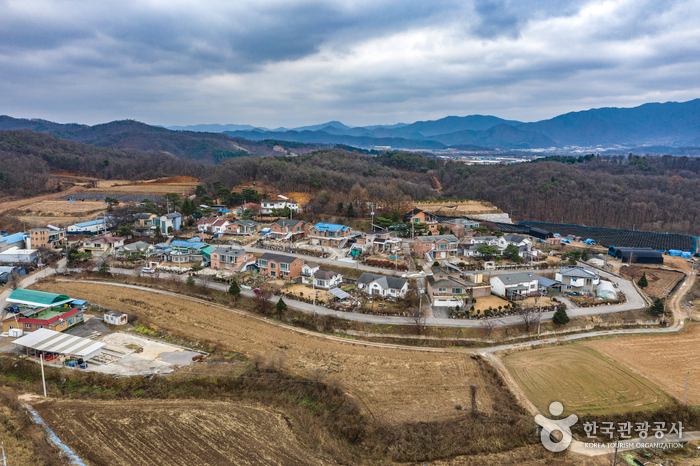
History inside a DMZ village now open to visitors in Gyeonggi-do Yeoncheon County · schedule Other · distance 43.3km · 4 stops · highlights Yeoncheon Gy…

There is a village called 38seon Village, which had been restricted for over 40 years, making it difficult even for residents to come and go. With the lifting of restrictions, both residents and visitors find their steps much lighter, to say the least. Throughout the village, you can encounter traces of the past. Along the paths to and from the village, you will also find the royal tombs of Silla, ancient relics, and scenes from the Joseon Dynasty.
This course is a sample one-day itinerary. Save it as-is or expand it into an AI itinerary.
Located near Yeoncheon Gorangpo Historic Park, Yeoncheon Gyeongsunwang Tomb is the burial site of Gyeongsunwang, the 56th and final king of Silla (reigned 927–935). His family name is Kim, and his given name is Bu; he was a sixth-generation descendant of the 46th Silla king Munseongwang (reigned 839–857) and the son of ichan Hyojong. After King Gyeae died in 927 during an attack by Later Baekje's Gyeon Hwon, Gyeongsunwang ascended the throne. In 935, he surrendered to Goryeo's Wang Geon, relinquishing the kingdom and leading to Silla's fall. Upon surrender, his eldest son, Prince Ma-ui, opposed submission and went to Mount Geumgang, while his youngest son entered Hwaeomsa Temple as a monk. After surrender, Gyeongsunwang was honored with the posthumous title Jeongseunggong, ranked above the crown prince, and Silla was renamed Gyeongju as his fief, where he served as sashimgwan (regional official). He remarried King Taejo Wang Geon's eldest daughter, Princess Nakrang, and had several children. The tomb is a circular earthen mound about 3m high and 7m in diameter, surrounded by flat stones. It is enclosed by a fence called gokjang, common in Goryeo royal tombs, indicating the tomb was built with royal honors. It is the only Silla royal tomb located outside Gyeongju, in Gyeonggi-do. The tombstone in front is inscribed with "Silla Gyeongsunwang Ji Neung" (新羅敬順王之陵), and the inscription on its back dates the tombstone to 1747 (23rd year of King Yeongjo). The Chunhyang and Chuhyang rituals are held annually in spring and fall. A guide house operates at the tomb where cultural explanations are available if needed. The site is about a 26-minute drive from Dangdong IC. Nearby attractions include Yeoncheon Gorangpo Historic Park, Yeoncheon Horogoru, British Army Seolmari Battle Memorial Park, Yulgok Yi I Historical Site and Hwaseokjeong, Imjingak (Pyeonghwa Nuri Park), Odusan Unification Observatory, Heyri Art Village, and Paju Samneung World Cultural Heritage Site.
Horogoru is located at an important gateway connecting Gaeseong and Seoul, built on a basalt cliff formed by a tributary flowing from Wondang-ri into the Imjin River. There are two theories about the origin of the name Horogoru: one says it is named because the nearby terrain resembles a gourd or bottle gourd, and another that it combines 'hol' meaning town and 'goru' meaning fortress. Among Goguryeo defense sites investigated in the Gyeonggi-do area, it is one of the three major flatland fortresses along with Dangposeong and Eundaeriseong. The east wall of Horogoru blocks the eastern part of the basalt plateau, with the highest point reaching 10 meters, offering views of the surrounding area and scenic Imjin River from atop the fortress wall. The first excavation of Horogoru was conducted from November 2000 to May 2002, confirming construction methods and structure of the fortress walls. The total perimeter of Horogoru fortress walls is 401 meters: south wall 161.9m, north wall 146m, east wall 93.1m, covering an internal area of 606㎡ on a roughly 28-meter-high basalt cliff. The east wall shows a construction technique that combines the advantages of stone and earth fortresses by layering packed earth multiple times and raising stone walls on top.
38선마을은 연천군 서남쪽에 위치하여 9km 전방에 휴전선과 마을 입구에 임진강이 흐르고 야산과 농지로 구성되어 있으며 인근에 제1땅굴 및 전곡리 구석기유적지, 경순왕릉, 숭의전 등 문화재가 소재하고 있어 도시민들의 관광과 휴식지역으로 최적지이다.
Sungui-jeon Site [崇義殿址] is the location where Sungui-jeon stood during the Joseon Dynasty, a shrine that enshrined the spirit tablets of kings and meritorious subjects from the previous Goryeo Dynasty and conducted memorial rites. Originally, this place was home to Angamsa Temple [仰巖寺], the original temple of Goryeo's founder King Taejo Wang Geon [王 建]. In 1397, a shrine was established here to enshrine the spirit tablet of King Taejo, becoming the origin of the current Sungui-jeon. After the shrine was built, in 1399 (the 1st year of King Jeongjong's reign), by royal decree, spirit tablets of eight Goryeo kings—including Taejo, Hyejong [惠宗], Seongjong [成宗], Hyeonjong [顯宗], Munjong [文宗], Wonjong (Chung-gyeong King 元宗), Chungnyeolwang [忠烈王], and Gongminwang [恭愍王]—were enshrined. The currently reconstructed buildings consist of Sungui-jeon, measuring three kan in front and three kan in depth, along with five auxiliary buildings: Baesincheong, Iancheong, Jeonsacheong, etc., as well as three gates—Naesinmun, Oesinmun, and Hyupmun—and six gates including Unjomon.
Good places to stop and rest after the course

Booking and payment continue on a partner site.
Check rooms & price
Booking and payment continue on a partner site.
Check rooms & price
Booking and payment continue on a partner site.
Check rooms & priceSign up to feature your channel.
(As a member, you can add your Instagram, YouTube, and blog links in My Page, and we’ll show them with every comment you write.)
““Stayed near Hongdae and did a night café tour. Perfect city views and vibes.””
Guest comments do not display social media links or profile cards.
Share a short tip about this place.
Or leave a quick comment as a guest.
Photo attachments are available after login.
No reviews yet. Be the first to share your experience!