
Meeting Goguryeo history in Yeoncheon in Gyeonggi-do Yeoncheon County · schedule Other · distance 51.9km · 4 stops · highlights 신탄리역, Godaesan, Dangpose…
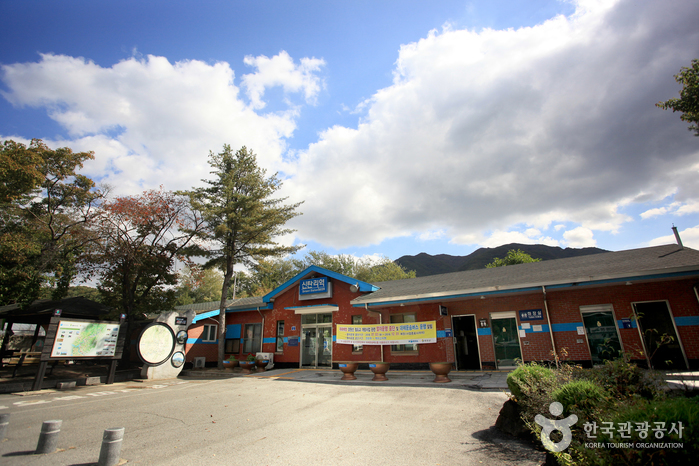
Shintan-ri Station was the terminus of the Gyeongwon Line railway until Baekmagogye Station opened. Around Shintan-ri Station, there are various attractions related to the 'Village hoping for unification,' and many visitors go to Godaesan Mountain. Horogoru Fortress, Eundaeri Fortress, and Dangposeong Fortress in Yeoncheon are Goguryeo relics rarely seen in South Korea. They were defense lines prepared by Goguryeo, which once controlled up to the Han River but retreated to the Imjin River. Discovered in the 2000s, all three sites are still unfamiliar travel destinations.
This course is a sample one-day itinerary. Save it as-is or expand it into an AI itinerary.
경원선의 대광리역과 백마고지역의 중간 역이다. 1913년 7월 10일 영업을 시작하였다. 1945년 8·15 광복과 동시에 북한에 귀속되었다가 1951년 수복되었다.
Godaesan (832m) is a mountain located on the border between Yeoncheon-gun, Gyeonggi-do, and Cheorwon-gun, Gangwon Special Self-Governing Province. Among mountains open for hiking, it is the closest to North Korea. From Godaebong, the summit of Godaesan, you can see the Cheorwon plain, Baengmagoji—a fierce battlefield during the Korean War—as well as North Korea’s Geumhak-san, Jijangbong, Bukdaesan, and Hyangrobong. Traditionally, Godaesan is considered one of Korea’s three sacred mountains (Samsinsan) associated with the legendary prophetic names Johwasin, Gyohwasin, and Chihwasin. The name Godaesan is also said to originate from “big whale,” linked to a new place name, referring to “banggorae” (a groove under the ondol heated floor where fire and smoke escape). Because Godaesan has deep valleys and is tall, it was named thus. Old maps also recorded it as Godae, meaning “like a high constellation.” The area around Godaesan was formerly known as Sintanmak, named for many taverns (jumak) established in villages amid abundant dense forests and rich forest resources suitable for producing timber and charcoal. Before the Korean War, the region was widely known for producing high-quality charcoal.
Dangposeong Fortress maximized the use of terrain, building stone fortress walls only on the east side, connected by flat land without vertical cliffs. The east fortress wall is about 50m long and remains approximately 6m high, with a length of about 200m from the east wall to the west end of the fortress, and an overall circumference of about 450m. Most stones used for construction were processed local basalt, a major characteristic of Goguryeo fortresses. Behind Dangposeong Fortress lies Majeonhyeon, a route to Gaeseong, making the fortress essential for defending against northern enemies approaching the Yangju basin area by the shortest route. It also held a very important position for defending against southern enemies, indicating it was used continuously even during the Silla occupation period.
Horogoru is located at an important gateway connecting Gaeseong and Seoul, built on a basalt cliff formed by a tributary flowing from Wondang-ri into the Imjin River. There are two theories about the origin of the name Horogoru: one says it is named because the nearby terrain resembles a gourd or bottle gourd, and another that it combines 'hol' meaning town and 'goru' meaning fortress. Among Goguryeo defense sites investigated in the Gyeonggi-do area, it is one of the three major flatland fortresses along with Dangposeong and Eundaeriseong. The east wall of Horogoru blocks the eastern part of the basalt plateau, with the highest point reaching 10 meters, offering views of the surrounding area and scenic Imjin River from atop the fortress wall. The first excavation of Horogoru was conducted from November 2000 to May 2002, confirming construction methods and structure of the fortress walls. The total perimeter of Horogoru fortress walls is 401 meters: south wall 161.9m, north wall 146m, east wall 93.1m, covering an internal area of 606㎡ on a roughly 28-meter-high basalt cliff. The east wall shows a construction technique that combines the advantages of stone and earth fortresses by layering packed earth multiple times and raising stone walls on top.
Good places to stop and rest after the course

Booking and payment continue on a partner site.
Check rooms & price
Booking and payment continue on a partner site.
Check rooms & price
Booking and payment continue on a partner site.
Check rooms & priceSign up to feature your channel.
(As a member, you can add your Instagram, YouTube, and blog links in My Page, and we’ll show them with every comment you write.)
““Stayed near Hongdae and did a night café tour. Perfect city views and vibes.””
Guest comments do not display social media links or profile cards.
Share a short tip about this place.
Or leave a quick comment as a guest.
Photo attachments are available after login.
No reviews yet. Be the first to share your experience!


