
Autumn festival in nature filled Yangpyeong in Gyeonggi-do Yangpyeong-gun · schedule Other · distance 약 52km · 5 stops · highlights Yangpyeong Dumulmeor…
Autumn, the most beautiful time of the year, passes by quickly, but Yangpyeong is a place where you can enjoy this precious season without wasting a moment. Experience the clear valley water of Yongmun and Jungwonsan and the wide natural grounds of Yangpyeong Mokkoji Village to fully enjoy the deep autumn.
This course is a sample 2-day itinerary. Save it as-is or expand it into an AI itinerary.
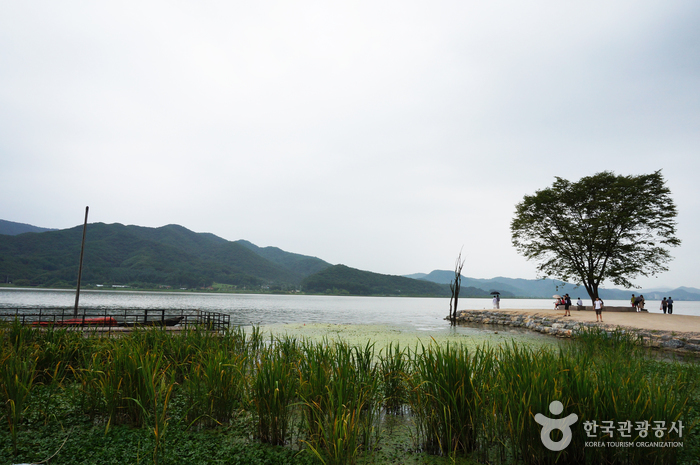
Dumulmeori is the place where the Bukhan River, flowing from Geumgangsan, and the Namhan River, originating from Geomryongso at the foothills of Geumdaebong in Gangwon-do, meet, marking the beginning of the Han River. Early morning mist, sunrise, yellow sailboats, and a zelkova tree over 400 years old blend harmoniously in Yangsu-ri Dumulmeori. It is a place that transforms beautifully through the four seasons and is selected as one of the must-visit spots in Korea by Korean Tourism 100. Known as Han River's No. 1 Scenic Spot (Dumulgyeong) and a filming location for various dramas and movies, it attracts numerous domestic and international tourists, serving as a representative ecotourism site in South Korea. The beautiful scenery of Dumulmeori has been famous since the Joseon Dynasty, preserved through Lee Geonpil's 'Two Rivers' Seungyudo' and Jeong Seon's 'Dokbaektan,' transcending time. It is an ecological treasure that should be passed on to future generations as a beautiful heritage of both South Korea and Yangpyeong.
Yongmun Millennium Market is one of the three major traditional markets in Yangpyeong-gun and is a 5-day traditional market with over 200 stalls that open immediately upon getting off at Yongmun Station on the Gyeongui-Jungang Line. It is famous as a tourist market with the Yongmunsan Tourist Complex and the Freshwater Fish Ecology Museum nearby. It operates not just as a shopping space but as a market full of food, sights, and entertainment with culture and arts. (Source: Yangpyeong-gun Cultural Tourism website)
Gyeonggi-do Freshwater Fish Ecology Learning Center is a provincial exhibition facility located in Yongmun-myeon, Yangpyeong-gun, Gyeonggi-do. It opened in July 2003 and is a place where visitors can observe the ecology of various native freshwater fish. The main building has two above-ground floors: the first floor displays 1,000 freshwater fish of 55 species including sturgeon, yellow perch, keokji, eel, catfish, true kung-gae, and miyugi; the second floor features hands-on experiences such as fish printmaking, quizzes, ecological experience corners, and a video learning room. Outdoors, there are ecological ponds and outdoor tanks where visitors can enjoy native wildflowers like noryang-eoriyeon, water lilies, dol-danpung, and maekmundong, as well as fish such as bi-dan-ingo, carp, and fragrant fish, providing various experiential spaces.
Yongmunsan is a mountain located on the boundary between Yongmun-myeon (龍門面) and Okcheon-myeon (玉泉面) in Yangpyeong-gun, Gyeonggi Province, with an elevation of 1,157m. It is situated 8km northeast of Yangpyeong (楊平) and 42km east of Seoul. Although part of the Gwangju (廣州) mountain range, it stands as an independent massif extending 8km east to west and 5km north to south. The main peak is Yongmunsan, accompanied by subsidiary peaks forming a mountain range: Doilbong (道一峰, 864m) 5.5km ENE, Jungwonsan (中元山, 800m) 4.5km east, and Baegunbong (白雲峰, 940m) 3.5km southwest. The summit is flat, with a developed ridge plateau. Between Jungwonsan and Yongmunsan lies a large gorge formed by Yonggye (龍溪) and Jogye (鳥溪) streams, where the plateau stands on sheer cliffs hundreds of meters high, reminiscent of Geumgangsan. The northern slope is gentle, the southern steep, with piled boulders, deep valleys, and waterfalls. The northwestern area has a high-level plateau 700–1,100m covering about 4㎢. Historic temples such as Yongmunsa (龍門寺), Sangwonsa (上院寺), Yunpilsa (潤筆寺), and Sanasa (舍那寺) are located in the southern foothill valleys. The ginkgo tree inside Yongmunsa is a natural monument, occupying an area of 260㎡. There are also two treasure-designated monuments: Jeongjiguksa Buddha Stupa (正智國師浮屠) and two steles.
The word 'mokkoji' refers to gatherings of people for play, festivals, or other events. Mokkoji Village in Yangpyeong, close to Seoul, hosts diverse experiences year-round. In spring, the air is filled with the sweet scent of strawberries. Visitors can pick strawberries to their heart's content and make strawberry jam by gently simmering them over a low fire. In summer, people enjoy cool water activities in Jungwon Stream, catch small fish called songsari, and ride rafts. They also write wishes on paper, attach ginkgo leaves as sails, and float paper boats. Autumn brings the joy of harvesting and sharing foods like peanuts and potatoes. Group kimchi-making experiences are also popular. In winter, visitors sled on the frozen Jungwon Stream and enjoy ice fishing for smelt. Freshly made garaetteok rice cakes and savory injeolmi are available on site. Nearby is the Yongmunsan Tourist Complex, where visitors can explore the scenic Yongmunsan and the tranquil Yongmunsa Temple. The Freshwater Fish Ecology Learning Center, where native freshwater fish can be observed, is also close by.
Good places to stop and rest after the course

Booking and payment continue on a partner site.
Check rooms & priceSign up to feature your channel.
(As a member, you can add your Instagram, YouTube, and blog links in My Page, and we’ll show them with every comment you write.)
““Stayed near Hongdae and did a night café tour. Perfect city views and vibes.””
Guest comments do not display social media links or profile cards.
Share a short tip about this place.
Or leave a quick comment as a guest.
Photo attachments are available after login.
No reviews yet. Be the first to share your experience!


