
Temple tour in Wanju seeking true peace of mind in Jeonbuk Special Self-Governing Province Wanju-gun · schedule Other · distance 약 50km · 4 stops · high…
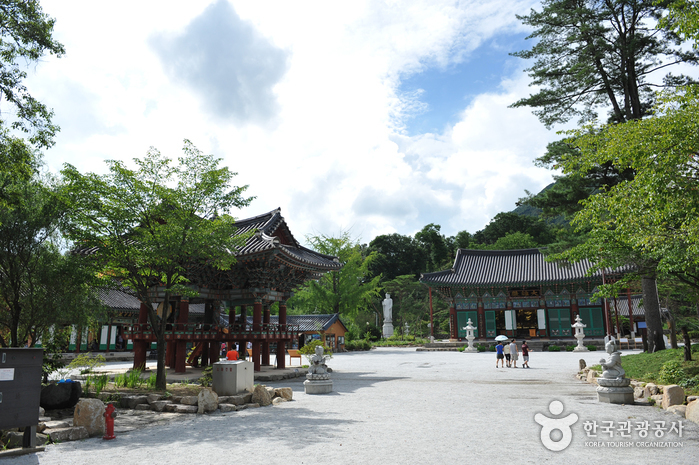
The temples of Wanju, Hwaamsa and Songgwangsa, are elegant and serene, making them ideal travel destinations to spend leisurely time reflecting on oneself. Hwaamsa, praised by poet Andohyeon as a "small but precious temple like a book you occasionally want to open alone," and Songgwangsa, where the cherry blossoms create a spectacular spring view, are connected by a trail along Weibongsanseong Fortress, where you can also make romantic memories alone. The Daeoho on the road from Hwaamsa to Songgwangsa is also beautiful.
This course is a sample one-day itinerary. Save it as-is or expand it into an AI itinerary.
Hwaamsa Temple is a traditional temple located south of Sirubong Peak on Bulmyeongsan in Wanju-gun, Jeollabuk-do, operated with a focus on practice by minimizing events. Although the founder and founding date are unclear, a restoration monument records that Wonhyo and Uisang performed ascetic practices here. In the early Joseon period, Haechong restored the temple with sponsorship from Seong Dalsaeng and completed Geukrakjeon, giving the temple a grand appearance, but many buildings were destroyed during the Imjin War. The main buildings, including Geukrakjeon, were rebuilt through several restorations and currently consist of Myeongbujeon, Sanshingak, Uhwaru, Jeokmukdang, and the monks' lodging. Major cultural assets include the Hwaamsa Temple Bell, restoration monument, and Gwaebul painting, making it a temple of high historical and cultural value.
Songgwangsa is a temple located on Jongsan Mountain in Wanju-gun, Jeollabuk-do. Songgwangsa first appears in historical records at the end of the Unified Silla period. Ven. Chejing practiced at Seoraksan's Eokseongsa Temple, and on his way to study in China, he briefly stayed at Baekryeonsa Temple after hearing its reputation as a sacred place. According to tradition, Baekryeonsa was a temple built beside a sacred spring south of Jongsan Mountain. After returning, Ven. Chejing renamed Baekryeonsa to Songgwangsa. Later, the temple was burned down during the Japanese invasions of 1592 and 1597, but from 1636, Ven. Byeokam Gakseong restored it with great effort to its current structure. Songgwangsa consists of Daeungjeon Hall, Jijangjeon Hall, Yaksa-jeon, Gwaneumjeon, Sipjagak, Geumgangmun, Hyangrojeon, Jeokmukdang, and more. Cultural assets on site include Wanju Songgwangsa Bell Tower, Wanju Songgwangsa Four Heavenly Kings statues, Songgwangsa Bronze Bell, and historical monuments. Experience programs include templestay and a Buddhist academy. The Buddhist academy, established for broad exploration of Buddhist philosophy based on correct Buddhist understanding, offers 16-week lectures in two semesters covering early Buddhism, Mahayana Buddhism, and commentary on the Madhyamaka. Templestay programs include day, experience, and rest types, featuring dawn prayers, 108 prostrations, meditation, and tea with monks, providing time to quietly embrace and understand oneself by temporarily setting aside the mind filled with constant thoughts.
Wibongsa is an ancient temple located on Wibongsan (Chujulsan) in Wanju-gun, Jeollabuk-do. It was rebuilt by the monk Naong at the end of the Goryeo period, and during the reign of King Sejo of Joseon, monks Seonseok and Seokjam repaired it. In the late Joseon Dynasty, through a reconstruction of more than 60 rooms led by the monk Poryeondae, and by 1312, it was one of the 31 main temples nationwide (large temples serving as the base for sects or subsects) overseeing about 50 branch temples throughout Jeonbuk. After liberation and the Korean War, it rapidly declined. In 1988, just before it was about to be abandoned, the monk Beopjung was appointed and immediately began restoring the temple site, repairing the deteriorated Bogwangmyeongjeon and Gwaneumjeon halls, and with the participation of several donors, constructed over 100 rooms of buildings. Currently, it includes Bogwangmyeongjeon, Geungnakjeon, Gwaneumjeon, Samseonggak, Nawoldang, and temple lodgings, housing 50 to 60 resident monks, presenting the scale of a major temple.
Wibong Fortress was built in the first year of Sukjong of Joseon (1675) and has an impressive circumference of about 16km. It was constructed to evacuate the portrait of King Taejo and the wooden memorial tablets symbolizing his ancestors from Jeonju Gyeonggijeon and Jogyeongmyo in emergencies. During the Donghak Peasant Revolution when Jeonju was actually captured, the portrait and wooden tablets were brought here. Inside the fortress, there was a small palace to enshrine the portrait and memorial tablets, but it was demolished a long time ago. Gates were built on the east, west, and north sides, but only a half-moon-shaped gate leading to Jeonju remains on the west side. Inside the fortress are Wibongsa Temple and Wibong Waterfall, one of the eight scenic spots of Jeonju.
Good places to stop and rest after the course

Booking and payment continue on a partner site.
Check rooms & price
Booking and payment continue on a partner site.
Check rooms & priceSign up to feature your channel.
(As a member, you can add your Instagram, YouTube, and blog links in My Page, and we’ll show them with every comment you write.)
““Stayed near Hongdae and did a night café tour. Perfect city views and vibes.””
Guest comments do not display social media links or profile cards.
Share a short tip about this place.
Or leave a quick comment as a guest.
Photo attachments are available after login.
No reviews yet. Be the first to share your experience!


