Enjoying a bamboo forest bath in the river breeze in Ulsan Ulju-gun · schedule Other · distance 40.1km · 4 stops · highlights Ulsan Ulju Cheonjeon-ri In…

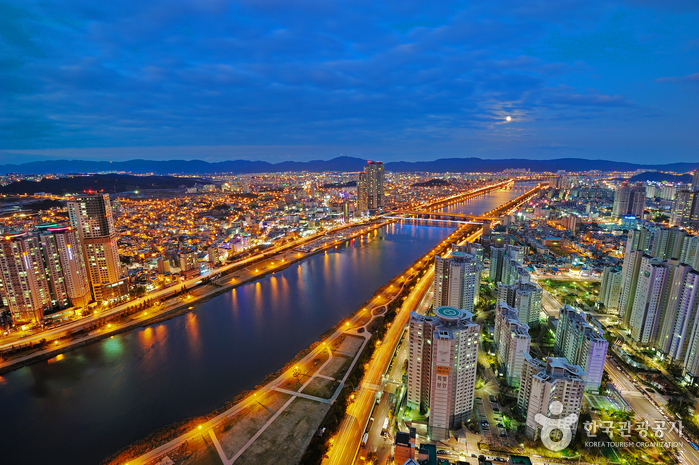
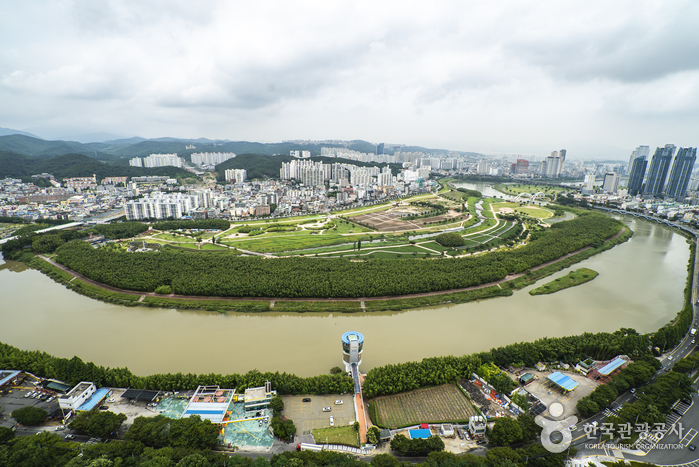
Along the Taehwa River, the symbol of Ulsan, nature, history, and culture harmoniously coexist. You can admire the Cheonjeon-ri Rock Carvings and Bangudae Petroglyphs, which retain traces of the prehistoric era, and enjoy bamboo forest bathing while walking through the Ten-ri Bamboo Grove, planted during the Japanese colonial period. The towering Seonbawi Rock is one of the scenic wonders of the Taehwa River. Be sure to also visit the observatory where you can take in the full view of the Taehwa River’s waterway.
This course is a sample one-day itinerary. Save it as-is or expand it into an AI itinerary.
Located on the midstream bank of Daegokcheon, a tributary of the Taehwa River, this rock bears various patterns, writings, and drawings. It is divided into two sections, upper and lower, each expressing different content with different techniques, and is densely sculpted overall. The upper section features geometric patterns, animals, and abstracted human figures carved by pecking techniques. The simplified forms, lacking realism, include a central circle symbolizing the sun, four deer running on either side, and a half-human, half-animal figure on the far left. These modest yet symbolically rich images are believed to date back to the Bronze Age. The lower section contains a mix of incised drawings and writings, including horse-riding procession scenes, animals, dragons, and boats. The horse-riding procession appears in three places and is well-expressed using simple dots and lines. The boat drawings provide important evidence of the maritime activities of the Silla people at the time. The inscriptions exceed 800 characters and commemorate visits by the king and queen, presumably inscribed in two phases during King Beopheung’s reign. References to official titles and the six-bu (six ministries) system contained in the text are valuable for studying Silla society around the 6th century. Created by multiple people over a long period, this work vividly depicts the life and thoughts from prehistoric to Silla periods. Rather than representing a single era, it encompasses multiple eras, making it a historically significant site. On July 12, 2025, the approximately 3km-long 'Bangugcheon Petroglyphs,' combining the Ulju Daegok-ri Bangudae Petroglyphs and Ulju Cheonjeon-ri Inscribed Cliff and Petroglyphs, were inscribed as UNESCO World Heritage (Source: Cultural Heritage Administration).
In Daegok-ri, Eonyang-eup, Ulju-gun, Ulsan, there is the scenic Bangudae, where a ridge of Yeongosan extends down and ends abruptly in striking rock formations, resembling the shape of a turtle lying flat, hence the name Bangudae (盤龜臺). The clear waters flowing down from Cheonjeon Valley in Doodong-myeon gather here to form a lakeside, celebrated as a place of exceptional beauty. Since ancient times, poets and scholars from various regions visited to enjoy the scenery through poetry. Petroglyphs are pictures carved into rocks by prehistoric people, depicting various events from their daily lives. Typically made on large rocks or sacred sites, these places were likely gathering spots for rituals. The Ulju Daegok-ri Bangudae Petroglyphs are located at the so-called "Geonneo Gakdan," a tributary of the Taehwa River called Daegokcheon, with the main rock face measuring 10m wide and 3m high. Numerous images are also found on surrounding rocks, totaling about ten sites with petroglyphs. These carvings are believed to have been made over multiple periods from the Neolithic era, showing stylistic differences by era. They are divided into two techniques: the area-chiseling method, where entire interiors are carved out, and the outline-chiseling method, where only contours are engraved. The depicted subjects include sea animals, land animals, humans, and tools. Sea animals include whales, seals, and turtles; land animals include deer, tigers, wild boars, and dogs. Human figures appear as faces only, standing frontally or sideways, and riding boats. Tools depicted include boats, fences, nets, harpoons, and crossbow-like objects. These images are thought to represent prehistoric hunting activities, carved with the hope for successful hunts and abundant game. Expressing animals and hunting scenes vividly and realistically, these petroglyphs serve as both hunting and religious art, offering invaluable insight into prehistoric life and customs. As the earliest whale hunting record and the first prehistoric art on the Korean Peninsula, the Bangudae Petroglyphs and the Cheonjeon-ri epigraphy and petroglyphs along the approximately 3km "Banguchon Petroglyphs" were inscribed as a UNESCO World Heritage site on July 12, 2025, representing a premier historical tourism resource of Korea.
Originating from Tapgolsaem at Baegunsan in Duseo-myeon, Ulju-gun, Ulsan, the river flows 47.54 km into the East Sea near Maeam-dong, Ulsan. It has a watershed area of 643.96 km² and is a precious river that has shared history with the people of Ulsan, known as the lifeline of Ulsan. Taehwagang River is home to diverse flora and fauna, including native species such as salmon and sweetfish, as well as about 700 species like egrets, swans, otters, and raccoons. The Taehwagang Migratory Bird Park at the river's estuary is the largest urban migratory bird habitat in South Korea, featuring spectacular gatherings of around 8,000 egrets and 50,000 crows. Seasonal eco-experiences like migratory bird schools are offered. In autumn, the silver waves of reeds at the estuary’s reed field combine with the sunset to create a fantastic scene.
Taehwagang Observation Deck is located in Mugeo-dong, Nam-gu, Ulsan. Originally built in 1963, the Taehwa intake station and intake tower, which had not been operational since 1995, were remodeled into the observation deck by Ulsan City and the Korea Water Resources Corporation to fit a modern aesthetic. The building is 4 floors above ground (28m high) with a total floor area of 514㎡. Inside, there is an outdoor observation deck, an information center, and a rest area. Visitors can enjoy a panoramic view of the Taehwa River and the National Garden Bridge using telescopes, free of charge. It also provides a space for citizens to relax.
Good places to stop and rest after the course

Booking and payment continue on a partner site.
Check rooms & price
Booking and payment continue on a partner site.
Check rooms & priceSign up to feature your channel.
(As a member, you can add your Instagram, YouTube, and blog links in My Page, and we’ll show them with every comment you write.)
““Stayed near Hongdae and did a night café tour. Perfect city views and vibes.””
Guest comments do not display social media links or profile cards.
Share a short tip about this place.
Or leave a quick comment as a guest.
Photo attachments are available after login.
No reviews yet. Be the first to share your experience!
![Ulsan Ulju Cheonjeon-ri Inscribed Cliff and Petroglyphs [UNESCO World Heritage] 1](https://tong.visitkorea.or.kr/cms/resource/15/3335115_image2_1.jpg)
![Ulsan Ulju Cheonjeon-ri Inscribed Cliff and Petroglyphs [UNESCO World Heritage] 2](https://tong.visitkorea.or.kr/cms/resource/16/3335116_image2_1.jpg)
![Ulsan Ulju Cheonjeon-ri Inscribed Cliff and Petroglyphs [UNESCO World Heritage] 3](https://tong.visitkorea.or.kr/cms/resource/17/3335117_image2_1.jpg)
![Ulsan Ulju Cheonjeon-ri Inscribed Cliff and Petroglyphs [UNESCO World Heritage] 4](https://tong.visitkorea.or.kr/cms/resource/18/3335118_image2_1.jpg)
![Ulju Daegok-ri Bangudae Petroglyphs [UNESCO World Heritage] 1](https://tong.visitkorea.or.kr/cms/resource/84/3507484_image2_1.jpg)
![Ulju Daegok-ri Bangudae Petroglyphs [UNESCO World Heritage] 2](https://tong.visitkorea.or.kr/cms/resource/86/3507486_image2_1.jpg)
![Ulju Daegok-ri Bangudae Petroglyphs [UNESCO World Heritage] 3](https://tong.visitkorea.or.kr/cms/resource/88/3507488_image2_1.jpg)
![Ulju Daegok-ri Bangudae Petroglyphs [UNESCO World Heritage] 4](https://tong.visitkorea.or.kr/cms/resource/89/3507489_image2_1.jpg)