Cherry blossoms as enchanting as white clouds spread out in Jeollanam-do Suncheon City · schedule Other · distance 76.5km · 6 stops · highlights Songsan…

There is a saying, 'Chunsonggwang Chuhaein' (春松廣 湫海印), meaning Songgwangsa is beautiful in spring, and Haeinsa is beautiful in autumn. The symbol of spring at Songgwangsa is the cherry blossoms. The cherry trees at Songgwangsa have thick and sturdy trunks, appearing quite aged. The cherry blossoms are as abundant as cotton candy. When the fully bloomed cherry blossoms flutter in the wind like clouds of flowers, deeply touching the heart, the path to Songgwangsa shines even more. As you slowly drive along and reach Juamho, the blue lake mingling with the cherry blossoms doubles the pleasure of the drive.
This course is a sample 2-day itinerary. Save it as-is or expand it into an AI itinerary.
Situated on the northern foothills of Jogyesan, Songsangsa is known as one of Korea's three treasure temples (삼보사찰), alongside Haeinsa (법보사찰) in Hapcheon and Tongdosa (佛寶) in Yangsan. It began in the late Silla period when the Zen master Hyerin built a small hermitage called Gilsangsa. Later, National Preceptor Jinul moved the Jeonghyegyeolsa movement here, making it a center for monastic meditation and practice, establishing it as a treasure temple. It produced 16 national preceptors, including Jinul. The temple has about 80 wooden structures and preserves 27 cultural heritage items: three national treasures including the Guksajeon (where the portraits of the 16 national preceptors are enshrined), 13 treasures such as Hasadang, Yaksajeon, and Yeongsanjeon, and 17 national cultural assets including the natural monument Ssanghyangsu. Additionally, 10 local cultural properties like the designated Guksasarihap are preserved. Centered around the Daeungjeon, with Seungbojeon and Jijangjeon to the left and right, the temple shows a majestic presence. The scent of incense, soft wooden fish sounds, clear chanting, and the sight of monks maintaining the brilliant temple tradition evoke a sense of reverence.
Seonamsa Temple, located on the eastern foothills of Jogyesan Mountain, was founded by Adohwa in the 7th year of King Seong of Baekje (529) by building Biroam, and then established as the current Seonamsa by Doseon Guksa, the master of Seon Buddhism, in the 1st year of King Gyeongmun of Silla. On the opposite western mountainside is the famous Seungbo temple Songgwangsa. Surrounding Seonamsa are dense forests of centuries-old oak, camellia, maple, and chestnut trees, with particularly famous autumn foliage. In front of the temple stands an arched Seungseon Bridge (treasure), solidly supported by natural bedrock, with a mysterious dragon head in the center. The three-story stone pagodas (treasures) flanking the Daeungjeon hall attract visitors’ attention. As one of the temples preserving the most traditional culture, in addition to seven treasures, it holds twelve local cultural assets including the majestic and colorful Daeungjeon, Palsangjeon, Wontongjeon halls, a gilt-bronze incense burner, and Iljumun gate. To the left of the main temple, following a steep hiking trail, a large 7-meter-high and 2-meter-wide rock-carved Buddhist image can be seen. The 800-year-old native tea garden, an ascent trail connecting Songgwangsa and Seonamsa through Jogyesan, crystal-clear valley water, dense trees, and autumn colors enhance the site’s charm. Nearby, like Jirisan and Baegunsan, native Gorosoe trees grow naturally, providing medicinal spring water around the annual Gyeongchip period. The Chiljeon Seonwon at Seonamsa is a meditation center on the eastern slopes of Jogyesan in Suncheon-si, the only Seon monastery of the Taego Order, where many monks train in both the Kangwon and Seonwon. "Chiljeon" refers to the seven buildings located at Seonamsa’s highest area. Behind Seonamsa lies a wild tea plantation over 800 years old. Although the finest tea in the region is known as Hwage tea, the naturally grown wild tea from Seonamsa is regarded as the best. The wild tea is characterized by a savory and deep flavor, stemming from tea plants growing under shaded cedar and oak trees, with mist and humid climate producing the unique taste. However, tasting Seonamsa tea is rare since the plantation is small, limiting harvests and making it highly prized.
Suncheon Traditional Wild Tea Experience Center is located on the way to Seonamsa Temple in Jogyesan Mountain, a cozy experience center harmonized with the sounds of the sky, water, and wind. It is a space where visitors can make and taste fragrant teas produced in Suncheon through tea ceremony and dasik (tea confectionery) experiences, offering modern people tired from daily life a comfortable rest, an opportunity to recharge, and a rich heart. Additionally, it provides Hanok meditation experiences and Hanok accommodations to feel the elegant charm, leisure, and old life atmosphere of traditional Korean houses. Group reservations are possible, and various experiences can be participated in.
Once the territory of Mahan during the Samhan period, a fortification during Baekje, and the site of Nagan-gun in Goryeo, this area preserves the fortress, Dongheon, guesthouse, General Im Gyeong-eop's monument, marketplace, and thatched houses in their original form from the Joseon Dynasty. The fortress and village were the first in the country to be designated a historic site together. In the 6th year of King Taejo of Joseon (1397), General Kim Bin-gil of Yanghyegong, a local from this area, raised an army to defend against Japanese pirate invasions by building an earthen wall. About 300 years later, in the 4th year of King Injo (1626), General Im Gyeong-eop, known as Chungmingong, was appointed governor of Nagan and rebuilt the stone fortress as it stands today. Unlike other fortresses, it was sturdily constructed on a wide plain using square natural stones 1–2m in size, reaching 4m in height, 3–4m in width, with total fortress length of 1,410m, enclosing three villages—Dongnae, Namnae, and Seonae—in a rectangular shape. Nearly 400 years later, it remains intact and grand. Many generations still live in this traditional folk village, recognized as valuable both for folklore scholarship and as a living history museum. Entering through the east gate as well as the west and south gates creates the illusion of a historical drama filming set (used for "Dragon Tears," "Taejo Wang Geon" among others). Unlike exhibit-style villages like Yongin or Jeju folk villages or aristocrat villages like Andong Hahoe, it shows the genuine lifestyle of ordinary Koreans, filled with the scent and warmth of ancestors. Distinctive southern housing features such as the verandah, kitchen, earth floor, roof, jangdok pots on stone steps, and stone walls linking neighbors are neither sharp nor high, entwined with fence gourds, evoking childhood memories of playing tag and a heartfelt sense of home. ◎ Travel info to experience Hallyu charm – The drama "Youth Geumdang" is set here, where one can see traditional Korean life from the Joseon era to present. The clustered thatched houses are heartwarming, and the earth-and-stone walls with beautifully curved roofs are simply beautiful. Walking along the fortress wall offers a panoramic view of the thatched village. This is the background for Minjae's village in "Youth Geumdang."
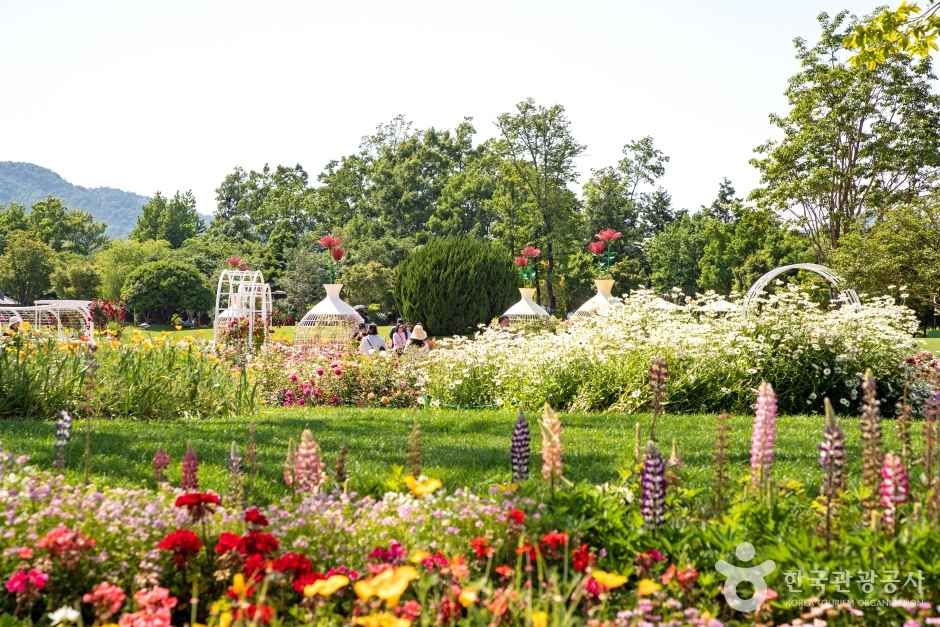
It is South Korea's first national garden and one of the world's five major coastal wetlands. The garden, created to protect Suncheon Bay, spans 1.12 million㎡ (340,000 pyeong) in the area of Dosadong, Suncheon, containing 505 species and 790,000 trees and 113 species and 3,150,000 flowers. In spring, tulips and azaleas bloom spectacularly. A 30,000㎡ area near Nanum Forest is planted with canola flowers, which bloom simultaneously in mid-May, creating waves of yellow. The city planted 50,000 trees such as Korean hackberry and zelkova, forming natural shade along main routes. A small unmanned rail train (PRT) runs on the 4.64 km section between Suncheon Bay Garden and Suncheon Literature Museum. Visitors who fully tour the garden can take the PRT to the museum, get off, and then transfer to the reed train to travel 1.2 km to Mujingyo at the entrance of Suncheon Bay. Eco-friendly transports such as the Sky Cube aerial taxi connect the national garden and the wetland. ◎ Travel info to enjoy the appeal of the Korean Wave - The variety show featured same-age friends Mina of Gugudan and Yoojung of Weki Meki on a spring flower trip themed around age twenty. Yoojung, who planned the Suncheon trip herself, walked through the tulip and canola flower-filled garden, capturing memorable photos with soap bubbles she prepared as props.
Suncheon Bay is an inlet located on the mid-western part of Korea's south coast, surrounded by Suncheon-si, Goheung-gun, and Yeosu-si in Jeollanam-do. The large bay enclosed by the elongated Goheung Peninsula and Yeosu Peninsula is also called Suncheon Bay, and the northern seawater area surrounded by Suncheon-si Inan-dong, Daedae-dong, Haeryong-myeon Seonhak-ri, and Sangnae-ri is also referred to as Suncheon Bay. Even when only considering the seawater area of Suncheon Bay within administrative boundaries, it covers a very wide area of over 75㎢. The tidal flats exposed at low tide alone cover a total area of 12㎢, with the total tidal flat area reaching 22.6㎢. Furthermore, from the confluence of Suncheon’s Dongcheon and Isacheon rivers to the front part of Suncheon Bay’s tidal flats, a vast reed bed spanning 5.4㎢ stretches out.
Good places to stop and rest after the course

Booking and payment continue on a partner site.
Check rooms & priceSign up to feature your channel.
(As a member, you can add your Instagram, YouTube, and blog links in My Page, and we’ll show them with every comment you write.)
““Stayed near Hongdae and did a night café tour. Perfect city views and vibes.””
Guest comments do not display social media links or profile cards.
Share a short tip about this place.
Or leave a quick comment as a guest.
Photo attachments are available after login.
No reviews yet. Be the first to share your experience!


![Seonamsa Temple [UNESCO World Heritage] 1](https://tong.visitkorea.or.kr/cms/resource/80/3498880_image2_1.jpg)
![Seonamsa Temple [UNESCO World Heritage] 2](https://tong.visitkorea.or.kr/cms/resource/81/3498881_image2_1.jpg)
![Seonamsa Temple [UNESCO World Heritage] 3](https://tong.visitkorea.or.kr/cms/resource/82/3498882_image2_1.jpg)
![Seonamsa Temple [UNESCO World Heritage] 4](https://tong.visitkorea.or.kr/cms/resource/83/3498883_image2_1.jpg)