Journey Along Joseon Era Fortresses that Guarded the West Coast in Chungcheongnam-do Seosan City · schedule Other · distance 65.8km · 5 stops · highligh…
The walls of Haemi Eupseong, walked with a generous heart, show clear traces of time. Visit Sinduri Coastal Sand Dunes and Cheonripo Arboretum to encounter the refreshing and expansive sea. A pleasant walking trail has been created along the Taean Coastal Road, making it enjoyable to walk.
Source: More Attractive the Longer You Stay, Chungcheong
This course is a sample one-day itinerary. Save it as-is or expand it into an AI itinerary.
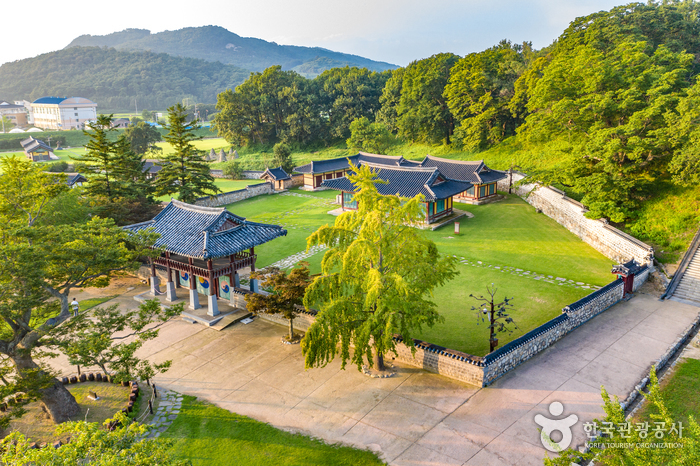
It is a representative eupseong (walled town) from the Joseon Dynasty. Eupseong are flatland castles built around an eup (town), with Haemi Eupseong being famous along with Gochang Eupseong and Nagan Eupseong. Haemi Eupseong is a stone fortress completed in 1491, the 22nd year of King Seongjong's reign. It has a circumference of about 1.8 km, a height of 5 m, and a total area of 196,381 m² (about 60,000 pyeong), featuring three gates: east, south, and west. Recently, restoration and purification projects have restored its original appearance and established it as a historic park. It is also famous as a martyrdom site for Catholics during the late Joseon period. During persecutions of Catholics, many believers from various parts of Chungcheong Province were captured, tortured, and killed at Haemi Eupseong, which had a government office. In particular, about 1,000 people were executed here during the 1866 persecution. In the plaza inside the fortress stands the site of a prison where Catholics arrested during the Daewon-gun regency were held, and an old pagoda tree under which they were brutally tortured by hanging. The 300-year-old tree at the prison entrance still bears iron wire marks from where victims’ hair was tied and hung. Just outside the fortress gate on the roadside is the Jari-gae-dol, where believers who resisted torture while hanging from the pagoda tree were beaten to death on stone slabs, making it a pilgrimage site for Catholics. Quince trees were once planted around the fortress walls to repel enemy troops, but now they are hardly seen.
Hyangsu Garden is a barley rice set meal restaurant near Haemi I.C., which is the gateway to the Taean Peninsula. It is about 1 km from Haemi I.C. and within a 5-minute walk from Haemieupseong. The restaurant has been operated since 1995 by the family of Mr. An Jongsok, a local resident. A part of their home was remodeled to create a comfortable atmosphere like that of a hometown house, and the neat meals are prepared personally by the owner couple. They use traditional soybean paste and red pepper paste made from native Korean soybeans sourced from the Seosan and Taean areas, properly aged. Perhaps because of the special taste of their pastes, the barley rice set meal served with ssamjang and soybean paste stew is the most popular. The barley rice set consists of barley rice mixed and cooked just right with rice steamed in a pressure cooker, served in a large bowl, accompanied by 10 kinds of fresh leafy vegetables. Along with 3 to 4 side dishes, spinach, soybean sprouts, bellflower root, zucchini salad, and mushrooms are seasoned in perilla oil and served separately on a large plate. Mixing the barley rice with red pepper paste and wrapping it once more with fresh leafy vegetables adds a fragrant flavor to the ssam, making it an even greater delicacy. The ssamjang is noted for its flavor from vegetables ground and stir-fried into it, and the fresh, fragrant taste of the leafy wraps is well enjoyed.
우리나라 마애불상의 초기 예로 부채꼴 바위 면에 사각형 감실을 마련하여 중앙에 보살상을 두고 좌우에 불상을 배치해 놓음으로써, 1구의 불상과 2구의 보살상으로 이루어지는 일반적인 삼존불상과 달리 2구의 불입상과 1구의 보살입상이 한 조를 이루는 특이한 삼존불상 형식을 보여주고 있다.
Cheollipo Arboretum is the first private arboretum in Korea, established by Dr. Min Byung-gal, who was born in Pennsylvania, USA, in 1921 and naturalized as a Korean, after purchasing land starting in 1962. It is divided into seven areas—Miller Garden (the main area), Eco Healing Center, Magnolia Garden, Nangsaeseom Island, Conifer Garden, General Garden, and Keungol—where various plant species are appropriately placed and managed according to the environment of each area. As of December 2024, Cheollipo Arboretum holds the largest number of plant species in Korea, with 16,895 taxa. Major plant collections include 926 taxa of magnolia, 1,096 taxa of camellia, 566 taxa of holly, 373 taxa of hibiscus, and 257 taxa of maple. It is a great place to visit with children and family to experience nature.
Taean Sinduri Coastal Sand Dunes began to gradually form about 15,000 years ago after the Ice Age. It is an area directly affected by northwest seasonal winds, where strong winds carry sand to the coast, creating sand dunes over a long period. It is a typical sedimentary landform featuring all natural conditions that can appear in dunes, including full dunes, dune grasslands, dune wetlands, and dune forests. It serves as a buffer zone connecting inland and coast and protects against tsunamis. Sinduri Coastal Sand Dunes are the largest sand dunes in Korea and one of Taean’s most unique ecological tourist destinations, designated as a Slow City.
Good places to stop and rest after the course

Booking and payment continue on a partner site.
Check rooms & priceSign up to feature your channel.
(As a member, you can add your Instagram, YouTube, and blog links in My Page, and we’ll show them with every comment you write.)
““Stayed near Hongdae and did a night café tour. Perfect city views and vibes.””
Guest comments do not display social media links or profile cards.
Share a short tip about this place.
Or leave a quick comment as a guest.
Photo attachments are available after login.
No reviews yet. Be the first to share your experience!