Experience the Nature of Cheonsuman Bay in Chungcheongnam-do Seosan City · schedule Other · distance 53km · 5 stops · highlights Seosan Haemi Eupseong,…
If you put aside your hurry for a moment and look leisurely, Seosan shows a graceful beauty without boasting. Haemieupseong, a stone fortress with a circumference of 1.8 km built on flat land, is a place where you can feel the old atmosphere by walking along its walls. Enjoy the unique scenery of Ganwoldam facing the sea, as well as the tranquility of Buseoksa Temple, which shares its origin with Yeongju Buseoksa.
This course is a sample one-day itinerary. Save it as-is or expand it into an AI itinerary.
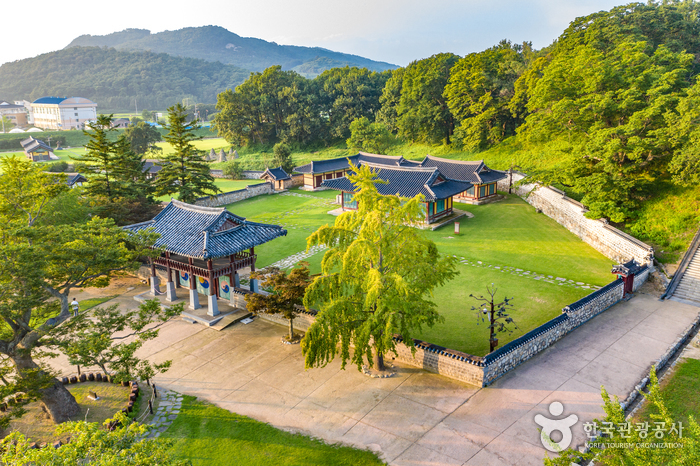
It is a representative eupseong (walled town) from the Joseon Dynasty. Eupseong are flatland castles built around an eup (town), with Haemi Eupseong being famous along with Gochang Eupseong and Nagan Eupseong. Haemi Eupseong is a stone fortress completed in 1491, the 22nd year of King Seongjong's reign. It has a circumference of about 1.8 km, a height of 5 m, and a total area of 196,381 m² (about 60,000 pyeong), featuring three gates: east, south, and west. Recently, restoration and purification projects have restored its original appearance and established it as a historic park. It is also famous as a martyrdom site for Catholics during the late Joseon period. During persecutions of Catholics, many believers from various parts of Chungcheong Province were captured, tortured, and killed at Haemi Eupseong, which had a government office. In particular, about 1,000 people were executed here during the 1866 persecution. In the plaza inside the fortress stands the site of a prison where Catholics arrested during the Daewon-gun regency were held, and an old pagoda tree under which they were brutally tortured by hanging. The 300-year-old tree at the prison entrance still bears iron wire marks from where victims’ hair was tied and hung. Just outside the fortress gate on the roadside is the Jari-gae-dol, where believers who resisted torture while hanging from the pagoda tree were beaten to death on stone slabs, making it a pilgrimage site for Catholics. Quince trees were once planted around the fortress walls to repel enemy troops, but now they are hardly seen.
Ganwolam is a small hermitage located in Ganwoldo-ri, Buseok-myeon, said to have been founded by Muhak Dae-sa in the early Joseon Dynasty and renovated by Song Mangong Dae-sa. Unlike other hermitages, it mysteriously connects to the land during low tide and becomes an island at high tide, making it feel like the hermitage is floating on the water. The serene natural scenery and the spirit of the ancestors attract many visitors. Additionally, the Oyster Worship Festival praying for a bountiful oyster harvest is held annually on the full moon of the first lunar month at the Jeongnyeok Monument for Eoriguljeot in Ganwoldo-ri during high tide. In this event, pure women who have not committed any wrongdoing dress in white robes and dance from the village entrance to the oyster monument, where they offer sacrifices and pray for an abundant oyster harvest. The oysters gathered are then offered for tasting to tourists.
[맛동산] 간월도 들머리에 있는 ‘맛동산’은 영양굴밥, 갱개미회무침이 유명한 집이다. 간월도에서 나는 굴로 지은 영양굴밥은 대추와 호두가 더 들어간다. [큰마을 영양굴밥] 바다의 허락이 있어야 접할 수 있는 간월도리에 위치한 큰마을 영양굴밥은 오래된 영양굴밥 업소다.
Cheonsuman is an inlet terrain located between the Chungnam mainland and Anmyeondo in the West Sea. It is home to a world-renowned migratory bird refuge where beautiful migratory birds can be observed. In 1984, a sea dike was constructed as part of a land reclamation project around Cheonsuman, creating artificial freshwater lakes Ganwolho and Bunamho and large-scale farmland (6,400 ha) in what was once tidal flats. This area serves as a major migratory route for birds traveling between Siberia or Manchuria and Southeast Asia. The influence of the West Sea results in an average winter temperature about 1℃ higher than inland areas at similar latitudes. Additionally, the large farmland growing rice provides leftover grains after harvest, which serve as excellent food for winter migratory birds, making this area well suited as a bird refuge. Nearly 200 species of migratory birds can be observed here in one place. In winter, ducks and geese visit, with more than 90% of the world's population of whooper swans gathering here. Endangered species such as the oriental stork, yellow-billed spoonbill, swan goose, and red-crowned cranes are also found in Cheonsuman. The sight of these birds flying in flocks is truly spectacular. Birds mostly move to feed at dawn or dusk, so these times are best for observation. To continue observing and preserving these precious and beautiful birds, visitors are advised to avoid approaching too closely to protect their sensitive vision and hearing, use binoculars or other observation equipment, and avoid wearing red, yellow, or white clothing as well as loud noises. Observing without leaving one’s vehicle is also a good method. Nearby are Changnipogu and Dangampo ports.
This temple, nestled at the foot of Dobisan Mountain on the west coast, was founded in 677 AD (the 17th year of King Munmu of Silla) by the monk Uisang and has a history of nearly 1,500 years. Later, it was rebuilt by the monk Muhak and was designated as a cultural asset of Chungcheongnam-do in 1984. The site includes Geungnakjeon Hall, monks' quarters, Singeomdang Hall, and Anyangru Pavilion. The main Buddha statue is Amitabha Buddha, accompanied by eight other statues including Avalokiteshvara, Mahasthamaprapta, and Ksitigarbha. The temple's scenic surroundings attract many tourists. Additionally, a templestay program allowing visitors to experience temple life firsthand is operated here. Dobisan Mountain, where the temple is situated, has a summit altitude of 352.8 meters. Though not very high, it stands alone on the west coast, providing expansive views, especially magnificent views of the West Sea sunset. The temple is also a waypoint on the Seosan Aramegil Dobimaru Trail, making combined tours convenient. Nearby attractions include Ganwol Lake, Cheonsuman Bay (a migratory bird habitat), and Seosan Birdland.
Good places to stop and rest after the course

Booking and payment continue on a partner site.
Check rooms & priceSign up to feature your channel.
(As a member, you can add your Instagram, YouTube, and blog links in My Page, and we’ll show them with every comment you write.)
““Stayed near Hongdae and did a night café tour. Perfect city views and vibes.””
Guest comments do not display social media links or profile cards.
Share a short tip about this place.
Or leave a quick comment as a guest.
Photo attachments are available after login.
No reviews yet. Be the first to share your experience!