Along the Arame Trail from Seosan’s Rock Buddha to Gaesimsa Temple in Chungcheongnam-do Seosan City · schedule Other · distance 9km · 5 stops · highligh…

This is a path where you can encounter modest and gentle smiles of Baekje-era Buddha statues and temples. Named by combining the native sea word 'Ara' and the native mountain word 'Me,' Seosan Aramegil is a trail where you can feel leisure embraced by the sea and gentle terrain of Seosan. The section from Seosan Yonghyeon-ri Ma-ae Yeorae Samjon Sang and Bowonsa Temple site to Gaesimsa allows you to feel relaxation while walking along a quiet mountain path.
This course is a sample one-day itinerary. Save it as-is or expand it into an AI itinerary.
This Mireukbul was originally located about 100m north of Gangdanggyo, at the entrance to Gangdaengi, within the former Gunjang-dong and currently inside the Gopung Reservoir. The area is elevated, remaining island-like, and is covered with grass, making it easy to identify. When this site was submerged due to the creation of the reservoir, the statue was moved to its current location. It is estimated to have been created between the late Goryeo and early Joseon periods. The statue is 216cm tall, 65cm wide at the shoulders, and 25cm thick. It wears a headdress, with the right arm raised and touching the chest, and the left arm bent resting on the abdomen, following the style of other Mireuk statues in the Seosan region. According to legend, it was erected as a guardian for the path used by Chinese envoys traveling through the West Sea, or as a protective guardian monk for Bowonsa Temple.
서산 마애삼존불은 보원사지 입구 좌측 가야산록에 있는 큰 바위에 조각되어 있으며, 우리나라에서 발견된 마애불 중 가장 오래되고 또한 가장 뛰어난 작품으로, 1958년에 발견되었다. 특히 이 지역은 백제시대 중국교통로의 중심지인 태안반도에서 부여로 가는 길목에 해당하므로, 이 마애불은 당시의 활발했던 중국과의 문화교류의 분위기를 엿볼 수 있게 하는 걸작이라 할 수 있다.
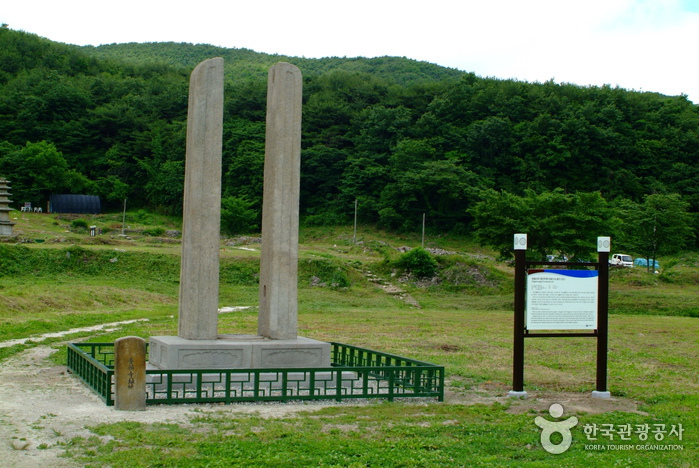
This site was where Bowon Temple existed from the Baekje period to the Joseon dynasty, holding a thousand years of history and many Buddhist cultural assets. Major cultural properties here include the 4-meter-high Dangganjiju (flagpole supports) that suggest the temple's scale, the five-story stone pagoda, stone statues, the Beopin Guksa pagoda, and the Beopin Guksa monument, all designated as treasures due to their great value. At one time, the temple housed about a thousand monks, and even by today's standards, the temple site deep in the mountains is so vast that it cannot be seen all at once. The gilt-bronze standing Buddha, iron standing Buddha, and iron seated Buddha statues excavated from Bowon Temple Site were moved to the National Museum of Korea in Seoul, but traces that suggest the grandeur of this millennium-old temple can still be found scattered around the site. Recognized for its value, it was designated a historic site in 1987, and it is especially notable that this area was significant during the Baekje period. Today, it is being reconstructed as a branch temple of Sudeoksa Temple in the 7th district of the Jogye Order of Korean Buddhism. Nearby are the Maae Samjon Buddha Rock Carving of Yonghyeon-ri in Seosan, another Baekje Buddhist cultural asset, as well as Yonghyeon Valley, Gayasan Mountain, and Gopung Reservoir. The Seosan Arame-gil Millennium Smile Trail and its circular route also pass through here, making it favorable for linked tourism.
Gaesimsa Temple, located in Sinchang-ri, Unsan-myeon, is one of the four major temples in Chungnam. It was founded by Monk Hyegam in 654, the 14th year of King Uija of Baekje, and is said to have been renovated by Cheoneung Daesa in 1350, the 2nd year of King Chungjeong of Goryeo. Only the base of the Daeungjeon Hall dates back to Baekje, while the building was destroyed by a mountain fire in 1475, the 6th year of King Seongjong of Joseon, and was rebuilt in 1484, the 15th year of King Seongjong of Joseon. Daeungjeon Hall, Treasure No. 143, was reconstructed on the original base in 1484 with an architectural style combining Dapo and Jusimpo methods, exemplifying exquisite craftsmanship and architectural artistry. The dense forest, bizarre rock formations surrounding the temple, and cherry blossoms that bloom around Buddha's Birthday make the scenery even more beautiful, filling the temple area with cherry blossoms to evoke a feeling of stepping into a transcendent realm far from worldly worries. Source: Seosan City Cultural Tourism Homepage
The northern ridge of Gayasan (678.2m), the highest peak in Seosan, splits through Seokmunbong (656.8m) into Ilraksan (521.4m)~Sangwangsan (309.6m) ridge and Okyangbong (621.2m)~Sujeongbong (453.3m), with Yonghyeon Valley nestled between these ridges. At its center lies the National Forest Recreation Forest, boasting the tranquil scenery of a deep mountain valley. The valley water is clear and clean, and the forest is dense with oak trees. Within the recreation forest, there are lodging facilities such as the Forest Culture Recreation Center, camping grounds, and forest classrooms. Hiking trails and forest roads connecting along the ridge link to the Seosan Ranch Trail, making walking and hiking convenient, while offering distant views of the West Sea from the ridge. This area is also a waypoint on the Seosan Aramegil and Cheonnyeon Miso Circular Courses, making it ideal for combined sightseeing. Nearby attractions include Seosan Yonghyeon-ri Maae Yeorae Samjon Statue, Seosan Bowon Temple Site, Gaesimsa Temple, and Gopung Reservoir.
Good places to stop and rest after the course

Booking and payment continue on a partner site.
Check rooms & priceSign up to feature your channel.
(As a member, you can add your Instagram, YouTube, and blog links in My Page, and we’ll show them with every comment you write.)
““Stayed near Hongdae and did a night café tour. Perfect city views and vibes.””
Guest comments do not display social media links or profile cards.
Share a short tip about this place.
Or leave a quick comment as a guest.
Photo attachments are available after login.
No reviews yet. Be the first to share your experience!