
Camping Trip in a Forest of Sea Pines in Chungcheongnam-do Seocheon-gun · schedule Other · distance 52.6km · 7 stops · highlights Chunjangdae Beach, Hon…
Enjoy camping at Heerisan, where the entire mountain is surrounded by haesong pine trees, allowing you to be fully immersed in the scent of phytoncide. Heerisan Natural Recreation Forest is the only natural recreation forest in the country where auto camping is possible, making it popular among camping enthusiasts. It is also recommended to visit Chunjangdae Beach, which boasts water as blue as the East Sea, and Maryang-ri Camellia Forest.
This course is a sample 2-day itinerary. Save it as-is or expand it into an AI itinerary.
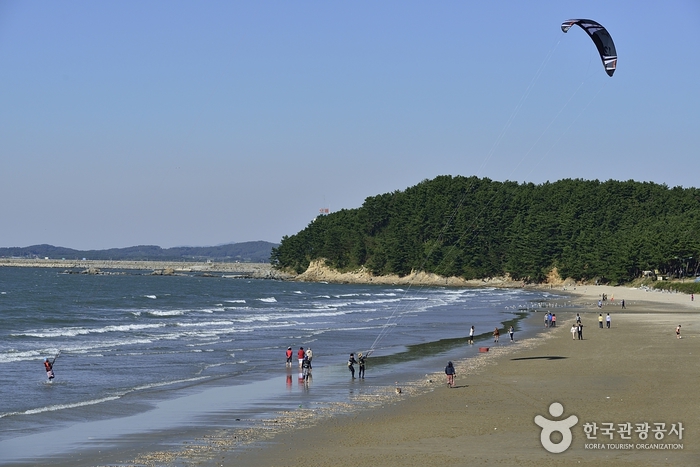
Chunjangdae Beach originally had a nearby bathing area at Dongbaekjeong, but when the Seocheon Thermal Power Plant was built there in the 1980s, landowner Min Wanki created several bungalows here and named the place Chunjangdae after his pen name Chunjang. Another theory says it was named Chunjangdae after the long stretches of camellia flowers. This beach features a gentle 1.5-degree slope and clear, calm waters, with dense pine and acacia forests widely spread, making it excellent for camping and relaxation. There is a plaza in the center used for cultural activities. Besides swimming, at low tide visitors can walk to nearby islands and catch seafood in the mudflats. The natural scenery is also a highlight. The area has concentrated camping grounds, auto camping sites, pensions, and motels, and nearby attractions like Hongwon Port, Busabangjoje, and Busaho make it good for combined tourism.
Hongwon Port is located on the way to Chunjangdae Beach and is a beautiful place with a breakwater extending into the sea and a white and red lighthouse where you can enjoy sea fishing and natural sashimi. Although smaller in scale compared to famous ports, among the West Sea coast ports it has a notably small tidal range, so many fishing boats come and go. What makes Hongwon Port most famous is the autumn gizzard shad. Called 'jeoneo' because it is believed to eat money, this fish has been mentioned in historical records with the phrase, "In the head of autumn jeoneo, there is a bowl of sesame seeds," and it is highly regarded on the West Sea coast with sayings like "Even a daughter-in-law who left home returns when she smells grilled jeoneo." Although jeoneo is available year-round, its taste is said to be best from late September to early November. Hongwon Port, along with Gwangyang Port in Jeollanam-do, is one of the places with the largest jeoneo catches. Every year from late September for two weeks, the 'Jeoneo Festival' is held at Hongwon Port.
Contrary to its name, Seosan Hoegwan is located in Seocheon and is a specialty restaurant for jjukkumi (small octopus). It is situated right in front of the tidal flat of Seocheon Maryang Port, where jjukkumi is caught alive using conch shells, making it fresh and well-known for its taste. The restaurant serves jjukkumi in stir-fried iron plate and shabu-shabu styles, with the season running from around February to early May. In addition, they offer seafood dishes such as rockfish soup and flower crab soup along with various other menus, with stir-fried jjukkumi on an iron plate being the main representative dish. Nearby attractions include Dongbaekjeong above Maryang Port, Seocheon Marine Glamping, and Chunjangdae Beach, making it a good area to combine sightseeing with dining.
서천 팔경 중의 한 곳인 서면 마랑리 동백나무 숲은 천연기념물 제169호로 지정되어 있다. 이곳에는 5백여 년 수령의 동백나무 85주가 8,265㎡에 울창한 숲을 이루고 있다. 동백나무 숲에 가면 3월 하순부터 5월 초순까지 푸른 잎 사이에 수줍은 듯 피어있는 붉은 동백꽃을 마음껏 감상할 수 있으며, 정상에 있는 동백정에 올라가면 서해의 푸른 바다와 낙조의 아름다움을 한눈에 볼 수 있다.
Opened in 1998, this natural forest of seaside pines covers the entire mountain, offering scenic views. There is a reservoir at the entrance, allowing for forest recreation. Hiking trails lead to the summit, where visitors can overlook the West Sea. Nearby attractions include Chunjangdae Beach, Geumgang Estuary Bank, and Hansan Mosi Town, allowing for combined trips. The recreation forest features educational facilities such as an exhibition hall explaining the forest's public functions and future forestry, a wildflower observation garden displaying wildflowers from Daejeon and Chungcheongnam-do along the entrance road, a mushroom cultivation site growing shiitake and reishi mushrooms, and a hibiscus garden exhibiting different varieties. There are also forest houses made from timber of oak, larch, cedar, seaside pine, Japanese cheesewood, Korean pine, and pine. Additionally, a forest training center accommodating 50 to 60 adults is operated. Sports facilities include a jokgu court and a basketball court.
The Seongbuk-ri Five-story Stone Pagoda, standing 6.2 meters tall, was built during the Goryeo period but reflects Baekje-style characteristics reminiscent of the Five-story Stone Pagoda of Jeongnimsa Temple Site in Buyeo, preserving the distinctive traits of the Baekje territory in the Seocheon area. This pagoda faithfully follows the Baekje stone pagoda style, featuring a single-story pedestal topped by five stories of the pagoda body. Notably, each face tapers upward in a trapezoidal shape—narrow at the top and wide at the base—clearly representing a Baekje pagoda. Therefore, it holds significant value as a national heritage site, playing an important role in tracing the distribution and diffusion routes of Baekje-style pagodas. In 1963, its value was formally recognized with designation as a treasure. The area also offers good opportunities for combined tourism with nearby sites such as Biin Eupseong Fortress, Biin Hyanggyo, Biin Beach, and Wolmyeongsan Mountain.
The Seocheon area lies on the west coast at the end of the Geum River, featuring widely developed tidal flats. Among them, Wolhaseong Village near Biin Beach is shaped like a bay with shallow waters, allowing well-developed tidal flats suitable for hands-on tidal flat experiences. Wolhaseong means 'castle under the moonlight,' reflecting the beautiful moonlight here. At low tide, nearly 1 km of tidal flat is exposed. The flat is sandy rather than muddy, making movement easy. From spring to autumn, visitors can enter the tidal flats to collect various shellfish such as clams, Manila clams, and razor clams, and observe the tidal flat ecosystem. In August, the Wolhaseong Torch Culture Festival is held, using the beautiful natural environment. Experience programs include boat launching culture, fisherman experiences, bare-hand fishing, and crab catching. Nearby attractions such as Biin Beach, Chunjangdae Beach, Dongbaekjeong, Seocheon Maryang-ri Camellia Forest, and Hongwon Port make this area ideal for combined tourism.
Good places to stop and rest after the course
Sign up to feature your channel.
(As a member, you can add your Instagram, YouTube, and blog links in My Page, and we’ll show them with every comment you write.)
““Stayed near Hongdae and did a night café tour. Perfect city views and vibes.””
Guest comments do not display social media links or profile cards.
Share a short tip about this place.
Or leave a quick comment as a guest.
Photo attachments are available after login.
No reviews yet. Be the first to share your experience!


