Special Experiences in Gunwi Gyeongbuk in Gyeongsangbuk-do Sangju City · schedule Other · distance 267km · 5 stops · highlights Beopjusa, Gunwi Janggok…
Gunwi-gun is located in the center of Gyeongsangbuk-do, with a short north-south span and a long east-west stretch. Its terrain is uneven with rugged mountains in many places, making it far from flat. However, the plains are flat and fertile, suitable for farming, and the natural mountain scenery is very beautiful. Enjoy the mountains and nature of Gunwi to the fullest.
This course is a sample 2-day itinerary. Save it as-is or expand it into an AI itinerary.
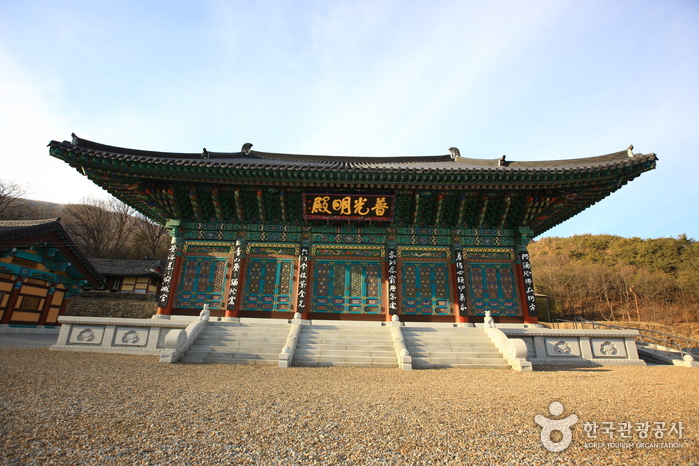
Beopjusa is located on a prominent peak southeast of Cheonghwasan in Dalsan-ri, Sobomyeon. It was founded by Simjikwangsa in the 15th year of King Soji of Silla but was destroyed in the first year of King Injo of Joseon and rebuilt in the first year of King Hyeonjong (1660). As the last temple of Eunhaesa in Yeongcheon, the grounds include Bogwangmyeongjeon, auxiliary buildings, Sanshingak, a millstone, and the main temple's five-story pagoda (Beopjusa Five-story Stone Pagoda). Bogwangmyeongjeon, currently preserved, was rebuilt in 1690 (Gyeonghi 30, Shinmi year) and has a history of over 300 years. Inside the temple hall, there are three Amitabha Buddha statues notable for their compassionate expressions and unusually large size, a rarity in other temples. Hanging on the wall behind the altar is a large Guabuldo (Hanging Buddha Painting), measuring over 23 ja 5 chi in length and 15 ja in width, which is a valuable Buddhist cultural asset despite significant damage. Within the grounds are Cultural Heritage material No. 27—the five-story stone pagoda—and the largest royal millstone in Korea (Folk Material No. 112) with a stone and upper stone measuring 115 cm in diameter and 15.5 cm thick, respectively, featuring four holes unlike typical millstones. This royal millstone reflects the large scale of the temple and can only be transported by more than ten strong men. It is uniquely preserved within the temple precincts near the temple's lodging quarters. (Source: Daegu Trip Road)
Gunwi Janggok Natural Recreation Forest was created in a deep mountain valley covered with natural forest to provide a resting space for public health and recreation, foster emotional well-being, enhance public functions through multipurpose forest management, and promote regional development. It serves as a recreational area connecting Gunwi Samjon Seokgul, Ingaksa, Ilyeon Park, Gunwi Dam, and the natural recreation forest, where visitors can experience history, culture, and nature together. Equipped with lodging facilities, leisure facilities, and seminar rooms. Located in a deep mountain valley dense with broadleaf trees and pine trees, it allows visitors to fully enjoy forest bathing with the pure air of nature. At Haksodae in front of Ingaksa, the clear water of Wicheon flows, providing a spot for water play as well.
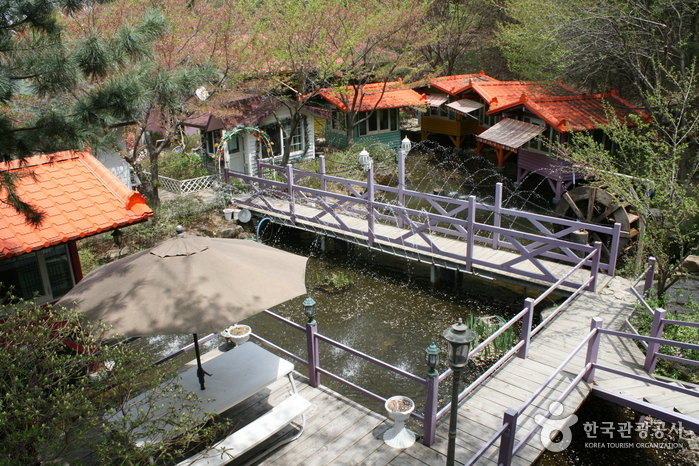
경북 팔공산 주변 음식점 중 15년 넘는 전통의 오리요리전문점이다. 물 좋고 공기 좋고 경관 좋은 팔공산 한티재 너머에 자리 잡은 이곳은 일단 도착하면 물레방아와 통나무 방갈로가 눈에 띈다. 예쁜 조경들 사이사이의 방갈로에서 오리고기를 맛볼 수 있다.
Hanbam Village is located in Bugye-myeon, Gunwi-gun, Daegu. Each house is surrounded by low stone walls that create a cozy atmosphere, as if quietly sharing old stories. The 10-ri-long stone walls and traditional houses have been preserved intact for 1000 years, and the surrounding pavilions and landscaping provide a tranquil setting that makes visitors stop and linger. Around 950 AD, a scholar named Hong Ran of the Burim Hong clan migrated here and named the village Daeya (大夜). Later, the character representing night (夜) was replaced with the character for large chestnut (大栗), and the village came to be called Daeyul-ri Hanbam Village.
In Namsan-ri, Bugye-myeon, Gunwi, there is a triad stone cave built by monk Geukdal in the 15th year of Silla King Soji's reign. Designated as a national treasure, the triad stone cave features Amitabha Buddha, Mahasthamaprapta Bodhisattva, and Avalokitesvara Bodhisattva with gentle postures inside a natural cliff cave. It remained unnoticed by the public until the late 1960s but was discovered by scholars in the early 1970s to have been created more than a century before Gyeongju Seokguram, revealing its origin and cultural value. Founded by monk Geukdal in 493 (the 15th year of King Soji of Silla), the cave has a flat floor and a square shape, with a ceiling that is highest in the center and lowers gradually towards all sides, resembling the sky. Inside the cave are the principal Amitabha Buddha and the two bodhisattvas on the left and right. The principal Buddha is seated in the lotus position with a shaven head and a full, grand, and solemn face. The ears are long, the neck is straight and slender, and the shoulders wearing the robe appear delicate and elegant. The shoulders are broad, supporting a majestic figure, and the robe is simple with ancient patterns, covering the wide knees and the front of the pedestal. Buddhism transmitted from Goguryeo blossomed on the slopes of Palgongsan and bore fruit in the Silla capital, Gyeongju. The mountain ridge extending from Birobong of Palgongsan forms a huge rocky cliff here. At 20 meters above the cliff’s midsection, a round natural cave facing south enshrines the triad Buddha statues, known as the triad stone cave.
Good places to stop and rest after the course

Booking and payment continue on a partner site.
Check rooms & priceSign up to feature your channel.
(As a member, you can add your Instagram, YouTube, and blog links in My Page, and we’ll show them with every comment you write.)
““Stayed near Hongdae and did a night café tour. Perfect city views and vibes.””
Guest comments do not display social media links or profile cards.
Share a short tip about this place.
Or leave a quick comment as a guest.
Photo attachments are available after login.
No reviews yet. Be the first to share your experience!