
Sancheong Cultural Heritage Tour 3 in Gyeongsangnam-do Sancheong County · schedule Other · distance 52.8km · 3 stops · highlights Daewonsa Valley, Sanch…
The third course in Sancheong passes through the Daewonsa Valley. Listening to the clear water flowing around the oddly shaped rocks will help you forget the worries of reality, and you can also enjoy the experience of visiting the peculiar stone tomb style from the Gaya period known as Gu-hyeong-wangneung.
This course is a sample one-day itinerary. Save it as-is or expand it into an AI itinerary.
Daewonsa Valley, the 2nd scenic spot of Sancheong's 9 views, is located at the entrance of the Jirisan hiking trail. It adjoins Daewonsa Temple, a representative Korean nunnery known for Seon meditation practice. You can enjoy the sound of clear water and dense pine trees year-round, and the scenery harmonizes beautifully in autumn. Daewonsa Valley is a mysterious and beautiful valley where deep, dense forest and bedrock merge. It was originally called Yupyeong Valley after the village name but is now known as Daewonsa Valley due to the increasing number of visitors to Daewonsa Temple.
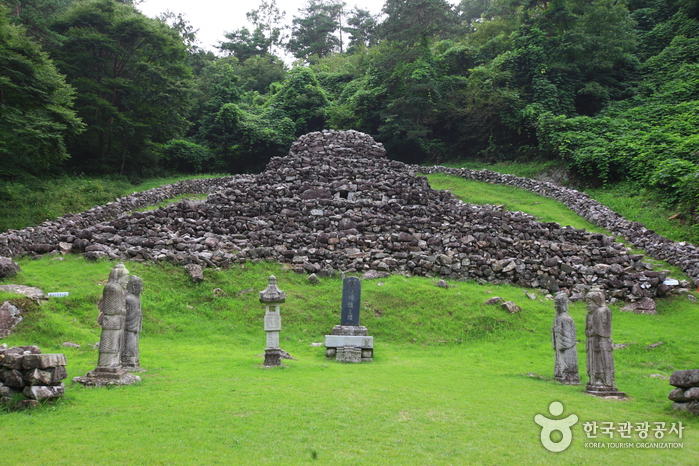
This stone tomb is said to be the grave of Guhyeong, the 10th king of Gaya and the great-grandfather of Kim Yushin. He became king of Gaya in 521 and ruled for 11 years until 532 when he surrendered territory to King Beopheung of Silla. There are two theories about this tomb: one that it is a stone pagoda, based on similar structures found in Andong and Uiseong regions, and another that it is a royal tomb, supported by records in Donggukyeojiseungnam and the San-eum-hyeon Sancheon section stating, "In the mountains 40 ri from the county, there is a stone structure called the nine dragons with layered sides, traditionally said to be a royal tomb." The first record naming the tomb after the king appears in the Joseon-era scholar Hong Ui-young's Wangsan Simneung, mentioning the temple Wangsan-sa west of the tomb, where the Wangsan-sa Chronicles refer to it as Guhyeongwangneung. Unlike ordinary tombs, it is constructed with a stepped stone base on a sloped hill. It has seven layers at the front, and uses the hill's natural slope at the back rather than creating a flat stepped pyramid. The tomb's summit is oval-shaped. In the center of the stone tomb is a stele inscribed 'Garakkuk Yangwangneung,' with stone artifacts in front, which are recently added facilities. Previously called Jeon Guhyeongwangneung, its official name was changed and announced in July 2011 to Sancheong Jeon Guhyeong Royal Tomb.
Saengcho International Sculpture Park, adjacent to the prehistoric Saengcho Burial Mounds and Eowoe Mountain Fortress, uniquely blends ancient and modern culture with the recently excavated two Gaya period burial mounds and over 20 contemporary sculptures from both domestic and international artists. The sculptures were created by world-renowned sculptors who participated in the Sancheong International Contemporary Sculpture Symposium in 1999, 2003, and 2005. The park is ideally located with a panoramic view of the Saengcho-myeon town center, Goeup Field, and Gyeongho River, and nearby there are many restaurants famous for freshwater fish dishes, making it a great place to taste Sancheong's local cuisine.
Good places to stop and rest after the course

Booking and payment continue on a partner site.
Check rooms & price
Booking and payment continue on a partner site.
Check rooms & priceSign up to feature your channel.
(As a member, you can add your Instagram, YouTube, and blog links in My Page, and we’ll show them with every comment you write.)
““Stayed near Hongdae and did a night café tour. Perfect city views and vibes.””
Guest comments do not display social media links or profile cards.
Share a short tip about this place.
Or leave a quick comment as a guest.
Photo attachments are available after login.
No reviews yet. Be the first to share your experience!


