Following the Traces of Scholar Nammyung Jo Sik in Gyeongsangnam-do Sancheong County · schedule Other · distance 37.7km · 5 stops · highlights Jeongchui…

Sancheong is a region where the relics of Master Nammyung Josik remain. Nammyung Josik was a scholar who, alongside Toegye Yi Hwang, formed the twin pillars of the Yeongnam School, living a life deeply secluded from the public eye. It is a pilgrimage site to learn about Nammyung and the Nammyung school, including Sancheonjae where the master devoted himself to study, Deokcheon Seowon which houses the master's memorial tablet, Sesimjeong, and the memorial hall. Sancheong is also famous for its plum blossoms. The journey to see the elegant plum blossoms in early spring, such as the Jeongdang Mae at Dansoksaji and the Nammyung Mae at Sancheonjae, is an experience not to be missed.
This course is a sample one-day itinerary. Save it as-is or expand it into an AI itinerary.
Jeongchuiam, located on the rocky cliffs of Daeseong Mountain, is said to have been founded by Uisang Daesa. It is a temple famous for the Jeongchuiam tanghwa (traditional Buddhist paintings), and it has long been called Sogeumgang (Little Geumgang) because its auspicious energy rivals even Geumgangsan. In the 6th year of King Sinmun of Silla, an Amitabha Buddha rose from the East Sea, casting two beams of light; one illuminated Geumgangsan and the other Daeseongsan. Uisang Daesa followed these beams and established Wontongam on Geumgangsan and Jeongchuiam on Daeseongsan. Jeongchuiam was renovated during the reign of King Gongmin of Goryeo, destroyed during King Hyojong of Joseon’s reign, and rebuilt by Bhikkhu Chiheon of Bongseongdang, who enshrined an Avalokitesvara statue. In 1987, Doyeongdang completed the Wontongbojeon construction, renamed the main hall, and enshrined the Buddha Shakyamuni, Avalokitesvara Bodhisattva, and Great Wisdom Bodhisattva statues. In 1995, 16 arhats and tanghwa were enshrined in Eungjinjeong, and the Sanshingak was renovated in 1996 to enshrine the Sanshin tanghwa, designated as a Gyeongsangnam-do cultural heritage asset. Nearby are beautiful natural tourist sites such as Duncheol Ecological Park and Seonyudong Valley.
In front of the golden hall site of the old Dansoksa Temple, there are two pagodas standing east and west; the one built on the east side is this pagoda. It is a typical Silla Dynasty stone pagoda with a three-story body placed on a two-tiered base. The lower tier of the base was made simultaneously with the floor stones using L-shaped stones. On top of this, another tier of the base was added, then the body stones and roof stones were alternately stacked to form the pagoda body. At the top, part of the finial remains on a square pedestal stone. Overall, the proportions of the upper and lower parts are suitable, and the size of the pagoda body is balanced as it goes up, giving it a beautiful appearance. When compared with the western pagoda standing alongside, the scale and technique are almost identical, indicating that they are works from the same era. Along with the twin pagoda arrangement, it is a notable work that well shows the construction techniques of the late Unified Silla period. It is said that the Dansoksaji site had a famous Silla-era painting of Yuma by the painter Solgeo, but it is no longer known. The East Three-Story Stone Pagoda has a typical Silla style from the mid-Silla period or later. Especially, the base has two tiers (upper and lower), with two pillars on the lower tier and one pillar on the upper tier, which well represents the features of stone pagodas from the mid-Silla period onward.
Namsa Yedamchon, where earthen stone walls and tiled hanok houses quietly stand, is an old village retaining the spirit of a seonbi (scholar). The village is brightened by pagoda trees, symbolic of seonbi, and features a 700-year-old plum tree and a 600-year-old persimmon tree that bloom and bear fruit, giving a feeling of hometown. Namsa Yedamchon is surrounded by Nigu Mountain with the Sasu stream encircling it. The village shaped by mountains and water is crescent-shaped, and thus, since olden times, the center of the village has been left open to prevent the village fortune from becoming a full moon and then waning. Around the village, there are many stories such as Sayangjeongsa built by a descendant of Jeong Mong-ju, a loyalist of Goryeo; Yeongmojae, which houses the royal document bestowed upon Lee Je, son-in-law of King Taejo Yi Seong-gye and a founding contributor; and Sahyojae, honoring the filial piety of Lee Yun-hyeon, who protected his father with his body against the blades of bandits. ◎ Travel information to experience the charm of Hallyu - Namsa Yedamchon, featured in the drama , is a representative hanok village of Gyeongsang province where you can see the heartwarming scenes of traditional houses beyond low fences. Here, you can enjoy hanok village tours, traditional wedding experiences, pagoda tree natural dyeing, traditional game experiences, and various other traditional cultural activities, providing a great opportunity to deepen your understanding of Korea.
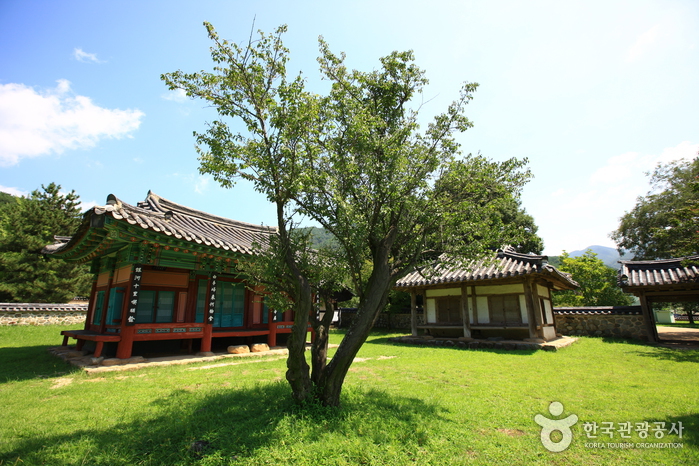
지리산 천왕봉 아래 산청군 시천면 사리에 있는 산천재의 뜰에는 남명 조식(曺植, 1501~1572)선생이 61세이던 명종 16년(1561)에 손수 심은 매화나무가 있다. 산천재는 선생이 학문을 닦고 연구하던 곳으로 명종 16년(1561)에 세웠고, 순조 18년(1818)에 고쳐졌다. 규모는 앞면 2칸, 옆면 2칸이다.
This seowon was established at the site where Nammyeng Jo Sik (1501~1572) studied to honor his scholarly virtue. It was built in the 9th year of King Seonjo of Joseon (1576) and became a state-recognized seowon with official support in the 1st year of King Gwanghaegun (1608). It was destroyed by Heungseon Daewongun's seowon abolition order during King Gojong's reign (1863~1907), but was rebuilt in the 1930s and remains to this day. The existing buildings include the shrine, sinmun, lecture hall, east and west dormitories, and outer three gates. The layout follows the jeonhak-humyo style, with study spaces in front and the shrine at the rear. Today, its educational function has ceased, leaving only its ritual functions. (Source: Cultural Heritage Administration)
Good places to stop and rest after the course

Booking and payment continue on a partner site.
Check rooms & price
Booking and payment continue on a partner site.
Check rooms & price
Booking and payment continue on a partner site.
Check rooms & priceSign up to feature your channel.
(As a member, you can add your Instagram, YouTube, and blog links in My Page, and we’ll show them with every comment you write.)
““Stayed near Hongdae and did a night café tour. Perfect city views and vibes.””
Guest comments do not display social media links or profile cards.
Share a short tip about this place.
Or leave a quick comment as a guest.
Photo attachments are available after login.
No reviews yet. Be the first to share your experience!