Meeting fresh green leaves in May in Gyeonggi-do Pocheon City · schedule Other · distance 75.1km · 4 stops · highlights National Arboretum, Pocheon Art…

The National Arboretum is a great place to feel the breath of spring. It is a place where you can not only enjoy family outings but also learn the importance of forests through various hands-on experiences. Along the dense forest trails, you can see diverse wildlife and take a walk through the fir tree paths. Nearby, Pocheon Art Valley, Herb Island, and the beautifully landscaped plant gardens of Pyeonggang Botanical Garden will add more fun in harmony with nature.
This course is a sample one-day itinerary. Save it as-is or expand it into an AI itinerary.
The National Arboretum was established independently on May 24, 1999, from the Central Forestry Experiment Station of the Korea Forest Research Institute, to effectively implement the Gwangneung Forest conservation measures initiated by the government in 1997. It is the nation's leading research institute on forest biological species, responsible for various roles related to plants and ecosystems. The arboretum conducts surveys, collection, propagation, and preservation of forest plants; collects, classifies, produces, and stores forest biological specimens; facilitates exchange and cooperation with domestic and international arboreta; explores and secures useful plants; and manages registration and import/export control of forest plant resources. It also serves public education and promotion regarding forests and preserves Gwangneung Forest. To fulfill these duties, it focuses on establishing a national plant resource management system, operating a plant conservation center, complementing and expanding the functions of specialty arboreta, exploring and securing domestic and foreign useful plants, building a forest biological specimen hall, expanding public education and promotion, installing a specialized arboretum library, and managing ecological conservation of Gwangneung Forest. The specialized exhibition gardens were started in 1984 and completed in 1987, consisting of 24 gardens categorized by plant characteristics or functions. The Forest Museum, opened on April 5, 1987, displays about 4,900 items including forestry records, artifacts, and wood products explaining the history, present, and future of Korean forestry. The Forest Biological Specimen Hall, completed in 2003, systematically stores and manages over 1.16 million specimens of domestic and international plants and insects, wild animal specimens, and plant seeds. The Tropical Plant Resource Research Center, completed in 2008, hosts about 2,703 species of pedigree tropical plants for research. Additionally, the arboretum operates the National Species Knowledge Information System, a database of forest biological specimens and plant information held by the National Arboretum and related universities, research institutes, arboreta, and botanical gardens nationwide, providing related information services. It also jointly operates, with the Korean Society of Plant Taxonomists, the National Standard Plant List Committee for standardization and naming of domestic plant names. The National Arboretum continues the tradition of Korean forest biological species research dating back to the 1920s and plays an essential role in securing Korea's forest biological sovereignty. Furthermore, it is a national research institution under the Korea Forest Service that manages and protects Gwangneung Forest, which has been preserved naturally for more than 550 years since its designation as King Sejo’s royal tomb forest in 1468 during the Joseon Dynasty.
Pocheon Art Valley is a complex cultural and artistic space where you can enjoy art within nature, featuring a picturesque emerald lake and towering granite cliffs resembling folding screens. Until the 1990s, it was an abandoned quarry that no one visited and left as an eyesore. However, it has since been completely transformed into a healing destination combining nature and art, attracting 400,000 visitors annually. Since 2014, an astronomy science center has also opened, allowing visitors to stargaze, making it popular as an educational spot for children and a dating course for couples.
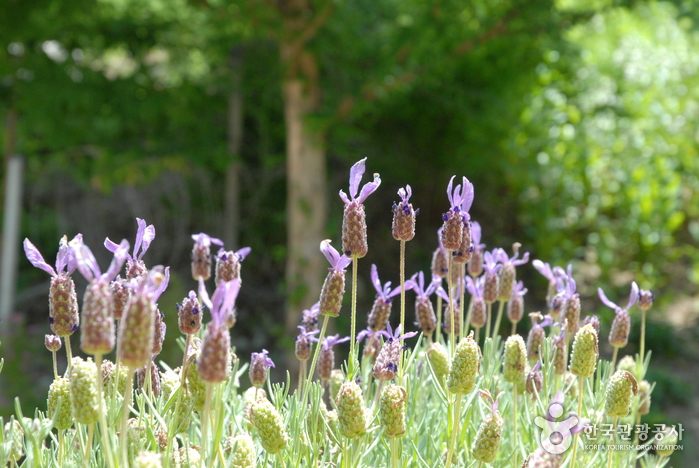
Herb Island is the largest herb botanical garden in the nation, registered as a first-class specialized museum (botanical garden) with a total area of 329,000㎡ including a botanical garden and exhibition hall (110,000㎡) within a tourist farm. The herb botanical museum contains over 250 species of herbs and various plants, allowing visitors to enjoy bright and lush plants throughout the four seasons. The herb botanical museum consists of a total of 4 indoor exhibition halls and an outdoor exhibition area. Each exhibition hall features key herbs and plants, providing an enjoyable experience, ecological education for children, and serving as a healing space.
산정호수 입구에 위치한 평강식물원은 10만여 평의 면적에 한국 자생식물과 전세계의 식물 5,000여 종이 전시되어 있다. 동양 최대 규모의 고산식물이 모여있는 암석원을 비롯하여 자연생태를 재현한 습지원, 50여 개의 연못과 화려한 꽃들로 구성된 연못정원, 깊은 계곡이나 숲에서 자연 발생하는 이끼를 관찰할 수 있는 이끼원, 사철 푸르름을 뽐내는 잔디광장 등 12개의 테마원으로 구성된 종합식물원이다. 희귀식물 보존뿐만 아니라 자연생태학습장으로서 새로운 식물원 문화를 만들어 가고 있다.
Good places to stop and rest after the course

Booking and payment continue on a partner site.
Check rooms & priceSign up to feature your channel.
(As a member, you can add your Instagram, YouTube, and blog links in My Page, and we’ll show them with every comment you write.)
““Stayed near Hongdae and did a night café tour. Perfect city views and vibes.””
Guest comments do not display social media links or profile cards.
Share a short tip about this place.
Or leave a quick comment as a guest.
Photo attachments are available after login.
No reviews yet. Be the first to share your experience!