Quiet Lakeside Views and Peaceful Moments in Chungcheongbuk-do Okcheon County · schedule Other · distance 49.8km · 4 stops · highlights Okcheon Gyeongyu…

The area around Okchon in Chungbuk features poetry monuments established in honor of past poets who have received the Jeong Ji-yong Literary Award. Walking along this path and strolling through the small courtyard of Gyeongryuldang, a quiet old seodang (traditional village school), naturally brings peace to the heart. (Source: The More You Stay, The More Charming Chungcheong)
This course is a sample one-day itinerary. Save it as-is or expand it into an AI itinerary.
Okcheon Gyeongyuldang is a seodang (village school) established by the scholar Jeon Huhui in the 11th year of King Yeongjo of Joseon (1735) to teach disciples at the village entrance. Gyeongyul is Jeon Huhui's pen name. He respected Yulgok Yi I and took the pen name Gyeongyul accordingly, naming the school Gyeongyuldang. It was used as a place for descendants' academic research and character development and produced many excellent talents. The structure has four bays in the front and two bays on the side, with a hipped roof shaped like the character '팔' (eight), a typical design of seodangs with a floor surrounding all four sides. It features a wooden veranda on all sides, and a storage room at the back has built-in shelves for books. The decorative tile inscription on the roof ridge confirms its construction in 1735. Though originally a seodang, it is now used as a meeting place for the Yonggung Jeon clan. The pine trees in the backyard and the surrounding wall encompassing the hill display the beauty of hanok architecture.
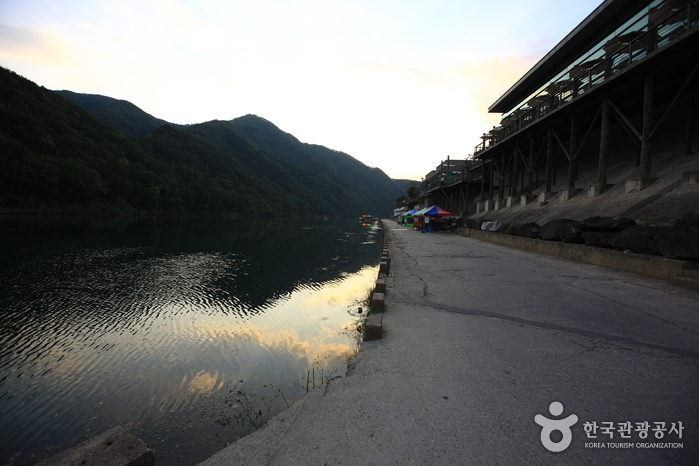
충북 옥천군 동이면(東二面) 조령리(鳥嶺里)에 있는 유원지이다. 1970년 개통된 경부고속도로의 옥천과 영동 인터체인지 사이에 시설된 금강 변의 휴게소이다. 험준한 산과 계곡을 막아 만든 댐은 경치가 아름다우며 공기도 맑아 피서객과 관광객이 모여든다. 잠수교 구실을 하는 이 댐을 건너 맞은편 우산리(牛山里)에 쉽게 이를 수 있다.
Anteo Prehistoric Park is a park where you can glimpse the prehistoric culture of Okcheon. It has one dolmen and one standing stone. The Seoktan-ri dolmen is Anteo No. 1 dolmen excavated in 1977 by Chungbuk National University Museum from three dolmens in Anteo Village. The capstone is turtle-shaped, and the tomb room was built above ground with four stone slabs, making it a table-style dolmen. At excavation, stones engraved with an X shape, face-shaped artworks, a spindle whorl, and net sinkers were discovered, suggesting the buried individual was female. The standing stone paired with the dolmen has a 90cm diameter circle carved at the lower part using a pecking technique, overall representing a pregnant woman. It is believed to serve as a monument symbolizing the person buried in Anteo No. 1 dolmen and as a protector of the tomb. Estimated to have been erected around the same time as the dolmen, it is a good place to comfortably explore prehistoric tomb styles with children.
The Hanok Gyodong House in the old town of Okcheon is the birthplace and childhood home of Lady Yuk Young-su. This house, once called 'Samjeongseung House' due to three prime ministers living there, was purchased and remodeled by Lady Yuk's father Yuk Jong-kwan before her birth into a typical late Joseon Dynasty countryside noble style home of Chungcheong-do. After Lady Yuk's passing in 1974, the house fell into disrepair and became abandoned, especially after former President Park passed away. In 1999, the family completely demolished the building, leaving only the foundation and stones. Then in September 2000, Okcheon-gun planned the restoration of Lady Yuk Young-su's birthplace, which was restored by a private group based on her recollections. Including the rear garden and orchard, the property spans 26,400㎡ with a 10,000㎡ main site, a size beyond ordinary homes. Upon entering the main gate, the stable (mabang) is to the right, and directly opposite is the sarangchae (men's quarters). To the left of the sarangchae is the annex. Passing around the sarangchae and opening the middle gate leads to the anchae (main quarters) at the center of the house. To the left of the anchae is the haengnang (servants' quarters), to the right is the yeondang sarang (study room), with a separate building at the back, and behind is a shrine and pavilion in the rear garden. To the right of the pavilion is another rear building. The outer sarangchae alone includes a raised wooden floor (numaru), outer and inner sarang rooms, sarangchae master’s room, large hall, storage, attic, guest rooms, and a kitchen exclusive to the sarangchae, all showing the scale of an upper-class household of the time.
Good places to stop and rest after the course

Booking and payment continue on a partner site.
Check rooms & priceSign up to feature your channel.
(As a member, you can add your Instagram, YouTube, and blog links in My Page, and we’ll show them with every comment you write.)
““Stayed near Hongdae and did a night café tour. Perfect city views and vibes.””
Guest comments do not display social media links or profile cards.
Share a short tip about this place.
Or leave a quick comment as a guest.
Photo attachments are available after login.
No reviews yet. Be the first to share your experience!