Into the Poetic World of Jeong Ji-yong’s “Nostalgia” in Chungcheongbuk-do Okcheon County · schedule Other · distance 42km · 5 stops · highlights Okcheon…

Okcheon is a region where the life and literature of poet Jeong Ji-yong remain intact. The song
This course is a sample one-day itinerary. Save it as-is or expand it into an AI itinerary.
Okcheon Huyuldang is a shrine enshrining the memorial tablet of Joseon mid-period scholar-official and militia leader during the Japanese invasions, Jo Heon (1544–1592). In the 21st year of King Seonjo's reign, Jo Heon resigned from his post as governor of Boeun and retired to Okcheon, where he revered scholar Yi I (Yulgok) and took the pen name 'Huyul.' He built a wall at Yongchon Bampi and named it 'Huyuldang.' When the Imjin War broke out, Jo Heon gathered about 1,600 militia members with Kim Gyeongbaek in Okcheon and, together with the monk Yeonggyu, recaptured Cheongju Fortress. However, due to interference by Yun Geukhyeong, the Chungcheong Province patrol officer, the militia was forcibly disbanded, and only about 700 participated in the Battle of Geumsan, where all were killed. Later, in the 5th year of King Cheoljong’s reign, descendants moved the shrine to Baekyangdong, Okcheon-gun, then relocated it to the current site in 1864 and rebuilt it in 1977. The building has a façade of 3 kan by 1 kan and a roof shaped like an eight (팔) character when viewed from the side. Surrounded by a gate and stone wall, the courtyard features the Hyoja Pavilion dedicated to his son Jo Wangi, who tried to sacrifice himself for his father during the Battle of Geumsan. The site also preserves a 1621 (Gwanghaegun 3rd year) woodblock print of (125 sheets), (10 sheets), and a royal decree from King Seonjo.
This is the birthplace of Jeong Jiyong, the representative poet of modern Korean poetry known for his poem 'Hyangsu,' located right next to the Jeong Jiyong Literature Museum. Jeong Jiyong was born here on November 20, 1902, and spent his childhood in this house. Although the house was demolished in 1974, it was restored to its original form in July 1996. Jeong Jiyong was a poet who wrote pure poetry while lamenting the pain of the Korean people during the Japanese colonial period. This site is an important space to understand the life and literature of Jeong Jiyong. The house is a single-story traditional hanok with a thatched roof, consisting of three bays in the front and three bays on the side. The inner quarters include a kitchen and two rooms, while the sarangchae consists of two rooms and a wooden floor. Around the birthplace, there is a statue and a commemorative stone of Jeong Jiyong, as well as a small stream flowing nearby. The Jeong Jiyong Literature Museum exhibits the poet's belongings such as his vest, brush, ink, and books, along with materials related to his life, works, and connection to Okcheon. A literary commentator is present for detailed explanations. Nearby are Janggyegwan Tourist Site, Okcheon Hyangsu 100-ri Bicycle Path, and the Yook Youngsoo Birthplace not far away.
충북 옥천에 향토 음식으로서 민물 생선을 12시간 동안 뼈째 푹 삶아 육수를 만들어 낸 색다른 음식이다. 옛 어른들이 강가에서 낚시하여 잡은 민물고기로 매운탕을 드시고 남은 국물에 소면을 넣어 먹었던 것에서 시작된 음식으로 전해지고 있는 생선국수이다. * 문의/안내 : 043-733-5788
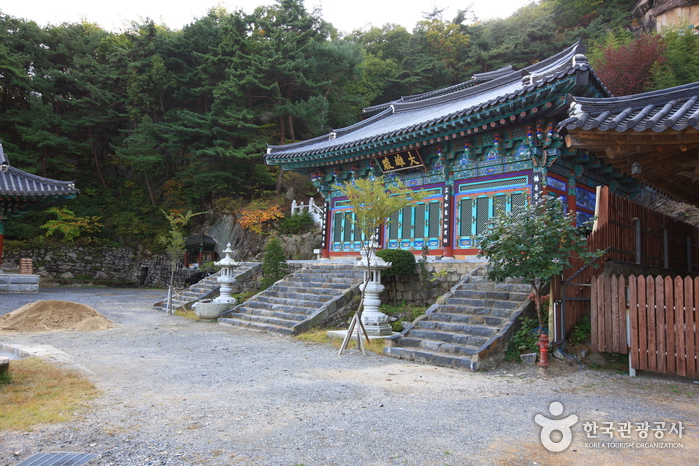
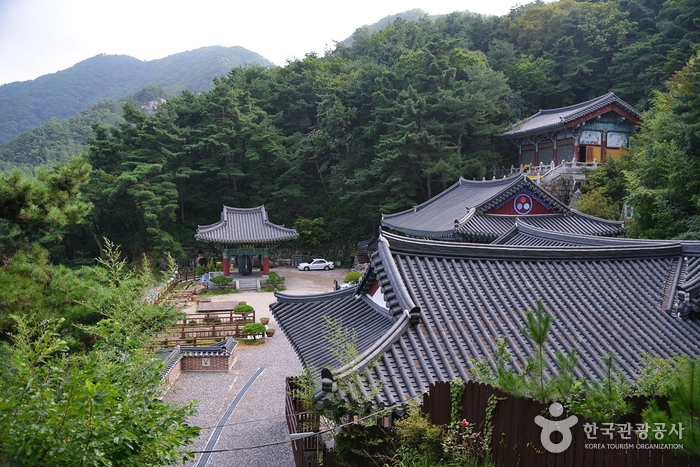
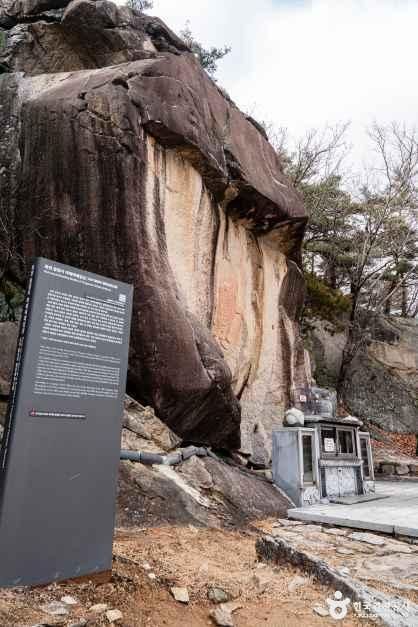
Yongamsa Temple is located on the mid-slope of Jangyongsan in Okcheon-gun and is a subordinate temple of Beopjusa, the head temple of the 5th district of the Jogye Order of Korean Buddhism. It was established by Uisin in 552 (the 13th year of King Jinheung's reign during the Silla period). The twin three-story stone pagodas at Yongamsa are uniquely situated on a low northern peak with views in all directions, unlike the usual temple layouts. These pagodas are believed to have been built following the Goryeo dynasty's sancheon bibo (mountain and river protection) belief, which involves erecting pagodas or buildings to revitalize the declining energies of the landscape. Yongamsa houses the Treasure-designated Okcheon Yongamsa Twin Three-story Stone Pagodas and the Yongamsa Rock-carved Buddha, and in the main hall (Daeseongjeon), there remains a wooden seated Amitabha Buddha statue. The twin pagodas consist of two identical stone towers standing side by side on a natural rock base, with three stories of the tower body rising proportionally without visual shortening—an unusual form. Based on the stylistic elements and simplified construction techniques of the stonework, the pagodas are estimated to have been built during the Goryeo period. Although the main hall, housing the wooden seated Amitabha statue created in 1651 (the 2nd year of King Hyojong of Joseon), and other buildings have been altered from their original forms, the twin three-story stone pagodas and the rock-carved Buddha have remained unchanged for over a thousand years. The temple buildings offer beautiful traditional architecture harmonizing with nature. To the left of the twin pagodas is a hiking trail that leads up to the summit of Jangryongsan.
충청북도 옥천군 군서면 금산리에 있는 자연휴양림으로 1994년 6월 17일에 개장했다. 해발 640m의 장령산 기슭에 있으며, 소나무와 참나무 숲 사이 계곡과 능선에 왕관바위, 포옹바위, 병풍바위 등 기암괴석이 절경을 이룬다.
Sign up to feature your channel.
(As a member, you can add your Instagram, YouTube, and blog links in My Page, and we’ll show them with every comment you write.)
““Stayed near Hongdae and did a night café tour. Perfect city views and vibes.””
Guest comments do not display social media links or profile cards.
Share a short tip about this place.
Or leave a quick comment as a guest.
Photo attachments are available after login.
No reviews yet. Be the first to share your experience!