
History trip through Namyangju nestled in nature in Gyeonggi-do Namyangju City · schedule Other · distance 56km · 6 stops · highlights Namyangju Gwangne…
Namyangju is suitable as a family travel destination with numerous historical sites scattered throughout, as well as various cultural, artistic, and ecological facilities. Gwangneung and Bongseonsa are both historical sites and beautiful forests, making them beautiful in all four seasons. Hongneung, Yureung, and the Dasan Historic Site offer historical stories alongside the enjoyment of nature.
This course is a sample one-day itinerary. Save it as-is or expand it into an AI itinerary.
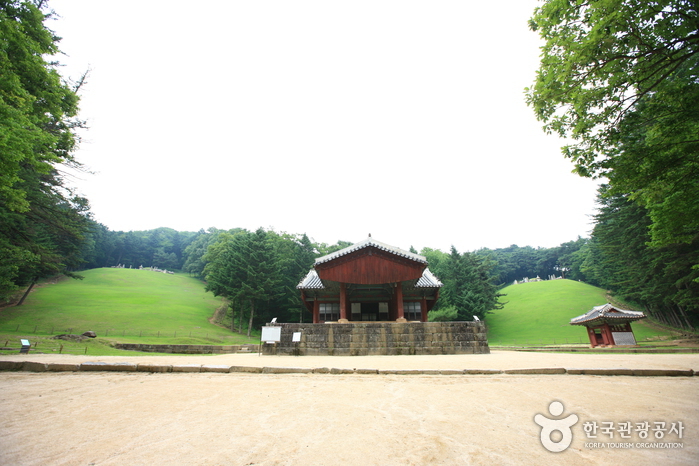
Gwangneung is the tomb of King Sejo, the 7th king of Joseon (reigned 1455–1468), and Queen Jeonghui Yoon (1418–1483). It was the first Joseon royal tomb to be constructed in the style of Dongwonigangneung (tombs on the same site but different hills), with one Jeongjagak (main shrine) in the burial area and the tomb chambers on separate hills. When viewed from the Jeongjagak, the left hill (west) is King Sejo's tomb, and the right hill (east) is Queen Jeonghui's tomb. After King Sejo died in 1468 (the first year of King Yejong's reign), the tomb was constructed at its current location. Originally, the site was the ancestral tomb area of Dongnae Jeong clan's Jeong Chang-son, but it was relocated due to Gwangneung’s construction. King Sejo left a will stating, "When I die, I must decompose quickly, so do not use stone chambers or stone coffins, and do not erect biangseok (folding screen stones)." Accordingly, the tomb chamber was made using huigyeok (ash isolation) instead of a stone chamber, reducing the cost and manpower of royal tomb construction. This method was applied to all royal tombs constructed after Gwangneung. Also, since biangseok were omitted, the twelve zodiac spirit figures normally carved on them were instead carved on the railing stones. In 1483 (the 14th year of King Seongjong), after Queen Jeonghui passed away, her tomb was built on the eastern hill of Gwangneung. The name Donggwangneung (East Gwangneung) was initially considered, but since it was within the same burial site, it was merged under the single name Gwangneung, and the Jeongjagak was relocated between the two tombs. The hyangro and eoro (incense and royal pathways) connecting the Hongsalmun gate to the Jeongjagak were created during the Joseon Dynasty but are now lost. At the entrance remains the only hamabi (dismounting stele) among Joseon royal tombs.
Bongseonsa is the main temple of the 25th district of the Jogye Order of Korean Buddhism, preserving the traditions of the Jogye doctrinal temples and the lineage of Seon temples. It was founded in 969 CE, in the 20th year of King Gwangjong of Goryeo, by the national monk Beopin and was originally called Unaksa. Later, in 1469 CE, the 1st year of King Yejong of Joseon, Queen Jeonghui, consort of King Sejo, enshrined King Sejo's tomb at I-san and named it Gwangneung, then established the current temple as Jaboksa to pray for the king's blessing, renaming it Bongseonsa. Bongseonsa suffered from repeated destruction during the Imjin War, the Qing invasion, and the Korean War. Following Nanghye Daesa (1539), Gye Min Seonsa (1637) rebuilt the temple, with further repairs in 1749 and 1848 restoring its grand and solemn appearance. Today's Bongseonsa reflects the temple's restoration efforts from around 1960. Every summer, Bongseonsa hosts the Bongseonsa Lotus Festival, a Buddhist cultural event centered on lotus flowers. With a lotus field spanning approximately 1,000 pyeong, visitors can enjoy a truly beautiful scene when the lotuses bloom. Since its inception in 2003, the festival continues annually to share the temple’s tranquil atmosphere and culture with the public and to promote Buddhist culture of communication and harmony.
Mieumnaru Folk Village is located in Suseok-dong, Namyangju-si, Gyeonggi-do. Small restaurants that once cooked meals for boatmen grew into a food culture street. Named after the pen name of descendants of the Andong Kim clan, Mieumnaru is well known as a large ferry crossing Hanam Misari. In 2006, Gyeonggi-do designated it as a food culture demonstration street where visitors can enjoy traditional dishes such as spicy fish stew, seafood stew, and grilled eel.
[미음매운탕] 미음매운탕은 미음나루터의 역사를 함께 한 매운탕의 원조다. 재료를 아끼면 손님을 잃는다는 신조아래 신선한 재료를 푸짐하게 담아내는 것이 미음매운탕이 30년을 유지해 온 비결이다. [초대한정식] 품질 높은 재료만을 엄선해 모든 음식은 즉석에서 파트별로 전문요리사가 직접 요리하는 한정식 전문점이다.
Hongneung is the tomb of Emperor Gojong, the first emperor of the Korean Empire, and his wife Empress Myeongseong. During Gojong’s reign, he could not successfully counter foreign invasions and faced internal political upheavals such as the Imo Incident, the Gapsin Coup, and the Eulmi Incident. Empress Myeongseong was a tragic queen brutally assassinated by the Japanese during the Eulmi Incident. Her tomb was initially located in Cheongnyang-ri but was moved to be buried together with Gojong’s tomb for feng shui reasons. Following the proclamation of the Korean Empire in 1897 (Gwangmu year 1), Hongneung’s tomb system combined the Ming Dynasty founder Taizu Xiaoling’s tomb system with that of Joseon royal tombs, differing from previous tomb practices. Yureung is the tomb of Emperor Sunjong, Empress Sunmyeong, and Empress Sunjeong. It is unique among Joseon royal tombs for having three chambers built within one mound, called Dongbongsamsilleung. Both Hongneung and Yureung adopt a style different from tombs before King Cheoljong’s era. By referring to Gojong as emperor, the tombs have solemnity as imperial tombs, resulting in different scales and types of stone artifacts. To unify the two tombs, a surrounding wall was constructed externally, and a stone pond was placed between the twin tombs.
The Jeong Yak-yong Historic Site is located in Neungnae-ri, Joan-myeon, Namyangju-si, Gyeonggi-do, and is the birthplace, childhood, and hometown where Dasan Jeong Yak-yong spent his later years. This is a historic area rooted from Jeong Yak-yong's fifth ancestor and reflects his life and scholarship. Dasan Jeong Yak-yong inherited Silhak scholarship from Yuhyeongwon and Yi Ik, embraced the ideas of the Northern Learning School, emphasizing practical knowledge and improving people's livelihood, and compiled Silhak into a comprehensive form. Throughout his life, he wrote over 500 books and more than 2,700 poems and passed away in his hometown in 1836, during the second year of King Heonjong's reign, at the age of 75. The historic site includes Jeong Yak-yong's tomb (a Gyeonggi-do monument), his birthplace Yeoyudang, the shrine Mundo-sa, a memorial hall, a cultural hall, and a cultural street. The memorial hall exhibits copies of works such as Mokminsimseo, Gyeongseuyupyo, and Heumheumsinseo, as well as a diorama reproducing the Suwon Hwaseong construction site. The cultural hall displays seven artworks themed on Jeong Yak-yong, including 'Sina Jigu Bang' and 'Jeong Yak-yong Garden.' Mundo-sa is a shrine named after Jeong Yak-yong's posthumous title, where descendants hold memorial rites annually on his death anniversary. Nearby the site are Paldang Lake, wildflower fields, an ecological pond, and Dasan Ecological Park. Sujongsa Temple has Samjeongheon, where Jeong Yak-yong drank tea with acquaintances. Since 1986, the annual Dasan Cultural Festival has become a historical cultural event where various citizen events and performances allow people to experience Jeong Yak-yong's life and ideas.
Good places to stop and rest after the course

Booking and payment continue on a partner site.
Check rooms & price
Booking and payment continue on a partner site.
Check rooms & priceSign up to feature your channel.
(As a member, you can add your Instagram, YouTube, and blog links in My Page, and we’ll show them with every comment you write.)
““Stayed near Hongdae and did a night café tour. Perfect city views and vibes.””
Guest comments do not display social media links or profile cards.
Share a short tip about this place.
Or leave a quick comment as a guest.
Photo attachments are available after login.
No reviews yet. Be the first to share your experience!
![Namyangju Gwangneung [UNESCO World Heritage] 1](https://tong.visitkorea.or.kr/cms/resource/71/3466171_image2_1.JPG)
![Namyangju Gwangneung [UNESCO World Heritage] 2](https://tong.visitkorea.or.kr/cms/resource/72/3466172_image2_1.JPG)
![Namyangju Gwangneung [UNESCO World Heritage] 3](https://tong.visitkorea.or.kr/cms/resource/74/3466174_image2_1.JPG)
![Namyangju Gwangneung [UNESCO World Heritage] 4](https://tong.visitkorea.or.kr/cms/resource/75/3466175_image2_1.JPG)


![Namyangju Hongneung and Yureung [UNESCO World Heritage] 1](https://tong.visitkorea.or.kr/cms/resource/96/3500296_image2_1.jpg)
![Namyangju Hongneung and Yureung [UNESCO World Heritage] 2](https://tong.visitkorea.or.kr/cms/resource/97/3500297_image2_1.jpg)
![Namyangju Hongneung and Yureung [UNESCO World Heritage] 3](https://tong.visitkorea.or.kr/cms/resource/99/3500299_image2_1.jpg)
![Namyangju Hongneung and Yureung [UNESCO World Heritage] 4](https://tong.visitkorea.or.kr/cms/resource/00/3500300_image2_1.jpg)


