Let us visit Naju on the broad plains of Honam in Jeollanam-do Naju City · schedule Other · distance 29km · 5 stops · highlights Namgomon, 한국천연염색박물관, 나주…

When you think of 'Naju,' the first things that come to mind are the Naju Plain and the Yeongsan River. Living in such beautiful landscapes makes it naturally attractive for people to gather. There are many stories accumulated in Naju. You can fully enjoy the picturesque scenery of Naju along the waves of the Yeongsan River, and there is no better way to enjoy a refreshing outing.
This course is a sample one-day itinerary. Save it as-is or expand it into an AI itinerary.
Passing through Dongjeommun, the east gate of Naju Eupseong, and running along Jungang-ro toward Naju Elementary School, there is a large fortress gate in the middle of the road. This is the south gate of Naju Eupseong located in Namnae-dong, called Namgomon. The name Namgomon was given because when leaving this south gate, people looked back toward Geumseonggwan, where the king was, hence the name Namgomon. It is also said that Sambong Jeong Dojeon climbed here when he returned to Naju and composed 'Yuburoseo.' (Source: Naju City Culture and Tourism website)
고대문화 중심지인 나주는 영산강유역을 배경으로 일찍이 염색문화와 실크생산의 큰 역할을 하여 왔다. 영산강과 바닷물이 합류했던 지리적 환경은 쪽재배와 뽕나무를 재배하기에 적합하여 이곳은 천연염색의 최적지이자 전국에서 유일하게 중요 무형문화재 염색장 기능 보유자도 활동하고 있는 곳이다.
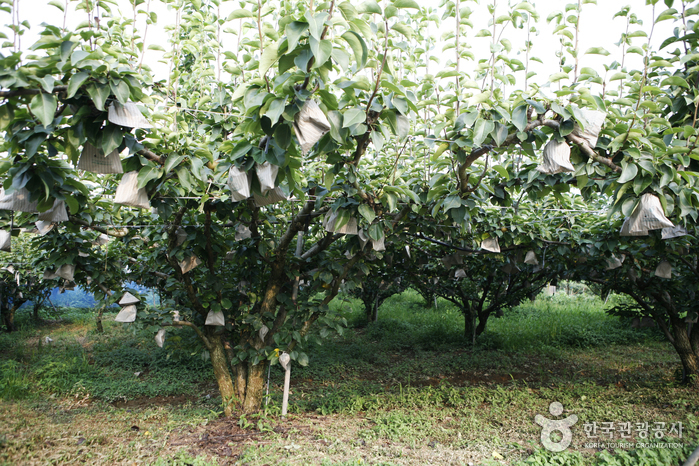
배의 고장 나주에는 다양한 품종의 배나무가 자란다. 따라서 배꽃의 개화시기도 조금씩 다른데 신고배나 황금배 같은 조생종은 4월 20일 전후로 만개하고 만삼길, 금촌추 같은 만생종은 4월 25일을 전 해서 활짝 피어나 나주 땅을 온통 백설처럼 하얗게 뒤덮는다. 배꽃은 매화나 벚꽃처럼 화려하지 않은 대신 은은한 기품을 풍긴다. 나주 배꽃은 광주시와 나주시의 경계를 지나자마자 들어서는 노안면에서부터 그 아름다움을 아낌없이 보여준다. 야트막한 구릉에 조성된 과수원마다 온통 새하얀 배꽃에 휩싸여 있다.
Although wild eels are rarely caught due to the damming of the Yeongsan River estuary, Naju's Gujinpo—named for being the ninth bend out of twelve in the Yeongsan River—is famous for eels as it is where seawater and freshwater meet. Gujinpo eels are especially delicious because they grow eating mudfish. Currently, around 7 to 8 eel restaurants maintain the tradition centered on Gujinpo Samgeori, mostly established since the 1940s, cooking using their unique method resulting in similar quality taste. Gujinpo was called 'Gubunaru' as a ferry crossing where the Yeongsan River bends, and was once known as Hoejinpo because the river water curved around Angam Rock before gathering and bending here again. About 10 minutes by car (4.2 km) away are Yeongsan River Hwangpodotbae Ferry Terminal and Naju Skatefish Street. The Naju Bannam Tumuli Cluster is a burial mound site from the Three Kingdoms period. First excavated during the Japanese colonial era, it revealed unique large pottery jar graves not found elsewhere, alongside gilt-bronze crowns, gilt-bronze shoes, phoenix-patterned ring-handled swords (hwandudaedo), and other artifacts demonstrating the highest rulers' status. Unlike Goguryeo's stone-cist tombs, Baekje's stone chamber tombs, Silla's stone and wooden tombs, and Gaya's stone chamber graves, the pottery jar grave style was unique to the Yeongsan River basin. Early jar graves were half-buried in the ground and covered with low tumuli, but later the tumuli were built first, and then the jars were placed inside after digging into the top, with larger mounds. This form of using jar graves as burial style appears worldwide and was part of Korea's funerary customs since the Neolithic. However, the use of large dedicated pottery jars like those in the Yeongsan River basin was unique, understood as a funerary culture developed by indigenous powers there. Around Daean-ri, 12 tombs exist; Tomb No. 9 is the largest with nine jars and artifacts including gold rings, large swords, copper bracelets, glass beads, and pottery. Around Sinchon-ri, 9 tombs are distributed; excavations during the Japanese colonial period uncovered Tomb No. 9 and others, yielding a National Treasure gilt-bronze crown along with gilt-bronze shoes, gold rings, phoenix-patterned ring-handled swords, and copper bracelets. A 1999 re-excavation of Sinchon-ri Tomb No. 9 uncovered 32 cylindrical pottery pieces decorating the mound's rim. These pottery items correspond to 'haniwa' artifacts found in Japanese tombs, providing key clues to ancient Korea-Japan historical interactions. Over 14 tombs are distributed in Deoksan-ri, with construction dates judged similar to those of Sinchon-ri and Daean-ri around the mid to late 5th century. Tomb No. 10, the latest among the Bannam Tumuli, is a stone chamber tomb believed built after the mid-6th century when Baekje influence expanded, marking the decline of local pottery jar tomb traditions. It is recommended to also visit the nearby National Naju Museum.
국립나주박물관은 첨단 기술을 문화영역에 접목한 새로운 개념의 열린 문화공간이다. 국내 박물관 최초로 스마트폰의 NFC기술(접촉식 무선통신)을 이용한 전시안내 시스템을 전시실 전관에 도입하여, 관람객이 스마트폰으로 전시내용을 안내받고 이를 다시 SNS상에서 서로 주고 받는 실시간 쌍방향 소통이 가능하도록 설비되어 있다. 또한, 6곳의 수장고 가운데 2곳의 수장고에 대형 관람창을 설치하여 관람객들이 수장고 내부를 직접 볼 수 있는 개방형 수장고를 운영하며 체험전시 공간을 확대하고, 박물관 옥상정원을 개방하여 박물관의 여러 공간을 보다 생생하게 체험하고 느낄 수 있게 만들었다.
Good places to stop and rest after the course

Booking and payment continue on a partner site.
Check rooms & price
Booking and payment continue on a partner site.
Check rooms & priceSign up to feature your channel.
(As a member, you can add your Instagram, YouTube, and blog links in My Page, and we’ll show them with every comment you write.)
““Stayed near Hongdae and did a night café tour. Perfect city views and vibes.””
Guest comments do not display social media links or profile cards.
Share a short tip about this place.
Or leave a quick comment as a guest.
Photo attachments are available after login.
No reviews yet. Be the first to share your experience!