Riding the Gondola up to Deogyusan Hyangjeokbong Peak in Jeonbuk Special Self-Governing Province Muju County · schedule Other · distance 20.7km · 4 stop…

Muju is a region that embraces Deogyusan Hyangjeokbong Peak, which stands at an elevation of 1,614 meters. Using the tourist gondola departing from Deogyusan Resort, it takes about 30 minutes to reach the summit of Hyangjeokbong. The hiking trail from Samgong Information Center to Hyangjeokbong follows a route passing Baekryeonsa Temple. Among the 33 scenic sites of Muju Gucheondong, 19, including Wolhatan to Hyangjeokbong, extend along the valley. A recommended course is to take the gondola up to Hyangjeokbong, then enjoy trekking via Baekryeonsa Temple back to the Samgong ticket office.
This course is a sample one-day itinerary. Save it as-is or expand it into an AI itinerary.
Muju Resort Tourist Gondola is located within Muju Deogyusan Resort, a representative mountain-type vacation spot in Deogyusan National Park. Riding the tourist gondola to Seolcheonbong at an altitude of 1,520m allows easy access to the peak of Deogyusan, Hyangjeokbong, in just 20 minutes. The mountain is not rugged, making it suitable for elderly couples or families to ascend leisurely. From the top of Hyangjeokbong, a panoramic view unfolds where you can see Jeoksangsan, Maisan, Gayasan, Jirisan, Gyeryongsan, and Mudeungsan at a glance.
Deogyusan is a mountain spanning Muju and Jangsu in Jeonbuk and Geochang and Hamyang in Gyeongnam, with Hyangjeokbong at 1,614m as its highest peak. Hyangjeokbong is the fourth highest peak in South Korea, featuring ecological diversity such as yew and Korean fir clusters and azalea clusters. In winter, heavy snowfall creates beautiful snow scenes, and the gondola route from Seolcheonbong to Hyangjeokbong is a popular short course. Hyangjeokbong has Course 1 (0.6km) and Course 2 (8.5km), connecting key points such as shelters, Baengnyeonsa Temple, and Osujagul Cave. It is also possible to traverse about 14.8km from Hyangjeokbong to Namdeogyusan for a through hike.
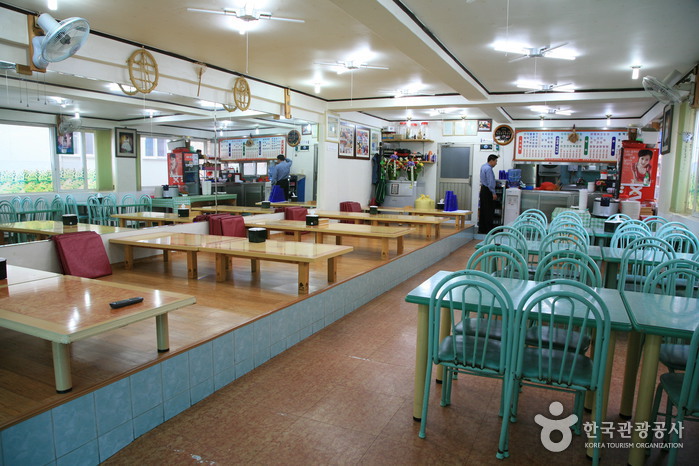
Hangukgwan is a Korean cuisine specialty restaurant located right in front of Deokyugyo Bridge in the Gucheon-dong Valley restaurant street within the Muju Gucheon-dong tourism district of Deogyusan National Park. It is one of the local food restaurants selected through a cooking evaluation in Jeollabuk-do. The menu includes soups such as native herb chicken soup, mushroom hot pot, neungi chicken soup, and spicy chicken stew, as well as meals like grilled deodeok set menu, stone pot bibimbap, neungi hangover soup, mountain vegetable bibimbap, and shiitake mushroom rice soup. Additionally, there are traditional dishes like shiitake mushroom pancake, tofu kimchi wraps, green onion pancake, and acorn jelly. Notably, meals come with nine types of side dishes mainly consisting of seasoned vegetables, offering not only great taste but also neat presentation. Among these, the shiitake mushroom rice soup is usually made with beef, but here it is made using only shiitake mushrooms, resulting in a clear and clean soup without the greasy heaviness.
Baengnyeonsa Temple is a temple located on Deogyusan Mountain in Muju and is a branch temple of Geumsansa, the main temple of the 17th district of the Jogye Order of Korean Buddhism. During the reign of Silla's King Sinmun, Baeknyeon built a hermitage and meditated there, and a white lotus flower sprouted, which led to the establishment of this temple. At the temple site, traces of a monument erected by Lee Haseop when he rebuilt the temple in Gwangu 4 (1900) can be found. The buildings were burned down during the Korean War, but the temple bell, said to have been made in Gyeongjong 3 (1723), remains after being relocated. In 1968, when the temple lodgings were constructed, the temple's name was changed from Baengnyeonam to Baengnyeonsa, and restoration efforts were made for over 30 years. The Daeungjeon Hall is five kan wide at the front and three kan deep at the side, with a distinctive eight-sided paljak roof when viewed from the side. Other structures include Seonsudang, Wontongjeon, Sacheonwangmun, and Iljumun gates. Behind the temple is the Baengnyeonsa stairway used for Buddhist precept ceremonies. Notably, it is said that anyone who chants 'Gwanseum Bosal' (Avalokitesvara Bodhisattva) and circles the area seven or more times will have their wish fulfilled, attracting many visitors continuously.
Sign up to feature your channel.
(As a member, you can add your Instagram, YouTube, and blog links in My Page, and we’ll show them with every comment you write.)
““Stayed near Hongdae and did a night café tour. Perfect city views and vibes.””
Guest comments do not display social media links or profile cards.
Share a short tip about this place.
Or leave a quick comment as a guest.
Photo attachments are available after login.
No reviews yet. Be the first to share your experience!