
Walking the Yeongnam Alps in Gyeongsangnam-do Miryang City · schedule Other · distance 8km · 3 stops · highlights Hobakso Valley, Jaeyaksan, Pyochungsa
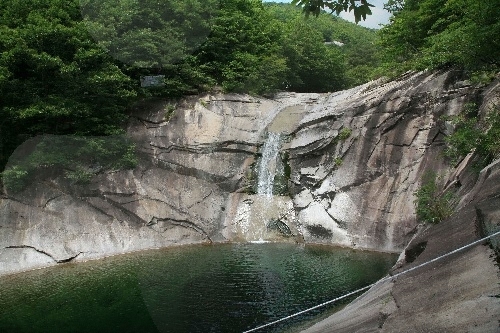
Cheonhwangsan and Jaeyaksan, located in Miryang, are high mountain areas over 1,000 meters above sea level, known as the Yeongnam Alps. In particular, Saja-pyeong of Jaeyaksan is a place where you can encounter a splendid dance of silver grass in autumn, making it one of the best autumn hiking destinations. You can enjoy the valleys of Hobakso and Eoreumgol and take the Eoreumgol cable car to comfortably experience the terrain of Cheonhwangsan and Jaeyaksan. The course descending from Cheonhwangsan and Jaeyaksan to Pyochungsa is recommended.
This course is a sample one-day itinerary. Save it as-is or expand it into an AI itinerary.
Located about 32 km from the center of Miryang city in Nammyung-ri Sirye Village of Sannae-myeon, there is the Ice Valley extending from Jaeyaksan (Cheonhwangsan), and about 3 km from here appears Hobakso Valley, a stream of Gajisan. Over hundreds of thousands of years, the valley water has washed white jade-like granite, creating white foam as it falls, and the surrounding natural scenery is so beautiful that it was selected as one of Korea's top 100 exquisite waters. According to Dongguk Yeoji Seungnam, Hobakso is a pond hollowed by a waterfall about 10 meters high and is called Hobakso because it looks like a type of mortar used in mills called hobak. Its circumference is about 30 meters, and it is also called Sirye Hobakso, Guyeon Waterfall, or Baekryeon Waterfall. Additionally, Hobakso was used as a rain prayer pond during long droughts. In the past, locals tried to measure the water depth by unspooling a thread of silk tied to a stone, but it was said they never reached the bottom, indicating great depth. This waterfall gorge with a white rock floor is an unpolluted area, with nearby Baekryeonsa Temple, Hyeongjeso, and five-thousand-pyeong flat rock, making the scenery very beautiful.
Jaeyaksan, towering behind the millennium-old temple Pyochungsa located in Miryang-si, is one of the Yeongnam Alps mountain range. It offers a panoramic view of Sajapyeong silver grass and wetlands. With its gentle terrain, it is a beautiful mountain suitable for light hiking with family and friends. The nearby area has many attractions such as Eoreumgol, Hobakso, Pyochungsa, Cheungcheung Falls, and Geumgang Falls, providing plenty to see. The silver grass ridge trail connecting Sumi Peak, Saja Peak, Neungdong Mountain, Sinbul Mountain, and Chweseo Mountain is a healing path where you can enjoy the beauty of autumn hiking. It is also a great place to visit with family and take photos.
Designated as Gyeongsangnam-do Monument No. 17, Pyochungsa Temple was named by the state to honor the loyal spirit of Saimyeongdaesa (四溟大師), who distinguished himself during the Japanese invasions of Korea (Imjin War). Although it was rebuilt in 1715 (41st year of King Sukjong's reign), most buildings except Eungjinjeon (應眞殿) were destroyed by fire in 1926 and later reconstructed to the present day. Main cultural properties and buildings include National Treasure No. 75, the Bronze Silver-incense Burner (靑銅含銀香), Treasure No. 467, the Three-story Stone Pagoda, as well as provincial cultural properties such as the Stone Lantern, Pyochung Seowon (表忠書院), and Daegangjeon (大光殿). There are 25 buildings and over 300 relics of Saimyeongdaesa preserved here.
Sign up to feature your channel.
(As a member, you can add your Instagram, YouTube, and blog links in My Page, and we’ll show them with every comment you write.)
““Stayed near Hongdae and did a night café tour. Perfect city views and vibes.””
Guest comments do not display social media links or profile cards.
Share a short tip about this place.
Or leave a quick comment as a guest.
Photo attachments are available after login.
No reviews yet. Be the first to share your experience!


