Experiencing the miracle of Moses along Jindo mysterious sea road in Jeollanam-do Jindo County · schedule Other · distance 47km · 6 stops · highlights G…

Jindo is the place where Moses' miracle occurs every year, a unique natural phenomenon appearing in the sea between Geumgye-ri, Gogun-myeon and Modo-ri, Uisin-myeon. The journey through the mysterious sea road of Jindo, the Juklim fishing village experience, and Jeopdo Wellbeing Hiking Trail with Supum Port in southern Jindo becomes a journey to encounter a mysterious and beautiful sea.
This course is a sample one-day itinerary. Save it as-is or expand it into an AI itinerary.
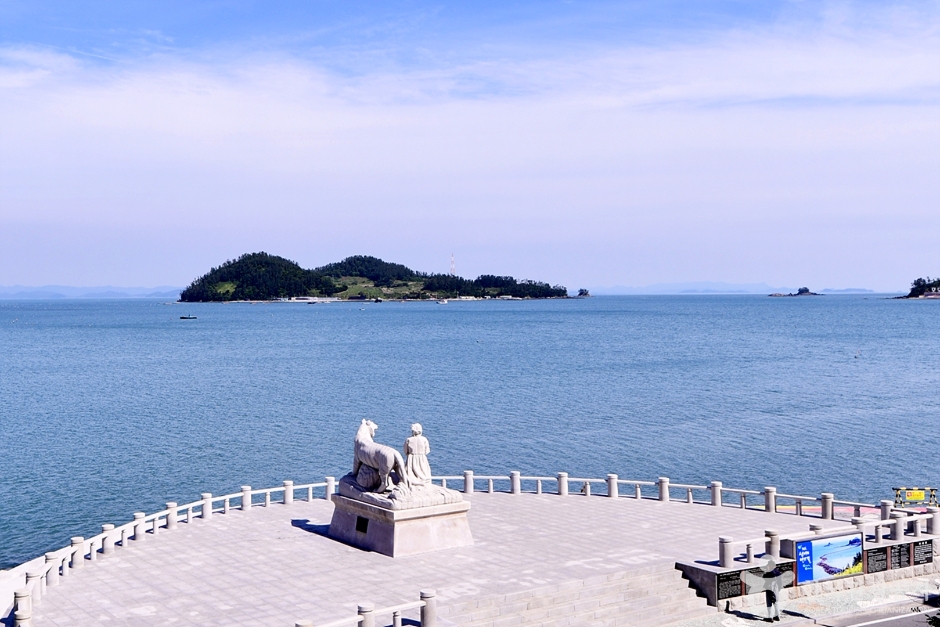
Gagae Beach is located next to the Sinbi-ui Badatgil, known as the modern-day miracle of Moses where the sea parts. It is a beach with a wide white sand shore, facing the Dadohae Sea, offering beautiful scenery with a 3 km-long sand beach. The beach is easily accessible and well-equipped with convenient facilities such as a large parking lot, shower rooms, and drinking fountains, making it popular among visitors using private cars. Near the beach, there are sculptures that serve as popular photo zones, and along the shoreline, pine trees and grass provide shade from the sun. The combination of green trees and blue sea allows visitors to enjoy beautiful views while swimming and relaxing. Additionally, sea fishing is available nearby at rocky areas, piers, and uninhabited islands for species such as mackerel, flatfish, sea bass, mullet, eel, and barley fish. Nearby attractions include the Jindo Marine Ecology Center, Jindo Sinbi-ui Badatgil, and Geumhodo.
Between Hoedong Village in Gogun-myeon and Modo in Uisin-myeon, the sea parts in an event called the 'Korean Moses Miracle.' When the water recedes, a sea road about 30-40m wide and 2.8km long opens. The sea road remains fully exposed for about an hour before closing again. There is a legend related to this mysterious sea road. Due to frequent tiger appearances causing harm to the village, villagers hurriedly fled to Modo, leaving behind an old woman called Bponghalmeoni. She prayed daily to the Dragon King to reunite with her family, and around the lunar new year's end in February, the sea road opened, allowing her to meet her beloved family, but she passed away from exhaustion. Since then, villagers have held her memorial every year during Yeongdeung Sari. The Jindo Mysterious Sea Road became widely known worldwide after the French ambassador to Korea witnessed the phenomenon in 1975 and introduced it in a French newspaper as the 'Moses Miracle.' Since the late 1970s, Jindo-gun holds the Yeongdeung Festival timed with Yeongdeung Sari, with memorial rituals at Bponghalmeoni's shrine by the seaside and Dragon King ceremonies. The festival features traditional folk performances unique to Jindo such as Ssingimgut, Dasiraegi, Ganggangsullae, Namdo Deulnorae, Jindo Manka, and Buknori, along with various events attracting numerous spectators from all over. There is also the Mysterious Sea Road Experience Center, where visitors can experience the sea road regardless of the timing of its appearance.
Juklim area in Jindo, named for its abundant bamboo since ancient times, includes three villages—Juklim, Ganggye, and Dongheon—with about 150 households and 300 residents. In front of the Juklim area, over 40,000 pyeong of mudflats are home to various clams such as dongjuk, bajirak, matjogae, and haebanggodong, where clam digging experiences are available. In winter, fresh oysters and grilled oysters, as well as oyster jeon, can be savored. There are facilities for family lodging and group events, and within the Juklim Elementary School grounds is the Hanguk Sihwa Museum, which features a calligraphy and stone art gallery holding seminars year-round. Nearby are the Jinyeong folk liquor distillery Yehyang Hongju, a pine forest lined with 200-year-old pine trees, and Hwanggeumbong Farm. Jido Port, a 20-minute drive away, serves as a high-speed ferry terminal to Jeju Island, and Sol Beach Daemyung Resort is also located nearby.
Jeopdo is called Jeopseom because it is close to the main island of Jindo, and it is written as Jeopdo. When Geumgap and Jeopdo are in one area, it is sometimes called Geumgapdo. The coast has three peninsulas protruding in the north, south, and east directions, with two bays formed between the peninsulas. Yeomiman in the southeast has deep waters and calm waves, forming a good harbor, while the west coast is rocky with sea cliffs developing like folding screens. Namman Mountain on Jeopdo is a well-being hiking trail that won the Coexistence Award at the 2018 Beautiful Forest National Competition. There are magnificent rock formations scattered around and beautiful forests mixed with evergreen broadleaf and deciduous trees. The island is still surrounded by clear and unpolluted sea, allowing visitors to experience pristine nature. Jeopdo offers pleasant walking paths and many sights, making it ideal for island travel and hiking. Additionally, visitors can enjoy island cruises by boat and fishing.
Bae Jungson Shrine is a shrine dedicated to General Bae Jungson of the Sambyeolcho, a military unit organized to oppose the Mongol invasions during the Goryeo military regime. It is said that General Bae Jungson met his end at Gulpo Beach, then a mudflat, while retreating there after losing the Battle of Namdo Jinseong. Yongjangseong is the fortress where the Sambyeolcho used Jindo as a base to resist government and Mongol forces during the Goryeo period. Most of the original fortress has disappeared, with only parts of the ruins remaining, including Yongjangsa temple site and the royal palace site inside. At Yongjangseong, there are the Goryeo Anti-Mongol Memorial Tower, a statue of General Bae Jungson, Sung-ui Gate, and the Jeongchungsa Shrine. To the right of these stands the Monument to General Bae Jungson's Anti-Mongol Loyalty. Jeongchungsa Shrine, formerly located at 4212 Jindo-daero, Imhoe-myeon, Jindo-gun, was relocated and newly built at Yongjangseong in February 2021. The original shrine is now used as the Gosan Yun Seondo Shrine. Adjacent to the site are the Yongjangseong Exhibition Hall and Yongjangsa Temple.
Jindo is a fertile land with thriving agriculture, also called Okju. The saying 'One year’s harvest feeds for three years' still reflects the abundant goods and generosity of this area. Jindo, a region of artistic heritage but very remote, was also used as a place of exile and is a strategic military point with many military-related relics. Namdojinseong is believed to have been the center of Maeguri-hyeon during the Baekje period. It served as a base during the reign of Goryeo King Wonjong when the Sambyeolcho army fought Mongol forces that had moved south to Jindo. Later, it was repaired again in 1438, the 20th year of King Sejong's reign. Namdojinseong's walls are 4 to 6 meters high and 2.5 to 3 meters wide, with a circumference of 610 meters. The round fortress walls and east, west, and south gates mostly remain. Battlements protrude outward on both sides of the west gate. Before the south gate flows a narrow stream bridged by Ssangungyo and Danungyo, two rainbow bridges. Both are constructed by layering slate-like phyllite slabs. Though small in scale, they represent a rare style nationwide.
Good places to stop and rest after the course

Booking and payment continue on a partner site.
Check rooms & priceSign up to feature your channel.
(As a member, you can add your Instagram, YouTube, and blog links in My Page, and we’ll show them with every comment you write.)
““Stayed near Hongdae and did a night café tour. Perfect city views and vibes.””
Guest comments do not display social media links or profile cards.
Share a short tip about this place.
Or leave a quick comment as a guest.
Photo attachments are available after login.
No reviews yet. Be the first to share your experience!