Path greeted by flowers and trees in Jeollanam-do Jangheung-gun · schedule Other · distance 90.5km · 4 stops · highlights Yuchi Natural Recreation Fores…

If you want to see plenty of flowers and trees, head to Jangheung. From the crape myrtle colony to the cypress forest, it is a refreshing date with nature that delights your eyes.
This course is a sample 3-day itinerary. Save it as-is or expand it into an AI itinerary.
Yuchi Natural Recreation Forest is located upstream of Jangheung Dam and offers outstanding natural scenery such as Rainbow Waterfall and Ongnyeo Waterfall coming down from Ongnyeobong, and the majestic strange rock formations including Byeonggangsoe and Ongnyeo Rock, which hold legends. The surrounding forest contains over 400 species of warm temperate forest trees such as hinoki cypress, birch, hornbeam, Torreya trees, cork trees, oak species, cornelian cherry trees, sap trees, wild cherry trees, and maple trees, emitting abundant phytoncides. In autumn, the autumn foliage is beautiful and provides forest bathing and relaxation that cannot be experienced anywhere else nationwide. Equipped with 17 forest houses, a water play area, playground, camping ground, sports facilities, parking lot, and suspension bridge, it is an ideal place for family and group leisure as well as various events. Additionally, hiking trails, walking paths, mountain biking courses, and driving courses around Jangheung Dam are popular. Nearby, there is Borimsa Temple, which has high Buddhist historic value, and around Borimsa Temple are over 300-year-old Torreya trees and a large-scale green tea plantation, as well as bamboo and pine forests used for forest bathing at Borimsa Forest Bathing Area. There are many attractions nearby, including Suinsanseong Fortress and Suinsan Mountain where you can see silver grass.
정남진 장흥은 서울 광화문에서 정남 쪽에 위치한 관광지로 산과 바다와 강이 있는 아름다운 생태 고을이다.
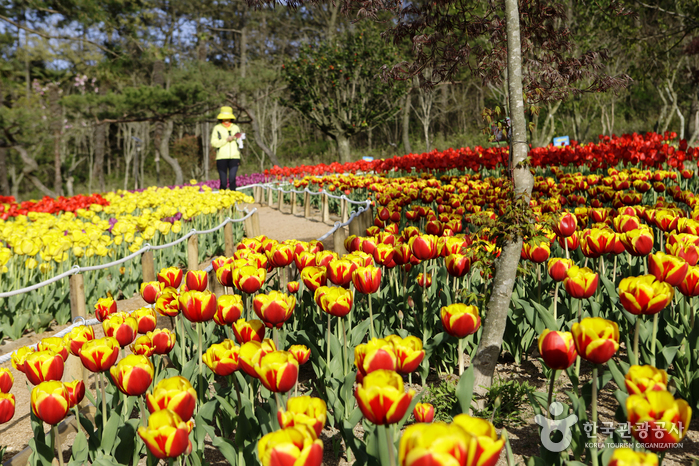
Haneulbit Arboretum is located on the foothill of Hamjibong (350m), at the boundary of Jangheung-eup and Yongsan-myeon, 8 km toward Cheongwan Mountain from Jangheung. It features an exquisite garden spanning about 10,000 pyeong and a dense forest area of approximately 2,000 pyeong composed of hinoki cypress and other trees, earning it the nickname 'Healing Forest.' The area around the ecological waterfall is especially splendid, with a fountain pond made using water flowing along the valley, where cool waterfall water flows, and visitors can see silky carp, trout, and sturgeon. Additionally, colorful tulips vividly decorate the arboretum in April and May. Facilities include an exquisite garden, wildflower area, hinoki forest, and cafeteria.
Hoeryeongjin Fortress (會寧鎭城) was constructed in April of the 21st year of King Seongjong's reign (1490) as a Manhojin Fortress (萬戶鎭城), serving as a naval fortress to eliminate Japanese pirates appearing in the South Sea. The exact time when Hoeryeongjin was first established is unknown, but records in the Sejong Sillok Jiriji confirm it was set up in early Joseon. Hoeryeongpojin was under the jurisdiction of Yeodo as the Jeolla Left Province Naval Manhojin alongside Naeye, Dolsan, Chukdu, Nokdo, Madu, Dallyang, and Eoran, each with assigned Manho officers, housing 4 medium ships, 4 special ships, 472 soldiers, and 4 boatmen. At that time, naval commanders routinely led warships for defense and reconnaissance, docking at designated ports called Yeong and Jin where provisions and military flags were stored. There were also unmanned warships that served as gathering points for reserve fleets in emergencies and functioned as naval operation harbors and supply bases. Thus, naval forces boarded the warships to defend against Japanese pirates at sea. In July of King Seongjong's 9th year (1478), there was discussion of building a dam between Eoran, Dallyang, Mado, and Hoeryeongpo, but it was never realized. Discussions about fortress construction for the various naval command posts occurred in October of the 15th year (1484). Hoeryeongpojin Fortress is an irregularly shaped fortress built using the village’s back mountain, currently protected externally by connected islands including Deokdo, Noryeokdo, Daemado, and the large and small Daegu Islands. Remaining fortress walls measure a total length of 616m. The east wall was built atop a sheer cliff but is now completely destroyed, with only ruins of the east gate near the Yunjoong Pil family house confirmed. The north wall currently stands 2.3m to 2.5m high, 1.5m to 2m wide, consisting of 150m of stone walls and 220m of newly built earth and stone walls.
Good places to stop and rest after the course

Booking and payment continue on a partner site.
Check rooms & priceSign up to feature your channel.
(As a member, you can add your Instagram, YouTube, and blog links in My Page, and we’ll show them with every comment you write.)
““Stayed near Hongdae and did a night café tour. Perfect city views and vibes.””
Guest comments do not display social media links or profile cards.
Share a short tip about this place.
Or leave a quick comment as a guest.
Photo attachments are available after login.
No reviews yet. Be the first to share your experience!