
Stories of Iksan from the Three Kingdoms to modern times in Jeonbuk Special Self-Governing Province Iksan City · schedule Other · distance 약 40km · 9 st…
Iksan is a gem that has embraced history from ancient times through the Three Kingdoms period to modern history. It features Mireuksaji Temple Site with many secrets, Seodong Park containing the legend of Baekje King Mu, the national treasure Wanggung-ri Five-story Stone Pagoda, and an artifact exhibition hall. Modern houses designated as registered cultural assets, such as the Ingok Cooperative Office, Chunpo History, and former Japanese farmhouses, are well preserved.
This course is a sample one-day itinerary. Save it as-is or expand it into an AI itinerary.
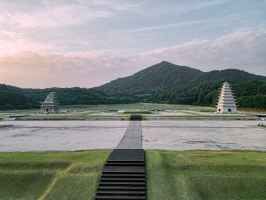
The founding of Mireuksa, the largest Buddhist temple complex of Baekje, is recorded in the Samguk Yusa. Ma Dong, who became King Mu (the 30th king of Baekje, 600–641) after marrying Princess Seonhwa of Silla, was on his way with her to visit the priest Jibyeom of Sajasa at Yonghwasan (present-day Mireuksan). Suddenly, the Three Bodhisattvas of Maitreya appeared from the pond, which led to the founding of Mireuksa. It is said that the shrine (Geumdang), pagoda, and Nangmu (Hwarang) were constructed for the Three Bodhisattvas. Another view suggests that in addition to the faith of King Mu and Princess Seonhwa, the founding of Mireuksa had political purposes, speculated to have been established in Geumma, a center of Mahan power, to expand Baekje’s national strength. The establishment of Mireuksa, Baekje’s largest temple complex, likely demonstrated the highest level of architectural and craft culture at the time. As recorded in Samguk Yusa, King Jinpyeong of Silla sent Baekgong to help, indicating that skills from the Three Kingdoms were combined. Mireuksa was clearly the focal point of Maitreya faith in Baekje Buddhism, contrasting with Hwangnyongsa of Silla, which centered on Huayan Thought and had one pagoda and three shrines. Mireuksa’s layout featured three pagodas and three shrines, embodying Maitreya Thought, while Hwangnyongsa embodied Huayan Thought centered on the king. Mireuksa’s Maitreya faith aimed to lead even common people to the Lotus World. * Additional relics at Mireuksaji: Mireuksaji Stone Pagoda and Dangganjiju * Mireuksaji contains two notable relics: the Stone Pagoda and the Dangganjiju (flagpole supports). The Mireuksaji Stone Pagoda, a National Treasure, is currently 14.24 meters tall, making it Korea’s tallest and largest stone pagoda. Although almost entirely collapsed, six tiers remain on the northeast corner, but it is estimated originally to have had nine tiers. Research by Wonkwang University’s Mahan Baekje Culture Research Institute in 1974–1975 revealed the eastern pagoda was stone, not wooden, confirming the so-called east-west twin pagoda layout. Excavations later verified nine tiers of the eastern pagoda, which was restored to nine tiers (27.67 m) in 1993. This pagoda is regarded as Korea’s finest because its style meticulously reproduces the wooden pagoda design in stone. Dangganjiju are the pillars built on either side of the flagpole to support it. The Mireuksaji Dangganjiju, designated a Treasure, stands 395 cm tall and is estimated to date before the mid-Unified Silla period. Two pillars stand about 90 meters apart facing each other east-west, south of the stone pagoda.
Seodong Park, located in Geumma-myeon, Iksan-si, was developed starting in 1990 as part of the Geumma Tourism Site project and opened in 2004 under the name Geumma Sculpture Park. It embraces the Geumma Reservoir, which resembles the Korean Peninsula, and along the reservoir, on a 40,000-pyeong area, there are a sculpture park and an observatory. Throughout the park, sculptures themed on Seodong and Seonhwa, the twelve zodiac statues, and other sculptural works are installed. Additionally, the park features a fountain with water height up to 5 meters, a lawn plaza, Mireuk Plaza, waterside plaza, and an outdoor stage, serving as a resting space for local residents. Every early May, the Iksan Seodong Festival, themed on the Seodong legend and Seodong song, is held at Seodong Park.
Ssangneung is a tomb located in Iksan, Jeonbuk Special Self-Governing Province, consisting of two tombs placed side by side along the north-south axis, hence the name Ssangneung. The internal structure is a Baekje late period stone chamber tomb (horizontal stone chamber tomb). The larger northern tomb is called Daewangmyo (Great King’s Tomb), and the smaller southern tomb is called Sowangmyo (Little King’s Tomb). Both tombs are circular tumuli with earthen mounds and no other decoration. When investigated in 1917, the tombs had already been looted, leaving no artifacts. Fortunately, remnants of a wooden coffin were found inside Daewangmyo, allowing accurate restoration. The coffin was slightly wider on the upper side than the bottom, with a rounded lid top. Lotus petal patterns with eight petals were also identified on the coffin handles. These two tombs were excavated in 1917 by Japanese scholar Yatsui Seiitsu, but accurate information was not recorded. Academic excavations aiming to clarify the structure and nature of the tombs were conducted in 2018 (Daewangneung) and 2019 (Sowangneung). The academic excavations confirmed that Daewangneung is a tomb of Baekje royalty from the Sabi period with an earth-packing tumulus technique. Notably, bone fragments previously unknown were discovered at the stone chamber’s end; detailed analysis suggested the bones’ age corresponded closely to King Mu’s death age, supporting that it is King Mu's tomb. While Sowangneung yielded no active materials, its stone chamber size and dignity indicate it is also a royal tomb.
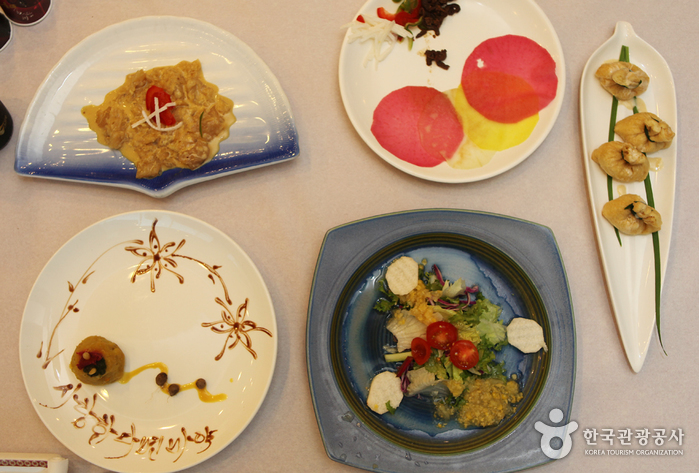
2002년 10월에 영업을 시작한 본향은 마요리 전문점 이다. 대한명인협회 서동마요리 명인으로 지정되어 있으며, 2007년 문화관광부선정 100대 음식으로 선정되기도 하였다. 본향에서는 모든 한정식에 마약밥을 제공하며, 한정식은 3인 기준으로 제공한다. 본향에서는 한정식 이외에 단품메뉴를 통해 다양한 메뉴를 제공하고 있다.
The Iksan Wanggung-ri Five-story Stone Pagoda is located about 2 km south of Wanggung-myeon, Iksan-si, Jeollabuk-do, known as the capital during the Mahan period. It features a five-story tower body raised above a single-tiered pedestal. The pedestal had been buried but was dismantled and restored in 1965 to its original form. At the pedestal's corners are octagonal foundation stones acting as pillars, with long rectangular stones interlocked in a zigzag pattern between them, faithfully reproducing the wooden pagoda style in stone. The spaces between the octagonal pillars and rectangular stones were filled with compacted earth, where Baekje period roof tile fragments were discovered. Excavation revealed two pillar carvings in the center of each pedestal side, and relic chambers were found inside the pedestal stone supporting the central pillar and under the first roof stone. Pillar motifs are carved at all four corners of the tower body from the first to fifth stories, with two additional pillar carvings in the middle of each side on the first story. The roof stones are thin and flat underneath, gently turned up at the four corners, with holes for bells. Each roof stone's upper surface has inserted stones to support the tower body. The finial decoration remains atop the fifth roof stone.
The Wanggung-ri Ruins located in Wanggung-myeon, Iksan-si, Jeonbukteukbyeoljachi-do were established during the reign of Baekje's 30th king, King Mu (600–641), and later transformed into a temple. It is understood as Wanggung, a political, economic, and cultural center during the late Baekje period's Iksan administration, regarded as a secondary capital alongside Sabi (Buyeo). The Baekje royal palace was built on a low hill at the end of a ridge originating from Yonghwa Mountain. Comprehensive excavations since 1989 revealed that the site was constructed as a late Baekje palace, used for a certain period, after which important palace buildings were dismantled and a complex site including a temple with a pagoda, Golden Hall, and lecture hall was established.
익산 구 익옥수리조합 사무실 및 창고는 2005년에 등록문화재로 지정되었다. 이 건물은 일본인 농장 지주들이 쌀 생산량을 늘리고자 창설한 익옥수리조합의 사무소이다. 토지 개량과 수리 사업을 명분으로 설립되어, 과다한 공사비와 수세(水稅)를 부담시켜 지역 농민을 몰락시키는 등 일제에 의한 우리나라 근대 농업 수탈의 역사를 증언하고 있다.
Iksan Chunpo Station is a historical building located in Deoksil-ri, Chunpo-myeon, Iksan-si, Jeonbuk Special Self-Governing Province. It was designated as a registered cultural heritage on November 11, 2005. Owned by Korea Railroad Corporation, Iksan Chunpo Station, built in 1914, is the oldest station building in Korea, a wooden structure with a slate-covered gable roof. Originally named Daejang Station (大場驛), it started as a regular station on the Jeolla Line connecting Iksan (then Iri) and Jeonju. Around that time, a Japanese immigrant village called 'Daejangchon' was formed nearby due to the establishment of a Japanese farm, and it was one of the stations frequently used by Japanese people. The name Daejang originated during the Japanese colonial period, using the characters for big (大) and yard (場) because the Japanese considered the fields wide. Later, in 1996, the station was renamed Chunpo Station and downgraded to an unmanned simple station managed by Samnye Station since 1997. Above the plaza-side entrance is a canopy, and the railroad side features a cross-shaped gable roof protrusion, similar to Gunsan Impi Station, making it a well-preserved example of a small-scale railway station typical of the Japanese colonial period, valued for both architectural and railroad historical significance. Keeping memories on the railroad, Chunpo Station in a quiet village on the Jeolla Line has disappeared into the back alleys of history. Though its railroad function has vanished, it now is recognized for its cultural heritage value. Chunpo Station vividly shows the painful history of the Japanese colonial era, where rice produced here was transported to Gunsan, and agricultural supplies came through the station. Though its past was splendid, its function as a station has disappeared.
The Iksan Chunpori Former Japanese Farmhouse is a two-story building constructed in the 1940s within a farm, with a building area of 106.78㎡ and a total floor area of 139.83㎡, built by joining wooden boards. The first floor has a near-square floor plan with rooms arranged along an ㄱ-shaped corridor, and the second floor features a balcony protruding outward for viewing the external scenery, giving the building a distinctive appearance. The building's roof is a hipped roof topped with Japanese-style roof tiles, and the exterior walls are treated with shingles. The first floor interior has been largely remodeled, with tatami rooms replaced by ondol heating and partition walls removed. However, the second floor retains a large room with tatami flooring, half-steps, and tokonoma, preserving its original form.
Good places to stop and rest after the course

Booking and payment continue on a partner site.
Check rooms & price
Booking and payment continue on a partner site.
Check rooms & price
Booking and payment continue on a partner site.
Check rooms & price
Booking and payment continue on a partner site.
Check rooms & price
Booking and payment continue on a partner site.
Check rooms & priceSign up to feature your channel.
(As a member, you can add your Instagram, YouTube, and blog links in My Page, and we’ll show them with every comment you write.)
““Stayed near Hongdae and did a night café tour. Perfect city views and vibes.””
Guest comments do not display social media links or profile cards.
Share a short tip about this place.
Or leave a quick comment as a guest.
Photo attachments are available after login.
No reviews yet. Be the first to share your experience!
![Iksan Mireuksaji [UNESCO World Heritage] 1](https://tong.visitkorea.or.kr/cms/resource/58/3533758_image2_1.jpg)
![Iksan Mireuksaji [UNESCO World Heritage] 2](https://tong.visitkorea.or.kr/cms/resource/59/3533759_image2_1.jpg)
![Iksan Mireuksaji [UNESCO World Heritage] 3](https://tong.visitkorea.or.kr/cms/resource/60/3533760_image2_1.jpg)
![Iksan Mireuksaji [UNESCO World Heritage] 4](https://tong.visitkorea.or.kr/cms/resource/61/3533761_image2_1.jpg)




![Iksan Wanggung-ri Ruins [UNESCO World Heritage] 1](https://tong.visitkorea.or.kr/cms/resource/24/3564124_image2_1.jpg)
![Iksan Wanggung-ri Ruins [UNESCO World Heritage] 2](https://tong.visitkorea.or.kr/cms/resource/25/3564125_image2_1.jpg)
![Iksan Wanggung-ri Ruins [UNESCO World Heritage] 3](https://tong.visitkorea.or.kr/cms/resource/26/3564126_image2_1.jpg)
![Iksan Wanggung-ri Ruins [UNESCO World Heritage] 4](https://tong.visitkorea.or.kr/cms/resource/28/3564128_image2_1.jpg)


