Walking Hwarimdong Valley in Hamyang, Land of Scholars in Gyeongsangnam-do Hamyang-gun · schedule Other · distance 44.6km · 5 stops · highlights Gaepyeo…

Hamyang, along with Andong, is a representative noble district of Gyeongsang-do. It is the hometown of Jeompiljae Kim Jong-jik, where you can also visit his grave and seowon (Confucian academies). True to its noble heritage, there is Hwarimdong Valley along the road over Yuksipryeong, where pavilions remain that scholars have enjoyed composing poetry and strolling in since ancient times. It is developed as a scholar culture exploration route, making it pleasant to take a walk following the valley and the pavilions.
This course is a sample one-day itinerary. Save it as-is or expand it into an AI itinerary.
Located in the center of Hamyang, Gaepyeong Hanok Village is a representative scholarly village of the Yeongnam region, known for producing many Confucian scholars and called the left Andrung and right Hamyang. It is the hometown of Jeong Yeo-chang, one of the five great Confucian scholars of the Joseon Dynasty. The village consists of three long-rooted families: Hadong Jeong, Pungcheon No, and Chogye Jeong, and has produced historically prominent scholars such as Jeong Yeo-chang and No Jin of Okgae. Gaepyeong Village has many traditional houses designated as cultural assets, including Ildu Old House (National Folk Cultural Heritage), Gyosujeong Pavilion (Gyeongsangnam-do Cultural Heritage Material) where ancestors enjoyed literature and arts, and Gaepyeong-ri Pine Cluster (Gyeongsangnam-do Natural Heritage), the meditation site of Ildu. These sites provide valuable cultural resources reflecting the ancestors' living customs and hold significant value as folk materials.
Hamyang Namgye Seowon was established in 1552 (the 7th year of Myeongjong) by Gaeam Kang Ik to restore the Daoist heart of loving others as oneself (Confucian education) and to honor the scholarly virtues of Ildu Jeong Yeo-chang. In 1566 (the 21st year of Myeongjong), it was granted the name 'Namgye.' It was burned down during the Jeongyu War in 1597 but was relocated to Nachon in 1603 (the 36th year of Seonjo), then rebuilt at its current site in 1612 (the 4th year of Gwanghaegun). Namgye Seowon utilized the topographical features with a unique layout of front academic space and rear ritual space, establishing a standard for seowon architecture known as jeonhak-hu-myo, which became a model for later seowons. Hamyang Namgye Seowon is one of 47 seowons that survived the 1868 seowon abolition decree by Heungseon Daewon-gun and the only remaining seowon in Gyeongnam. It was inscribed as a UNESCO World Heritage site in 2019.
Gibaeksan Yongchu Valley was known in the old Anui-hyeon as one of three magnificent scenic spots called 'Anui Samdong.' Among them, Yongchu Valley is also called 'Simjindong,' meaning 'a place immersed in the truth as a result of the deep valley’s beauty.' At the entrance of Yongchu Valley is the pavilion Simwonjeong, considered the essence of Simjindong, along with Cheongsindam, a clear pond, and a layered granite rock formation spread out at once. About 3 km beyond Simwonjeong lies Jangsu Temple's Jogye Gate (Iljumun) standing alone behind a large parking lot. Founded by monk Gakyeon in the 9th year of King Soji of Silla, Jangsu Temple was destroyed in the Korean War leaving only the Iljumun, and has not been restored. Further up from Iljumun is Yongchu Temple, in front of which is Yongchu Waterfall, where the thunderous sound of water can be heard. At the end of Yongchu Valley is the Yongchu Natural Recreation Forest created by Hamyang County, equipped with charming mountain huts, a large parking lot, a water play area, and an observatory. Hiking trails are established here to climb Gibaeksan and Hwangseoksan, ridges of Namdeogyusan.
Ani Original Galbi Restaurant has been in operation since 1962, maintaining its reputation as a premium Korean beef galbi restaurant. It is designated as a regional specialty restaurant by Hamyang-gun. The menu consists of only two items: galbijjim (braised short ribs) and galbitang (short rib soup). This reputable galbi restaurant has long prepared galbijjim in the Anui area. The galbitang, seasoned with traditionally brewed soy sauce made in-house, is one of the establishment's longstanding menu items.
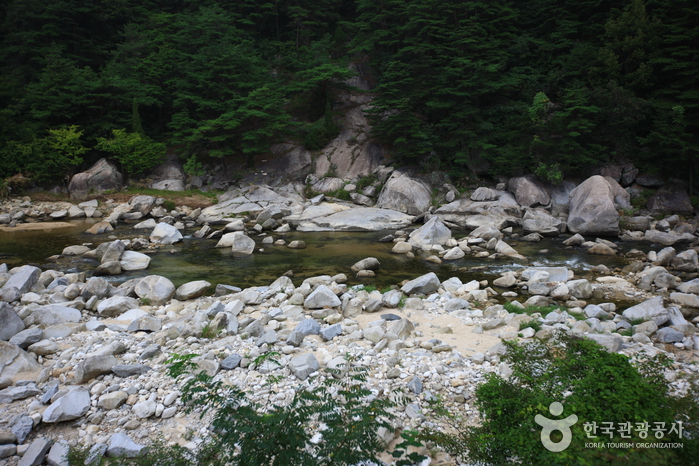
Hwarimdong Valley extends for 60 ri (15 km), where Geumcheon (upper stream of Namgang), originating from Namdeoksan Mountain at an elevation of 1,508 meters, flows from Seosang to Seoha. Along the stream, it forms remarkable rocks and pools, and at Nongwoljeong, the flowing jade waters over the rock slabs blend with pine trees to create a landscape like a utopia. Known as a mecca of Korea's pavilion culture, the valley features numerous pavilions and bizarre rock formations scattered across a wide rock bed. Nongwoljeong is where Master Park Myeong-bu from this region, who passed the civil service exam during the Joseon Seonjo era, served as Vice Minister of Rites, raised militia troops during the Imjin War, and held poetry gatherings while fishing over time. The area around Nongwoljeong has been developed by Hamyang-gun into a national tourism complex welcoming visitors.
Good places to stop and rest after the course

Booking and payment continue on a partner site.
Check rooms & price
Booking and payment continue on a partner site.
Check rooms & priceSign up to feature your channel.
(As a member, you can add your Instagram, YouTube, and blog links in My Page, and we’ll show them with every comment you write.)
““Stayed near Hongdae and did a night café tour. Perfect city views and vibes.””
Guest comments do not display social media links or profile cards.
Share a short tip about this place.
Or leave a quick comment as a guest.
Photo attachments are available after login.
No reviews yet. Be the first to share your experience!


![Namgye Seowon [UNESCO World Heritage] 1](https://tong.visitkorea.or.kr/cms/resource/27/3538327_image2_1.jpg)
![Namgye Seowon [UNESCO World Heritage] 2](https://tong.visitkorea.or.kr/cms/resource/28/3538328_image2_1.jpg)
![Namgye Seowon [UNESCO World Heritage] 3](https://tong.visitkorea.or.kr/cms/resource/29/3538329_image2_1.jpg)
![Namgye Seowon [UNESCO World Heritage] 4](https://tong.visitkorea.or.kr/cms/resource/30/3538330_image2_1.jpg)