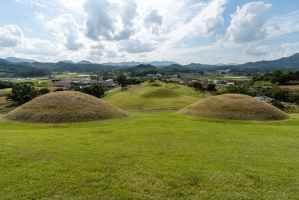
A Time Capsule of Ara Gaya History in Gyeongsangnam-do Haman County · schedule Other · distance 18.5km · 5 stops · highlights 함안박물관, Haman Maryisan Tumu…
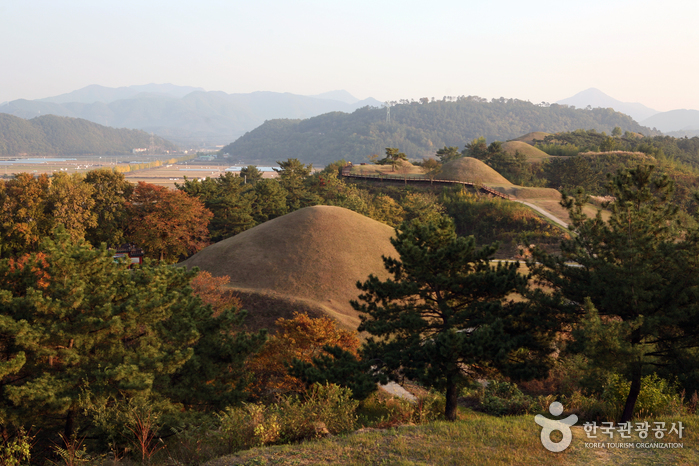
Because Haman is an unfamiliar travel destination, the Maeyisan Burial Mounds are also extremely unfamiliar. The Maeyisan Burial Mounds are relics of Aragay, which, along with Geumgwan Gaya, represent Gaya culture. When thinking of Gaya culture, Gimhae or Goryeong usually come to mind first, but the Maeyisan Burial Mounds in Haman are an open-air museum that can rival the burial mounds of Gyeongju.
This course is a sample one-day itinerary. Save it as-is or expand it into an AI itinerary.
함안박물관은 아라가야의 말이산고분군(사적 제515호)을 배경으로 조성되어 있는 함안군립의 박물관이다. 국내에서 처음으로 출토된 말갑옷을 비롯하여 불꽃무늬토기, 수레바퀴모양토기, 새모양이 붙은 미늘쇠 등 가야시대의 각종 유물들이 전시되어 있어 아라가야의 역사와 우수한 문화를 한눈에 살펴볼 수 있다. 이외에도 성산산성 목간, 도천재 단서죽백, 영종대왕국휼복상도 등 함안지역의 각종 문화재들이 함께 전시되고 있으며, 야외에는 700년 만에 꽃을 피운 아라홍련 연못과 고인돌 공원이 조성되어 있어 색다른 볼거리를 제공하고 있다.
The Haman Maryisan Tumuli Cluster was managed as Dohang-ri Tumuli Cluster (Historic Site No. 84) and Malsan-ri Tumuli Cluster (Historic Site No. 85), but based on excavation results, the tombs of the same era were integrated and redesignated as Historic Site No. 515 on July 28, 2011. It boasts one of the largest scales among Gaya period tumulus sites, located in Dohang and Malsan-ri areas of Gaya-eup, which was the capital of Ara Gaya, and vividly shows the splendid Gaya culture. About 100 large tumuli, believed to be the tombs of Ara Gaya kings, are aligned on a high place, with around 1,000 medium and small tumuli distributed below. The cluster was first investigated during the Japanese colonial period; the then No. 34 tumulus was the largest royal tomb with a mound diameter of 39.3m and height of 9.7m. Recently, horse armor similar to those depicted in Goguryeo tomb murals was excavated from Magap-chong at the northern end of the cluster, and No. 8 tumulus, where the skeletal remains of five sacrificed attendants were confirmed, became more famous through investigation.
Mujinjeong is a pavilion built on a hill to enjoy elegant leisure activities. This pavilion was established by the descendants of Mu Jin (無盡), Jo Sam (趙參), in the 22nd year of King Myeongjong of Joseon (1567) to commemorate his virtue, and it was named Mujinjeong after his pen name. Mu Jin passed the jin-sa exam in the 14th year of King Seongjong (1483) and passed the civil service exam in the 2nd year of King Jungjong (1507). He served as a magistrate of Hamyang, Changwon, Daegu, Seongju, and Sangju, and held positions such as Jipui (執義) of Saheonbu (司憲府) and editor of Chunghugwan (春秋館). Every year, the Haman Nakwhanoori, a traditional folk game unique to Haman, is held around Mujinjeong to pray for the people's well-being. The Haman Nakwhanoori is a fireworks display where fireworks made of oak charcoal powder are hung between lanterns, ignited, and scattered over the water like pollen. *Shape and Structure of Mujinjeong* The building has three bays in the front and two bays on the side with a hipped-and-gabled roof resembling the shape of the number eight on the sides. The middle bay on the front is a wooden-floored room (not an ondol heated room), and the pavilion floor is entirely raised in the manner of a wooden floor. The pillars have no decorations or carvings, making the building simple and unadorned, exemplifying the pavilion style of early Joseon. The current building was reconstructed in April 1929, maintaining the simple, unadorned eight-shaped hipped roof style, showing the early Joseon pavilion form as is. It has three bays front and two bays side, with extended eaves front and back, and a heated ondol room arranged in the central one bay.
In the old Haman marketplace, there is Gukchon Village that specializes in Gyeongsang-style beef soup with rice. This place has been operated by two generations for over 40 years. Its distinctive feature is the inclusion of a small amount of seonji (blood curd), with broth made from beef leg bones, brisket, shank, innards, and round cut. Radish, bean sprouts, and green onions blend in, creating an umami flavor typical of the original Gyeongsang-style beef soup house. The softness of boiled pork dipped lightly in soy sauce with chili is also a special dish here.
Located at San 122, Seochon-ri, Daesan-myeon, Haman-gun, Akyangru is a pavilion on a cliff north of Akyang village, said to have been built in 1857 (the 8th year of King Cheoljong's reign of Joseon). Akyangru (岳陽樓) is situated in a place with an excellent view, with the Namgang River flowing below the pavilion and broad fields along with the embankment of Beopsu-myeon stretching ahead. The pavilion's name is said to be taken from the famous Chinese scenic spot 'Akyang.' In the past, there was a signboard called 'Giduhon (倚斗軒),' but now only the 'Akyangru' signboard written by Cheongnam O Jaebong (菁南 吳濟峰) remains. It was designated as a cultural asset on October 21, 1992. At the entrance of Akyangru, there is a monument for the song 'Virgin Boatman.' The pavilion was restored after the Korean War and repaired in 1963, remaining until today. The building has 3 bays at the front and 2 bays at the side, with a roof shaped like the Korean traditional paljakjibung (hip-and-gable roof) forming an eight-character (팔) shape from the side view.
Sign up to feature your channel.
(As a member, you can add your Instagram, YouTube, and blog links in My Page, and we’ll show them with every comment you write.)
““Stayed near Hongdae and did a night café tour. Perfect city views and vibes.””
Guest comments do not display social media links or profile cards.
Share a short tip about this place.
Or leave a quick comment as a guest.
Photo attachments are available after login.
No reviews yet. Be the first to share your experience!