
Hadong, Tender Tea Leaves and Seomjin River Spring Clams in Gyeongsangnam-do Hadong-gun · schedule Other · distance 약 38.3km · 4 stops · highlights Beot…
Enjoy a gourmet trip that revitalizes both body and mind by discovering the natural flavors offered by Seomjingang River and Jirisan Mountain.
This course is a sample 2-day itinerary. Save it as-is or expand it into an AI itinerary.
Beotgul Restaurant, located in Gojun-myeon, Hadong-gun, operates only during the period from February to the end of April when the cherry blossoms bloom, as this is when the Beotgul oysters taste the best. Therefore, it is recommended to call ahead and confirm before visiting. Beotgul oysters grow not in salty sea water but at the point where freshwater and seawater meet, making them less salty, sweet in flavor, and about five times larger than regular oysters. The main dishes are grilled Beotgul and steamed Beotgul, and they also serve Beotgul jeon, jaecheop hoe muchim (seasoned small freshwater clams), and jaecheop guk (clam soup). The plum makgeolli, made from makgeolli brought from a nearby brewery mixed with homemade plum syrup, pairs well with the dishes. Oysters are prepared on the spot for convenient eating. Grilling them whole on the shell over charcoal in a kiln and eating with chojang (spicy dipping sauce) or aged kimchi offers an exquisite taste.
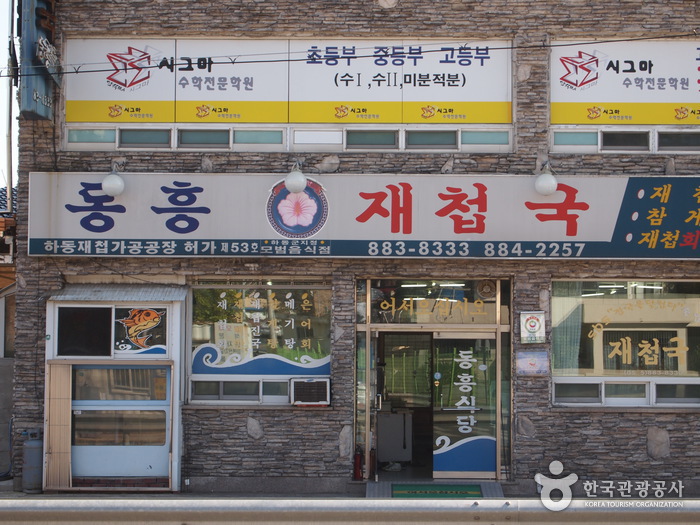
This is a jacheop-guk (freshwater clam soup) specialty restaurant located about 3 minutes towards Hwagae near Hadong Police Station on a main city street. Jaecheop is known as a popular hangover soup because it activates liver function, relieves fatigue, and restores vitality. The owner, who has 11 years of cooking experience, personally prepares the dishes using only natural jaecheop from the Seomjin River, resulting in excellent taste. The jaecheop soup flavored with natural buchu (wild chive) from the foothills of Jirisan is fragrant and rich, while the raw jaecheop mixed with spicy vinegar sauce and various vegetables is wonderfully sweet, sour, and chewy. A large framed photo depicting jaecheop harvesting in front of the Seomjin River adds visual interest.
Hwage Jangteo, famous as the setting of Kim Dong-ri's novel 'Yeokma,' is located at the border between Yeongnam and Honam regions. It was a hub for distributing seafood and salt from the southern coast, fertile grains from the Honam plains, mountain vegetables and woodenware from the Jirisan mountain area, through the developed waterways of Hadong port. From the mid-Joseon Dynasty to before liberation, it prospered as one of the nation's notable markets. However, with the development of transportation and distribution systems, it declined, disappearing its old appearance. Hwage Jangteo was a traditional market held at the confluence of the Hwage Stream, originating from Jirisan, and the Seomjin River, where a five-day market thrived. Recently, it operates as a permanent market without a separate five-day market. To meet the expectations of visitors drawn by Cho Young-nam's song 'Hwage Jangteo' and restore its traditional atmosphere, a project investing 1.6 billion won on about 2,540 pyeong was undertaken to build traditional market buildings and a green tea specialty mall with convenience facilities. It opened on April 5, 2001, with the 9th Hwage Jangteo Cherry Blossom Festival, operating as a permanent market.
Located near Hwagae Market in Hwagae-myeon, Hadong-gun, Ssanggyemyeongcha operates a direct-managed tea garden and its own farm covering approximately 132,200㎡, cultivating eco-friendly pesticide-free green tea and over 150 types of wild mountain teas. Its signature products include various infusion teas and solid teas officially designated in 2023 as recognized products of the Hadong World Tea Expo, as well as handmade signature teas (Ujeon, Jakseol, Cheongohyang). A variety of simple desserts and rich green tea ice cream are also available. The building, which won the gold prize in the Gyeongsangnam-do Architecture Awards, features a modern and clean interior; on the left are tables for tea drinking, and on the right, various teas and tea utensils are sold. The spacious staircase seating connecting the first and second floors is popular among visitors. The second floor houses a tea museum exhibiting various tea-related artifacts. With 40 years of tradition, Ssanggyemyeongcha contributes to popularizing the wild tea of Jirisan and strives to promote its excellence worldwide.
Sign up to feature your channel.
(As a member, you can add your Instagram, YouTube, and blog links in My Page, and we’ll show them with every comment you write.)
““Stayed near Hongdae and did a night café tour. Perfect city views and vibes.””
Guest comments do not display social media links or profile cards.
Share a short tip about this place.
Or leave a quick comment as a guest.
Photo attachments are available after login.
No reviews yet. Be the first to share your experience!


