
Haeporang Trail in Gyeongsangbuk-do Gyeongju · schedule 3+ nights · distance 77.7km · 7 stops · highlights Gyeongju Munmu Daewang Tomb, Gyeongju Gameuns…
The Haeparang Trail is the longest walking trail in South Korea, with a total length of 750km starting from Oryukdo in Busan. This course covers the section through Gyeongju, Pohang, and Yeongdeok. You can visit Munmu Daewang Tomb, Gameun Temple Site, and Igyundae in Gyeongju. The course also includes Yangpo Port, Janggi Eupseong, Malmok Jangseong in Pohang, and Goesiri Traditional Village in Yeongdeok.
This course is a sample 4-day itinerary. Save it as-is or expand it into an AI itinerary.
This is the underwater tomb of Munmu the Great, the 30th king of Silla (reigned 661–681), offering insight into the creative thoughts of the Silla people. It is located 200m offshore from Bonggil-ri in the East Sea and is exposed above sea level about 35m east-west, 36m north-south, and 5.3m high. Munmu continued the achievements of his father, King Taejong Muyeol, defeated Goguryeo, repelled Tang invasions, and achieved the unification of the Three Kingdoms. He also established central government offices such as the Ministry of War and the Ministry of Stores, laid the foundation for local governance with the five small administrative units and the military system of nine seodang and ten jeong. Having unified the Three Kingdoms, Munmu wished to become a dragon to protect the kingdom against invading Japanese pirates, ordering his body to be cremated in Buddhist rites and his ashes to be buried in the East Sea. This rock is called Daewangam or Daewang Rock, and an underwater royal tomb like this is unparalleled worldwide. Daewangam was made using natural rock; artificial waterways in a cross shape were created east-west and north-south on the rock island, with a small pond-like harbor in the center. A flat turtle-shaped stone measuring 3.7m long, 2.06m wide, and 0.9m thick is placed two meters underwater, believed to house his ashes underneath. His son, King Sinmun, built Gameunsa Temple near the East Sea, designing a drainage channel beneath the Dharma Hall facing the sea to allow the dragon-turned Munmu to travel.
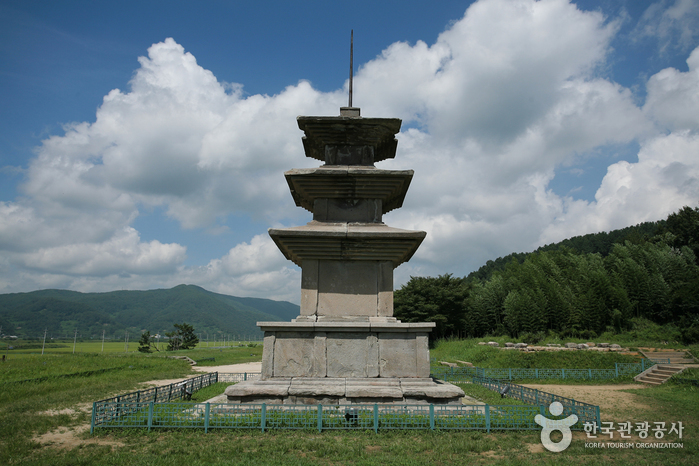
Gameunsa Temple is a Unified Silla period temple located on the east coast, established by King Munmu of Silla after unifying the Three Kingdoms to invoke the power of Buddha to repel Wako invasions. Before the temple was completed, King Munmu died, and his son, King Sinmun, completed it in 682, continuing his father's will. Before his death, King Munmu wished to become a sea dragon to protect the country and requested his cremation and burial in the East Sea. His tomb is at Daewangam, and King Sinmun named the temple Gameunsa to express gratitude for his father's grace. Currently, only two three-story stone pagodas, the main hall site, and lecture hall site remain. Along with Hwangnyongsa and Sacheonwangsa, it was a national protective temple, but the timing of its ruin is unknown. The current state of Gameunsaji was exposed and restored based on the foundational structures through a full excavation from 1979 to 1981. Additionally, a symbolic passage allowing East Sea water to enter under the main hall was created, representing King Munmu’s transformation into a sea dragon to rest. The two soaring three-story stone pagodas, symbolizing Gameunsaji, are early Unified Silla pagodas assembled from dozens of parts and are the largest stone pagodas in Korea.
There are two significant places to observe Daewangam meaningfully. One is Igyeondae in front of Daebon Elementary School, and the other is the site under the Donghaegu (East Sea Entrance) marker stone where the monument 'My Unforgettable Sea' stands. Igyeondae is the historic site where King Munmu, who refused lavish tombs and vowed to protect the country as a dragon of the East Sea, showed his transformed dragon form. His son, King Sinmun, obtained the priceless treasure Manpasikjeok here. The name Igyeondae is taken from the I Ching phrase 'The flying dragon is in the sky; it is beneficial to see the great man (飛龍在天 利見大人).' The current building was newly constructed based on the foundation stones revealed during the 1970 excavation. Descending below the Donghaegu marker, visitors see the monument 'My Unforgettable Sea,' erected in 1985 by the disciples of scholar Go Yu-seop to honor his anti-Japanese resolve. This monument and Go's poem 'Daewangam' stand side by side at a spot overlooking Daewangam, underscoring the significance of King Munmu's national defense will against Japanese invasion attempts justified under the pretext of Japan-Korea Unity during the Japanese colonial period, reflecting resistance dating back to the Unified Silla dynasty.
Yangpo Port is a fishing port located in Nam-gu, Pohang-si, Gyeongbuk. Many people enjoy fishing around the port where fishing boats are docked and on the breakwater. Additionally, Yangpo Port regularly operates fishing boats for outings, making it a popular spot among fishing enthusiasts. The main fish species in Yangpo Port are flatfish, yellowtail, greenling, and octopus. Surrounding Yangpo Port, there are fishing supply stores, supermarkets, restaurants, and pensions. Moving north from Yangpo Port, you will find Guryongpo Port, Guryongpo Beach, and Homigot Sunrise Square in order. Also, heading south leads to several beaches around Gampo in Gyeongju, making combined sightseeing convenient.
Located in Eupnae-ri, Janggi-myeon, Nam-gu, Pohang-si, Janggi Eupseong Fortress sits on a ridge extending east from Dongaksan, the prominent mountain of the area. Below the ridge, Janggicheon flows east to the sea, forming the Hyeonnae field. Built as an earthen fortress in 1011 (2nd year of King Hyeonjong of Goryeo) to defend against Jurchen coastal invasions, it was rebuilt in stone in 1439 (21st year of King Sejong) during the Joseon Dynasty to guard against Japanese pirate invasions and used as a military base. The harsh Japanese occupation led to the destruction of all official buildings inside the fortress, leaving only the sites of the east, west, and north gates; one water gate; twelve bulwarks; four wells; and three ponds, allowing the original fortress layout to be inferred. Only the hyanggyo (local Confucian school) has been restored and maintained by local residents, and the collapsed walls are under restoration (as of August 2023). Eupseong refers to fortifications surrounding local government offices and residential areas. According to historical records such as Sinjeung Dongguk Yeoji Seungnam, the fortress was about 2,980 cheok (approx. 1,392m) in circumference and 10 cheok tall, with four wells and two ponds inside; these dimensions closely match the remaining fortress today. Constructed as a mountain fortress eupseong, it is a rare example in Korea and is highly valued as a well-preserved site for eupseong research.
The Guryongpo Malmok Jangseong Trail was created in 2009 by the Guryongpo-eup office by excavating approximately 4 km of stone walls and turning it into a walking path. At the summit, 205 meters above sea level, a two-story observatory is installed, offering a panoramic view of the beautiful coastal village of Guryongpo and the ridge of the Homigot Peninsula in the Taebaek Mountains. Near the summit, azaleas and chrysanthemum flowers have been planted to provide visitors with more diverse sights. The stone fortress of Malmokjang refers to a stone fence where horses were raised. Although the exact construction period is unknown, various records, including the Samguk Yusa, suggest that the history of Malmokjang dates back about 1,400 years. Originally, it was built to extend about 8 km from Guryongpo to Heunghwan-ri in Nam-gu, but currently, 5.6 km remains. A sixth-rank official managed the ranch, and it is said that ranch workers lived here, handling chores such as cleaning animal waste.
About 800m northeast from the Yeonghae-myeon office, there is Goesiri Village, the birthplace of the great scholar of the late Goryeo period, Mogeun Lee Saek, and a village surrounded by traditional Joseon Dynasty houses. Its original name was Hojichon, but after Mogeun Lee Saek returned from a mission to China and said his hometown resembled Guishi in China, the name Goesiri was established, though some still call it Hojigol, Hojimaeul, or Hojichon. Goesiri Traditional Village is a Yeongyang Nam clan village where they have lived for over 400 years, shaped like the character for 'palja,' with the vast Yeonghae Plain spreading out in front. The remaining old houses, all built over 200 years ago, feature the four-sided style with sarangchae facing the courtyard and anchae hidden behind, completely separating inside and outside, representing aristocratic architectural design. Among the houses, four Gyeongsangbuk-do folk cultural properties—Goejeong, Yeonghae Gugyedaek, Yeonghae Jugokdaek, and Mulsowa Seodang—along with 12 cultural asset materials, about 30 traditional houses, and the village scenery are well preserved. Walking among the old houses connected by low walls, you can see well-maintained gardens, the harmony of old houses and modern life, and also experience staying in a Hanok stay.
Good places to stop and rest after the course

Booking and payment continue on a partner site.
Check rooms & price
Booking and payment continue on a partner site.
Check rooms & price
Booking and payment continue on a partner site.
Check rooms & priceSign up to feature your channel.
(As a member, you can add your Instagram, YouTube, and blog links in My Page, and we’ll show them with every comment you write.)
““Stayed near Hongdae and did a night café tour. Perfect city views and vibes.””
Guest comments do not display social media links or profile cards.
Share a short tip about this place.
Or leave a quick comment as a guest.
Photo attachments are available after login.
No reviews yet. Be the first to share your experience!


