Going to the King in Gyeongsangbuk-do Gyeongju · schedule Other · distance 10.3km · 7 stops · highlights Tomb of King Muyeol of Gyeongju, Stele of King…

When you enter the Gyeongju National Museum, you will see a large bell. It is the Emille Bell of King Seongdeok, made by King Gyeongdeok to honor his father. It is a great course to see Silla's golden cultural heritage, and if you pay attention to the stories contained in each historic site, it will be a meaningful experiential trip.
This course is a sample one-day itinerary. Save it as-is or expand it into an AI itinerary.
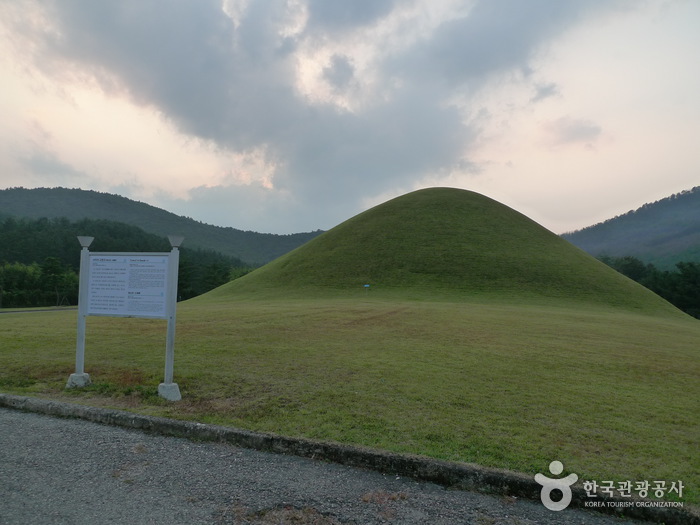
The Tomb of King Muyeol of Gyeongju is the burial site of King Taejong Muyeol (reign 654–661, Kim Chun-chu), the 29th king of Silla. It is located at the southern end of a hill extending from Seondosan (仙桃山) to the northwest of Gyeongju. Kim Chun-chu was the first true bone (jingol) king of mid-Silla, who allied with Tang to conquer Baekje and laid the foundation for the unification of the Three Kingdoms, though he died before completing unification. The tomb is relatively large, with a circumference of 114 meters and a height of 8.7 meters. Natural stones support the lower part of the tomb, with large stones placed at intervals, now buried in soil. To the east remain the stone turtle pedestal and headstone for the stele inscribed with the calligraphy of Kim Inmun, King Muyeol’s second son, titled 'Stele of King Taejong Muyeol,' confirming this as King Muyeol’s tomb.
국립경주박물관은 신라 천년의 문화를 간직한 보고로서 많은 사랑과 깊은 관심과 성원을 받아왔다. 최근 박물관은 미술관 개관, 고고관 및 월지관 그리고 특별전시관을 새롭게 단장하여, 전시환경을 일신하였다. 신라문화의 보존·전시·조사·연구를 수행하는 핵심 문화센터로서 앞으로 다양한 기획전시와 국제교류사업 및 사회교육프로그램을 추진하여 동아시아의 중추적인 문화 복합기관으로 도약하고자 한다.
This place was built as the royal fortress of Silla in 101 AD, in the 22nd year of King Pasa, and served as a palace until Silla fell in 935 AD. The terrain resembles a crescent moon, hence it was called 'Sinwolseong (New Moon Fortress)' or simply 'Wolseong (Moon Fortress)', and also named 'Jaeseong' meaning the fortress where the king lived. From the Joseon Dynasty, it has been known as Banwolseong (Half Moon Fortress) to the present. The fortress is a soil and stone rampart, 1,841 meters long, covering an area of 193,585㎡. To the east, it connects to Donggung and Wolji; to the north is Cheomseongdae, and to the south the Namcheon stream serves as a defense line. Records mention gates named Nammun, Guijeongmun, Bukmun, Inhwamun, Hyeondeokmun, Mupyeongmun, Jonlyemun, and Imhaemun; pavilions including Wolsangnu, Mangdeoknu, Myeonghaknu, Goru; halls such as Jowonjeon, Sungryejeon, Pyeonguijeon, Namdang, Woljeongdang, Usa Rogwan, Jwa Sarokgwan, Yeonggakseong; and palaces including Naeseong, Yeongmyeonggung, Woljigung, Yeongchanggung, Donggung, and Naehwangjeon. Beneath Wolseong, artifacts from the Bronze Age Mokmun pottery to Unified Silla pottery, roof tiles, and building foundation stones are found. Before the fortress was built, a person named Hoegong lived here. Legend says that when King Seok Talhae was young, he cleverly seized this place, and Namhae King, hearing this, made Seok Talhae his son-in-law; Seok Talhae became the 4th king of Silla. From the 22nd year of King Pasa (101 AD), the fortress was built and the royal residence moved here, with successive kings living in Wolseong thereafter.
This forest is located between Cheomseongdae and Wolseong, and it is a historic place with a legend that Alji, the progenitor of the Gyeongju Kim clan, was born here. During the reign of King Talhae of Silla, Hoegong heard a rooster crowing in this forest and found a golden box glowing on a tree branch. He reported this to the king, who personally came and lowered the box. When the lid was opened, a baby boy appeared, so he was named Kim Alji and the forest, originally called Sirim or Gurim, was renamed Gyerim. Gyerim was also used as a national name for Silla. The spacious forest is densely filled with old trees such as zelkovas, and a small stream flows from north to west. Although the king made Alji crown prince, the throne later passed to King Pasa of the Park clan, and Alji did not become king. From King Naemul's generation, the Kim clan became the royal family of Silla. Within the area stands a monument erected in 1803 during King Sunjo's reign that records Kim Alji's birth. As a sacred forest near the Silla royal palace, it is revered as the birthplace of the Silla Kim royal family, and even now, royal paulownias and zelkovas shade the sky. Along the trail connecting Daereungwon, Gyerim, and Banwolseong, yellow rapeseed flowers bloom in spring, adding to the charm of the historic site.
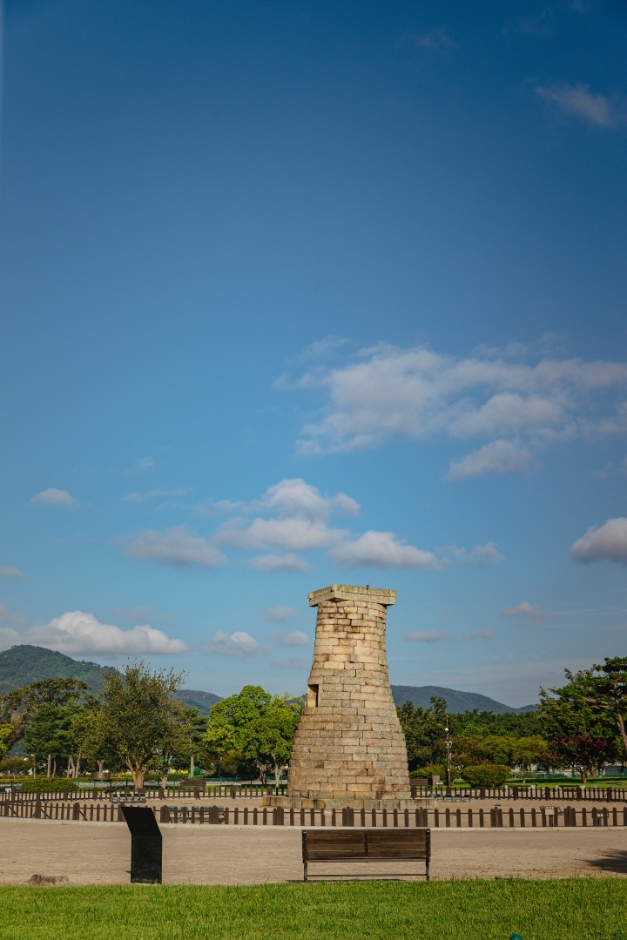
Cheomseongdae is estimated to have been built during the reign of Queen Seondeok, the 27th ruler of Silla, and is one of the landmarks symbolizing Gyeongju. It stands about 9 meters tall and features a base foundation supporting a cylindrical body shaped like a bottle, topped with a well-shaped (井) peak. The cylindrical section is built with 27 layers of fan-shaped stones. A window facing southeast has a lower part filled with rough stones and an upper part hollowed out up to the peak. The eastern half of the peak, sealed with a board, has long stones interlocking in the shape of the well (井) character, with ends protruding outside. Similar features appear on the 19th-20th and 25th-26th layers, suggesting the use of internal ladders. Historical records state, "People are meant to climb through the center," indicating that ladders were placed outside to enter through the window and climb up for astronomical observation. Each stone of Cheomseongdae holds symbolic meaning: its round upper and square lower shapes represent heaven and earth. The approximately 365 stones symbolize the days of the year; the 27 stone layers refer to Queen Seondeok, the 27th ruler; including the peak yields 29 or 30 layers, symbolizing the lunar month's days. The 12 layers above and below the central window represent the 12 months and 24 solar terms of the year. Cheomseongdae was used to calculate celestial movements to determine farming seasons and also to predict the nation's fortune. ◎ Travel information to experience the charm of Korean Wave - The drama features Cheomseongdae, a landmark representing Gyeongju and the world's oldest astronomical observatory, where characters Bogyum and Jia, linked by a special past, crossed paths. Besides its high historical value, the site attracts many visitors for seasonal flowers and plants, ideal for outings.
Cheonmachong, located in Daereungwon in Gyeongju, is a pre-unification Silla tomb estimated to have been built in the late 5th to early 6th century. Excavated in 1973, it features the unique Silla stone chamber tomb style. The tomb measures 12.7m in height and 50m in diameter, with a stone layer built with river stones inside the mound. Inside the stone layer is a wooden chamber measuring 6.5m long, 4.2m wide, and 2.1m high, with a wooden coffin placed in the center for the burial. Cheonmachong is the only tomb in the Daereungwon tumulus group open to the public and was surveyed as a pilot before excavating the nearby Hwangnamdaechong, which was difficult to excavate immediately due to its massive scale. A total of 11,526 artifacts were found, including accessories worn by the deceased such as gold crowns, gold caps, wing-shaped ornaments, gold belts, and gilt-bronze shoes. The representative gold crown is a typical Silla crown with three rows of branch-shaped decorations on the front and two rows of deer antler-shaped decorations on the back. The branch decorations feature sprouting bud shapes and comma-shaped jade pieces symbolizing life. It is regarded as the largest and most ornate crown among those discovered so far. The name Cheonmachong comes from the 'Cheonmado' painting found in this tomb—a depiction of a heavenly horse on birch bark and part of a saddle apron (an item hung on both sides of a horse's saddle to protect the rider's clothes from dirt). This painting is the first pictorial artwork excavated from a Korean tomb and a representative work of Silla painting, designated as a national treasure. The artifacts excavated from Cheonmachong are currently displayed at the National Gyeongju Museum.
Gyeongju Donggung Palace and Wolji Pond is the site of a Silla royal palace's auxiliary palace. Used as the eastern palace where princes resided along with other annex buildings, it was a place for banquets during national celebrations or when welcoming important guests. After the fall of Silla, wild geese and ducks flew here, leading to the former name Anapji, derived from 'geese an' and 'duck ap.' In the 1980s, earthenware shards with the inscription 'Wolji' — meaning 'pond where the moon shines' — were unearthed. Historical records state that in the 14th year of King Munmu’s reign (674), a large pond was dug with three islands in the center and twelve mountain peaks built to the north and east of the pond. Beautiful flowers and trees were planted, and rare birds and animals were raised. This confirms that the site was indeed Wolji in Silla times, and the name was changed in 2011 to Gyeongju Donggung Palace and Wolji. Around the pond of Imhaejeon Hall, which suffered damage such as railways being built during the Japanese occupation, 26 building sites including corridors were identified in a 1975 excavation combined with dredging. Among them, three sites believed to be Silla-era buildings, including one presumed to be Imhaejeon in 1980, and Wolji were restored to the present state. Many relics were excavated here; among them, bricks engraved with a peony pattern bear the inscription 'Joro 2nd year (680),' supporting that Imhaejeon was built during King Munmu’s reign. Numerous bowls and plates were also found, believed to have been used in daily life, unlike those unearthed from Silla tombs. Though Imhaejeon was part of the auxiliary palace, its importance was significant, and Wolji is recognized as a representative relic of the original Silla palace site. The pond’s edges are curved so that the entire pond cannot be seen from any single viewpoint, an ingenious design allowing a small pond to feel like a vast ocean, showcasing the wisdom of the Silla people. The eastern palace had 27 buildings including Imhaejeon, with only three restored today. The brilliant lighting reflecting the restored buildings and Wolji’s surface makes it one of Gyeongju’s premier nightscape spots.
Good places to stop and rest after the course

Booking and payment continue on a partner site.
Check rooms & price
Booking and payment continue on a partner site.
Check rooms & priceSign up to feature your channel.
(As a member, you can add your Instagram, YouTube, and blog links in My Page, and we’ll show them with every comment you write.)
““Stayed near Hongdae and did a night café tour. Perfect city views and vibes.””
Guest comments do not display social media links or profile cards.
Share a short tip about this place.
Or leave a quick comment as a guest.
Photo attachments are available after login.
No reviews yet. Be the first to share your experience!