
Road to Meet the Treasures of Gyeongju in Gyeongsangbuk-do Gyeongju · schedule Other · distance 55.6km · 7 stops · highlights Gyeongju Poseokjeongji, Gy…
This is a journey to witness the treasure-like essence of Silla culture. Do not miss the exquisite water flow structure beauty of Poseokjeong, essential to any Gyeongju trip, as well as the distinctiveness of Bulguksa, Seokguram, and the man-made stone temple Golguram. At the Silla History Science Museum, you can explore the scientific roots of our cultural heritage, making it a must-visit.
This course is a sample one-day itinerary. Save it as-is or expand it into an AI itinerary.
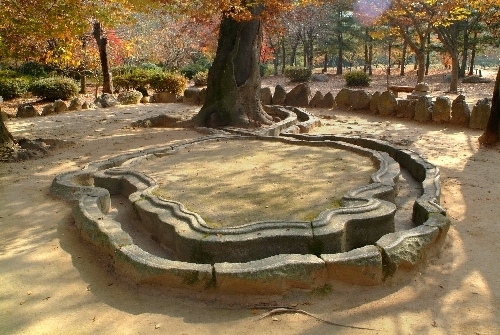
Poseokjeong, located west of Namsan in Gyeongju, was one of the royal villas prepared for the king to enjoy drinking, but currently only the water channels for pleasure remain, with no pavilion left. Its creation date is considered to be during the reign of Silla's 49th king, Heongang (875–886). The scale is about 35 cm wide, an average depth of 26 cm, and a total length of about 10 m. Poseokjeong originated from the Chinese ancient riverside event, Yusang Goksuyeon, which was a ritual to invite spirits and drive away evil spirits. In the 353 AD piece Nan-jeong Seo-mun by Wang Xizhi, clear stream water flowed through nine bends where floating cups of liquor would drift, and poems had to be composed before the cup passed all nine bends; otherwise, one had to drink three penalty cups. The surroundings of Yusang Goksu included high, rugged mountains, forests, bamboo groves, and a clear stream. Likewise, in Silla, Poseokjeong was built with the rugged Namsan peaks behind it, dense bamboo and pine forests, and a clear mountain stream flowing through the valley. Originally, at the entrance where the Namsan valley water entered, there was a large turtle-shaped stone that let water flow out, but it is now lost, so its exact form is unknown. The Samguk Yusa records that King Heongang came here and created the Eomusangsim dance following the Namsan spirit's dance. This place was also a beautiful location for cultivating the human mind, for Hwarang to train their spirits, compose poetry, and feel detachment from worldly desires. In 927, King Gyeongae of Silla held a feast here but was attacked by Later Baekje's Gyeon Hwon, captured, and committed suicide, marking a humiliating place in Silla's thousand-year history. The Hwarang Segi manuscript refers to Poseokjeong as Poseoksa (鮑石社), and in 1998, many relics were excavated 50 m south, revealing a large building existed here. Ritual vessels believed to be used in ceremonies were also found, suggesting that Poseokjeong was not only a place for feasting but also a sacred site for national peace rituals. The Poseokjeongji visitor center at the entrance offers models and videos to help understand Poseokjeong.
Namsan is a mountain rising south of Gyeongju city and has been an object of worship for the Silla people. Composed of over 40 valleys and ridges flowing down from the two peaks of Geumobong (468m) and Gowi-bong (494m), Namsan stretches 8 km north to south and 4 km east to west in an oval shape tilted slightly southward, forming a right triangle shape at the summit. With around 100 temple sites, 80 Buddhist stone statues, and 60 stone pagodas scattered around, Namsan is like an open-air museum. It has some 40 valleys and is divided into Southwest Namsan, the sacred birthplace of Silla, and Southeast Namsan, home to numerous Buddha statues buried in stones such as Mireukgol, Tapgol, and Bucheogol. Najung at the western foot of Namsan is where the birth myth of Silla’s first king, Park Hyeokgeose, resides, and Yangsanjae is a shrine honoring the founders of the six villages of Seorabeol before Silla’s founding. Poseokjeong is where the tragedy that ended Silla’s thousand-year rule unfolded. In Southeast Namsan, there is the Boryeosa seated stone Buddha full of Korean beauty and compassion, the 9m tall Buddha rock of Bulmusa Temple with carvings of pagodas and statues on four sides, and the seated stone Buddha statue in the arch-shaped rock chamber at Bucheogol. Namsan includes 11 treasures such as the Mireukgol (Boryeosa) seated stone Buddha, Yongjangsa site’s three-storied stone pagoda, and the national treasure Chilsamam rock-carved Buddha group, along with 12 historic sites including Poseokjeong, Najung, and Samneung, 9 tangible cultural heritages including Simneunggol rock-carved Avalokitesvara Bodhisattva and Ipsugol stone Buddha, and 1 important folk material. Beyond historic relics, Namsan also boasts excellent natural scenery, with many ever-changing valleys, remarkable rock formations resembling zoomorphic shapes, and numerous hiking trails frequented by visitors. Those who rank Namsan first with a thumbs-up say, “Without climbing Namsan, you cannot say you have seen Gyeongju.” Namsan is thus a place where natural beauty, the long history of Silla, and the aesthetic and religious sensibilities of the Silla people are elevated as art.
용산회식당은 경주시 내남면 이조리에 있는 회덮밥 전문 음식점이다. 내남면사무소 인근에 있으며, 용산회식당의 메뉴로는 단일메뉴인 회덮밥을 제공한다.
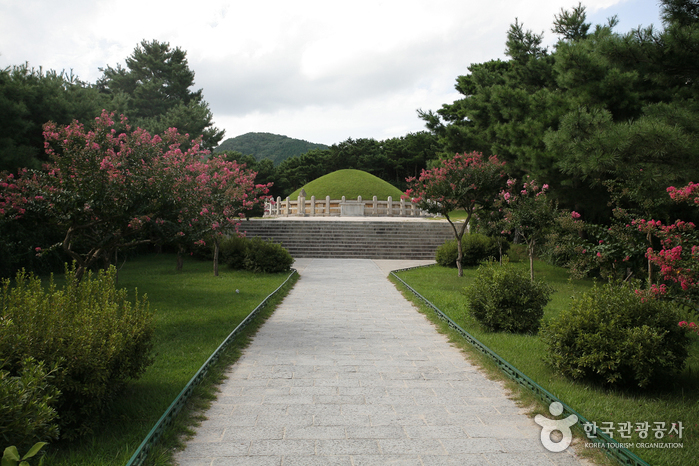
Kim Yushin General's tomb is located on the ridge of Oknyobong in Chunghyo-dong, Gyeongju, and was constructed in 674 (the 14th year of King Munmu). Kim Yushin was a general and prime minister of Silla who greatly contributed to unifying the Three Kingdoms. King Munmu bestowed 1,000 pieces of silk, 2,000 seok of rice, sent 100 military musicians to hold the funeral, erected a monument to record his achievements, and assigned people to tend the tomb, showing the highest respect. Later, during King Heungdeok's reign, he was posthumously honored as King Heungmu. The burial mound is a large circular tomb measuring 30 meters in diameter, surrounded by 24 ho-seok (stone slabs) and a stone railing, with stones laid between the ho-seok and railing on the floor. The tomb’s style and scale are comparable to royal tombs. The ho-seok feature sculptures of the 12 zodiac guardians, usually armored warriors guarding the tomb, but here they wear plain clothes holding weapons. The figures face forward but turn their heads to the right, a unique and gentle appearance without armor. While several guardian statues exist in Gyeongju royal tombs, none match the excellence and grand scale of those at Kim Yushin’s tomb. Covering an area of 14,143 square meters, it is managed by Gyeongju city and designated a historic site on January 21, 1963. The tomb area includes a monument hall, Geumsanjae, enshrining Kim Yushin General’s spirit tablet.
1988년 한 개인의 소유물로 출발한 신라역사과학관은 유물의 일부만 남아 있는 과학문화재를 복원하여 그 제작원리를 탐구하여 모형으로 그 구조와 미의 원류를 분석 실험해 과학적 보존 방법을 보여주어 관심 있는 교육현장으로 자리 잡고 있다.
Bulguksa Temple was founded in the 15th year of King Beopheung of Silla according to his mother's will to pray for the country's peace and the people’s well-being. In 751, the 10th year of King Gyeongdeok, Prime Minister Kim Dae-seong rebuilt the temple, establishing it at its current scale. Most buildings and cultural assets were burned or looted during the Imjin War. Until before 1920, only some buildings and pagodas remained, but restoration and repairs have since been carried out. Today, Bulguksa is a large temple housing cultural properties, including seven national treasures. About 3km away on a ridge is Seokguram Grotto, centered on the seated Buddha statue facing the East Sea, regarded as a masterpiece of the East. Bulguksa and Seokguram were registered as UNESCO World Cultural Heritage on December 6, 1995, recognized domestically and internationally as the essence of Silla Buddhist culture.
Golgulsa Temple is located on Hamwolsan Mountain in Gyeongju and is the main headquarters of Seonmudo (禪武道), earning the nickname of Korea's Shaolin Temple. Around 1,500 years ago, the Buddhist monk Gwangyu and his group from India settled on Hamwolsan Mountain in Gyeongju and established Golgulsa and Girimsa Temples. Golgulsa is the oldest stone cave temple in Korea, created in the form of an Indian stone cave temple inspired by Gwangyu. At the foot of Hamwolsan, in Golgulam, there are 12 stone caves carved into a large tuff rock several tens of meters high, and at the highest point of the cliff is a bas-relief Buddha statue. The main hall cave has a front wall with tiles making it look like a house, but inside the ceiling and walls are all stone cave. In a chamber in the north wall, a Buddha was enshrined, though severe erosion makes the facial features unrecognizable. The caves vary in size from ones barely fitting a single person to larger ones fitting three to four. Inside are various Buddha statues ranging from cute young monks to dignified elder monks. Passageways between caves are connected by steep steps carved into the rock, and to reach the bas-relief Buddha at the top, one passes through a natural cave. The Golgul stone cave depicted in the Joseon Dynasty painter Gyeomjae Jeong Seon’s artwork shows all 12 caves and the bas-relief Buddha as wooden tile-roofed buildings, but only the rock caves remain as the outer halls have all been lost. The bas-relief Buddha on the cliff top, about 4 meters high and 2.2 meters wide, is designated as a treasure. Since it is carved into granite mixed with many sand particles, its preservation state is poor and it is heavily weathered, so it is sheltered by a glass roof. Golgulsa Temple began its templestay program in 1992 as a Seonmudo weekend retreat and offers group, rest, experiential, and long-term healing programs.
Good places to stop and rest after the course

Booking and payment continue on a partner site.
Check rooms & priceSign up to feature your channel.
(As a member, you can add your Instagram, YouTube, and blog links in My Page, and we’ll show them with every comment you write.)
““Stayed near Hongdae and did a night café tour. Perfect city views and vibes.””
Guest comments do not display social media links or profile cards.
Share a short tip about this place.
Or leave a quick comment as a guest.
Photo attachments are available after login.
No reviews yet. Be the first to share your experience!




![Bulguksa Temple [UNESCO World Heritage] 1](https://tong.visitkorea.or.kr/cms/resource/65/3506165_image2_1.jpg)
![Bulguksa Temple [UNESCO World Heritage] 2](https://tong.visitkorea.or.kr/cms/resource/66/3506166_image2_1.jpg)
![Bulguksa Temple [UNESCO World Heritage] 3](https://tong.visitkorea.or.kr/cms/resource/68/3506168_image2_1.jpg)
![Bulguksa Temple [UNESCO World Heritage] 4](https://tong.visitkorea.or.kr/cms/resource/69/3506169_image2_1.jpg)


