Discovering the Finest Cultural Heritage of Gyeongju in Gyeongsangbuk-do Gyeongju · schedule Other · distance 18km · 3 stops · highlights Bulguksa Templ…

There is no doubt that Bulguksa Temple and Seokguram Grotto at the foot of Tohamsan in Gyeongju are among Korea's representative cultural heritages. Registered as World Cultural Heritage sites, Bulguksa and Seokguram are essential tour courses in Gyeongju where visitors can experience the essence of Buddhist culture from the Silla period. Beyond Seokguram, at Janghang-ri Historic Site, you can find the Five-Story Stone Pagoda, regarded as a masterpiece of the Unified Silla era.
This course is a sample one-day itinerary. Save it as-is or expand it into an AI itinerary.
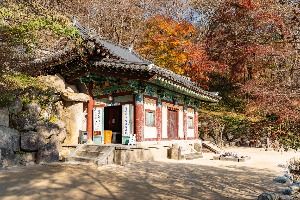
Bulguksa Temple was founded in the 15th year of King Beopheung of Silla according to his mother's will to pray for the country's peace and the people’s well-being. In 751, the 10th year of King Gyeongdeok, Prime Minister Kim Dae-seong rebuilt the temple, establishing it at its current scale. Most buildings and cultural assets were burned or looted during the Imjin War. Until before 1920, only some buildings and pagodas remained, but restoration and repairs have since been carried out. Today, Bulguksa is a large temple housing cultural properties, including seven national treasures. About 3km away on a ridge is Seokguram Grotto, centered on the seated Buddha statue facing the East Sea, regarded as a masterpiece of the East. Bulguksa and Seokguram were registered as UNESCO World Cultural Heritage on December 6, 1995, recognized domestically and internationally as the essence of Silla Buddhist culture.
국보 제24호인 석굴암은 신라 경덕왕 10년에 당시의 재상인 김대성에 의해 창건되었다고 전해진다. 불국사에서 산등성이를 타고 등산로로 3km, 신도로로는 9km거리에 있는 석굴암의 구조는 방형과 원형, 직선과 곡선,평면과 구면이 조화를 이루며 특히 벽 주위에 조각된 38체는 어느 것 하나 걸작이 아닌 것이 없고 전체적인 조화를 통해 고도의 철학성과 과학적인 면모를 나타내고 있으며 중앙에는 백색 화강암으로 된 여래좌상의 본존불이 동해를 굽어보고 있다.
The Janghang-ri temple site is located in Janghang-ri, Munmudaewang-myeon, Gyeongju-si, east of Tohamsan Mountain. Since the exact name of the temple is unknown, it is called Janghang-ri temple site after the village name. There was an east and west pagoda centered on the golden hall site, but only the west pagoda, which collapsed due to grave robbers, was newly restored in 1932. The five-story stone pagoda, 9 meters tall, represents typical features of Silla-era stone pagoda style and is large in scale. It has a double base, and only the no-ban (chest plate) remains on the top portion, with the lower base made relatively wide for stability. On the four sides of the first-story body stone, two doors with iron rings shaped like dokkaebi are carved, and each side finely engraves a pair of guardian kings, showcasing a rare technique. Based on the carving style, it is evaluated as an 8th-century work. The overall proportions are beautiful, and the carving techniques are excellent, regarded as a masterpiece demonstrating the new style of early 8th-century pagodas, and it is a valuable resource for the study of Silla stone pagodas.
Good places to stop and rest after the course

Booking and payment continue on a partner site.
Check rooms & price
Booking and payment continue on a partner site.
Check rooms & priceSign up to feature your channel.
(As a member, you can add your Instagram, YouTube, and blog links in My Page, and we’ll show them with every comment you write.)
““Stayed near Hongdae and did a night café tour. Perfect city views and vibes.””
Guest comments do not display social media links or profile cards.
Share a short tip about this place.
Or leave a quick comment as a guest.
Photo attachments are available after login.
No reviews yet. Be the first to share your experience!
![Bulguksa Temple [UNESCO World Heritage] 1](https://tong.visitkorea.or.kr/cms/resource/65/3506165_image2_1.jpg)
![Bulguksa Temple [UNESCO World Heritage] 2](https://tong.visitkorea.or.kr/cms/resource/66/3506166_image2_1.jpg)
![Bulguksa Temple [UNESCO World Heritage] 3](https://tong.visitkorea.or.kr/cms/resource/68/3506168_image2_1.jpg)
![Bulguksa Temple [UNESCO World Heritage] 4](https://tong.visitkorea.or.kr/cms/resource/69/3506169_image2_1.jpg)