Meeting Silla People from One Thousand Years Ago in Gyeongsangbuk-do Gyeongju · schedule Other · distance 10km · 10 stops · highlights Gyeongju Wolseong…

Gyeongju is a space where the Silla period and the modern era coexist. Numerous burial mounds rising gently throughout Gyeongju city are a treasure trove of Silla-era cultural heritage, where many artifacts that allow us to infer the lives of the Silla people have been excavated. Walking leisurely among the peaceful burial mounds such as Daereungwon and Bonghwangdae feels as if the Silla people from a thousand years ago are speaking to you.
This course is a sample one-day itinerary. Save it as-is or expand it into an AI itinerary.
This place was built as the royal fortress of Silla in 101 AD, in the 22nd year of King Pasa, and served as a palace until Silla fell in 935 AD. The terrain resembles a crescent moon, hence it was called 'Sinwolseong (New Moon Fortress)' or simply 'Wolseong (Moon Fortress)', and also named 'Jaeseong' meaning the fortress where the king lived. From the Joseon Dynasty, it has been known as Banwolseong (Half Moon Fortress) to the present. The fortress is a soil and stone rampart, 1,841 meters long, covering an area of 193,585㎡. To the east, it connects to Donggung and Wolji; to the north is Cheomseongdae, and to the south the Namcheon stream serves as a defense line. Records mention gates named Nammun, Guijeongmun, Bukmun, Inhwamun, Hyeondeokmun, Mupyeongmun, Jonlyemun, and Imhaemun; pavilions including Wolsangnu, Mangdeoknu, Myeonghaknu, Goru; halls such as Jowonjeon, Sungryejeon, Pyeonguijeon, Namdang, Woljeongdang, Usa Rogwan, Jwa Sarokgwan, Yeonggakseong; and palaces including Naeseong, Yeongmyeonggung, Woljigung, Yeongchanggung, Donggung, and Naehwangjeon. Beneath Wolseong, artifacts from the Bronze Age Mokmun pottery to Unified Silla pottery, roof tiles, and building foundation stones are found. Before the fortress was built, a person named Hoegong lived here. Legend says that when King Seok Talhae was young, he cleverly seized this place, and Namhae King, hearing this, made Seok Talhae his son-in-law; Seok Talhae became the 4th king of Silla. From the 22nd year of King Pasa (101 AD), the fortress was built and the royal residence moved here, with successive kings living in Wolseong thereafter.
Seokbinggo is a warehouse used to store ice. This Seokbinggo is located lengthwise from north to south on the northern fortress tower within Banwoldong Fortress in Gyeongju. Entering through the entrance on the south side leads downwards by stairs. The floor slopes inward so water can flow and drain. The roof is semicircular with three ventilation holes allowing outside air circulation. According to the seokbi (stone monument) and the gateway stone inscription, it is recorded in detail that in the 14th year of Yeongjo of Joseon (1738), Jomyeong-gyeom reconstructed a wooden binggo with stone, and four years later, it was moved from the west to its current location. It is also considered an excellent masterpiece in terms of scale and technique.
This forest is located between Cheomseongdae and Wolseong, and it is a historic place with a legend that Alji, the progenitor of the Gyeongju Kim clan, was born here. During the reign of King Talhae of Silla, Hoegong heard a rooster crowing in this forest and found a golden box glowing on a tree branch. He reported this to the king, who personally came and lowered the box. When the lid was opened, a baby boy appeared, so he was named Kim Alji and the forest, originally called Sirim or Gurim, was renamed Gyerim. Gyerim was also used as a national name for Silla. The spacious forest is densely filled with old trees such as zelkovas, and a small stream flows from north to west. Although the king made Alji crown prince, the throne later passed to King Pasa of the Park clan, and Alji did not become king. From King Naemul's generation, the Kim clan became the royal family of Silla. Within the area stands a monument erected in 1803 during King Sunjo's reign that records Kim Alji's birth. As a sacred forest near the Silla royal palace, it is revered as the birthplace of the Silla Kim royal family, and even now, royal paulownias and zelkovas shade the sky. Along the trail connecting Daereungwon, Gyerim, and Banwolseong, yellow rapeseed flowers bloom in spring, adding to the charm of the historic site.
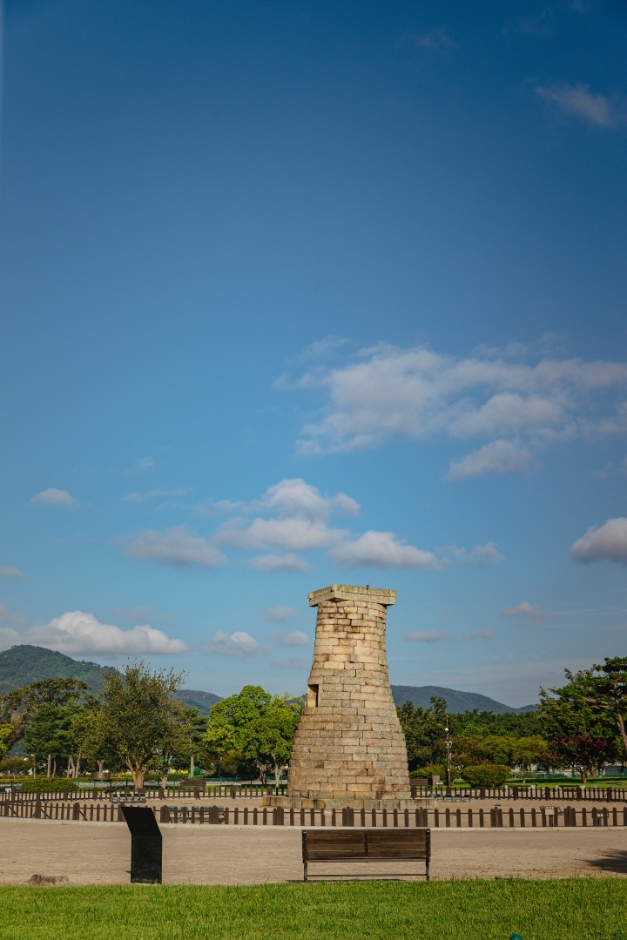
Cheomseongdae is estimated to have been built during the reign of Queen Seondeok, the 27th ruler of Silla, and is one of the landmarks symbolizing Gyeongju. It stands about 9 meters tall and features a base foundation supporting a cylindrical body shaped like a bottle, topped with a well-shaped (井) peak. The cylindrical section is built with 27 layers of fan-shaped stones. A window facing southeast has a lower part filled with rough stones and an upper part hollowed out up to the peak. The eastern half of the peak, sealed with a board, has long stones interlocking in the shape of the well (井) character, with ends protruding outside. Similar features appear on the 19th-20th and 25th-26th layers, suggesting the use of internal ladders. Historical records state, "People are meant to climb through the center," indicating that ladders were placed outside to enter through the window and climb up for astronomical observation. Each stone of Cheomseongdae holds symbolic meaning: its round upper and square lower shapes represent heaven and earth. The approximately 365 stones symbolize the days of the year; the 27 stone layers refer to Queen Seondeok, the 27th ruler; including the peak yields 29 or 30 layers, symbolizing the lunar month's days. The 12 layers above and below the central window represent the 12 months and 24 solar terms of the year. Cheomseongdae was used to calculate celestial movements to determine farming seasons and also to predict the nation's fortune. ◎ Travel information to experience the charm of Korean Wave - The drama features Cheomseongdae, a landmark representing Gyeongju and the world's oldest astronomical observatory, where characters Bogyum and Jia, linked by a special past, crossed paths. Besides its high historical value, the site attracts many visitors for seasonal flowers and plants, ideal for outings.
Gyeongju Hyanggyo is located near Gyeongju Gyochon Hanok Village and Gyeongju Choi Buja House. This area is called Gyochon, Gyori, and Gyodong because of this hyanggyo. On this site, the highest central education institution of Silla, Gukhak, was first established in the 2nd year of Sinmunwang (682). During the Goryeo period, a local educational institution called Hagwon was established in the 6th year of Seongjong (987), and its facilities were refurbished in the 11th year (992). In the Joseon period, it continued as a hyanggyo and was rebuilt in the 23rd year of Seongjong (1492) following the layout style of Munmyo and Seonggyungwan. The current building arrangement became a model for hyanggyo. After being burned during the Imjin War, the Daeseongjeon and other ritual spaces were rebuilt in the 33rd year of Seonjo (1600), and lecture spaces such as Myeongnyundang were renovated in the 6th year of Gwanghaegun (1614). After liberation, it was temporarily used as a school building, and since 1999, a social education center has been operating to continue its academic tradition. The Daeseongjeon and Dongmu and Seomu in front of the hyanggyo are ritual spaces enshrining memorial tablets of sages for ceremonies. At the rear are lecture spaces including Myeongnyundang and dormitories Dongjae and Seojae where students lived and studied. The school admitted 90 students who were mainly taught the Confucian classics and poetry. It is the largest hyanggyo in Yeongnam, housing numerous memorial tablets like the Seoul Munmyo.
Located near Daereungwon in Gyeongju, Ipungnye Guro Ssambap is known as a Korean set meal restaurant that serves a bountiful amount of side dishes that could almost break the table legs. Its popular secret lies in the table setting reminiscent of Jeolla-do style set meals. The menu consists of a single dish, ssambap. As a side, grilled short rib patties (tteokgalbi) are offered. Various distinctive regional side dishes are prepared, including Jeolla-do salted seafood, Gyeongsang-do pickled vegetables, and fresh kimchi. The variety of ssam vegetables changes seasonally, using seasonal produce.
Cheonmachong, located in Daereungwon in Gyeongju, is a pre-unification Silla tomb estimated to have been built in the late 5th to early 6th century. Excavated in 1973, it features the unique Silla stone chamber tomb style. The tomb measures 12.7m in height and 50m in diameter, with a stone layer built with river stones inside the mound. Inside the stone layer is a wooden chamber measuring 6.5m long, 4.2m wide, and 2.1m high, with a wooden coffin placed in the center for the burial. Cheonmachong is the only tomb in the Daereungwon tumulus group open to the public and was surveyed as a pilot before excavating the nearby Hwangnamdaechong, which was difficult to excavate immediately due to its massive scale. A total of 11,526 artifacts were found, including accessories worn by the deceased such as gold crowns, gold caps, wing-shaped ornaments, gold belts, and gilt-bronze shoes. The representative gold crown is a typical Silla crown with three rows of branch-shaped decorations on the front and two rows of deer antler-shaped decorations on the back. The branch decorations feature sprouting bud shapes and comma-shaped jade pieces symbolizing life. It is regarded as the largest and most ornate crown among those discovered so far. The name Cheonmachong comes from the 'Cheonmado' painting found in this tomb—a depiction of a heavenly horse on birch bark and part of a saddle apron (an item hung on both sides of a horse's saddle to protect the rider's clothes from dirt). This painting is the first pictorial artwork excavated from a Korean tomb and a representative work of Silla painting, designated as a national treasure. The artifacts excavated from Cheonmachong are currently displayed at the National Gyeongju Museum.
Bonghwangdae is a cliff located at the entrance of Byeokkye Reservoir in Pyeongchon-ri, Gungnyu-myeon, Uiryeong-gun. The massive strange rock formations create a magnificent view, and the name comes from its shape resembling the head of a phoenix. Following the stone steps of Bonghwangdae, there is a natural cave between the cliffs, and beyond this cave lies a narrow stone gate blocking the way. After barely passing through this stone gate, you encounter another cave which has a spring that flows perennial mineral water, providing cool water to visitors. In spring, the scenery is splendid with flowering ephemerals, and in summer, the dense shade offers cool relief. However, Bonghwangdae's true charm is its autumn foliage. The evening sunset cast over the phoenix cliff covered with crimson leaves presents a truly picturesque scene. Surrounding areas also offer many scenic spots, including Muun Rock, Yongso, Gaksi-so, and Gaeggi Rock in Chalbi Valley, and local delicacies such as village chicken baeksuk and goat bulgogi can be enjoyed. Midway up Bonghwangdae is a small flat area with a pavilion called Bonghwangnu. Another attraction is Ilbungsa, a temple of the Daehan Buddhist Ilbung Seon-gyo sect located below Bonghwangdae.
Hwangnyongsa Temple was built during the 6th century Silla period and was destroyed by fire during the Mongol invasion in the 13th century of the Goryeo dynasty; now only the site remains to estimate its scale. The temple is estimated to have been a large complex of 8,800 pyeong, about eight times bigger than Bulguksa Temple. Construction began by royal command in 553 (Silla King Jinheung, 14th year), with main halls completed in 566, and the Golden Hall finished in 584 (King Jinpyeong, 6th year). By 645 (Queen Seondeok, 14th year), the tower construction was completed, making Hwangnyongsa the center of Silla’s national faith. Inside the temple was the nine-story wooden pagoda, one of Silla’s treasures, built in just three years by Abiji of Baekje at the suggestion of monk Jajang, who returned from Tang China; it symbolized Silla. The site where the pagoda stood still has the central pillar foundation stone supporting the tower. The temple was located east of the Silla royal palace Wolseong; records say King Jinheung intended to build a new palace east of Wolseong but halted the plan after seeing a yellow dragon ascend there, dedicating the site to a temple named Hwangnyongsa. As a state temple, it was frequently visited by successive kings and held the highest status among Silla temples. It continued to be revered and protected into the Goryeo dynasty, receiving wood supplies for tower repairs. However, in 1238 (King Gojong, 25th year), the Mongol invasion burned down all buildings including the tower. In 1969, the lecture hall site was excavated, revealing foundation stones from the Golden Hall, lecture hall, and pagoda. From March 1976, eight years of excavation showed a unique layout with one pagoda and three Golden Halls, uncovering over 40,000 artifacts. While the lower structures including the platform were confirmed, the upper buildings could not be precisely verified, so complete restoration was not possible; only the platform with 64 foundation stones was restored. Next to the temple site is the Hwangnyongsa History and Culture Center, featuring a 3D audiovisual room showing the temple’s construction and destruction process, and a Silla history exhibition room displaying artifacts found during excavation. The first floor exhibits a model pagoda reproducing the Hwangnyongsa nine-story wooden pagoda at one-tenth scale.
Bunhwangsa Temple is a branch temple of Bulguksa, the main temple of Jogye Order of Korean Buddhism’s 11th district, located in Gyeongju-si, Gyeongsangbuk-do. It was founded in 634, the 3rd year of Queen Seondeok's reign, and is a historically significant temple where Monk Wonhyo and Monk Jajang stayed. Inside the temple is the Mojeon Stone Pagoda, designated as a national treasure, which represents a typical stone pagoda style built before the Unified Silla period. Originally, the Mojeon Stone Pagoda had more than five stories, but only three remain today, and restoration during the Goryeo Dynasty is confirmed from relic containers found there. The first tier of the pagoda features carvings of a reliquary chamber and guardian statues, as well as stone lion statues. The temple grounds include Samnyongbyeoneojeong, a large stone well from the Unified Silla period, which is associated with a legend of national protection. This well is also a historic site where 14 stone Buddha statues were excavated in 1965. Bunhwangsa preserves various relics including Yaksa-jeon (Medicine Buddha Hall), a standing statue of Yaksa Buddha, a stone lantern, and foundation stones. The Hwajaeng Guksa Bibu is the pedestal stone of a monument honoring Monk Wonhyo, made during King Myeongjong's reign in the Goryeo period. Currently, Bunhwangsa Temple is valued as a temple of significant historical and cultural importance.
Sign up to feature your channel.
(As a member, you can add your Instagram, YouTube, and blog links in My Page, and we’ll show them with every comment you write.)
““Stayed near Hongdae and did a night café tour. Perfect city views and vibes.””
Guest comments do not display social media links or profile cards.
Share a short tip about this place.
Or leave a quick comment as a guest.
Photo attachments are available after login.
No reviews yet. Be the first to share your experience!