Tracing the Footsteps of Scholar Hoejae Yi Eonjeok in Gyeongsangbuk-do Gyeongju · schedule Other · distance 13km · 4 stops · highlights Gyeongju Yangdon…

Gyeongju Yangdong Village, registered as a World Cultural Heritage site along with Andong Hahoe Village, is a place preserving a long history and tradition. It is perfect for a quiet walk along the alleys of Yangdong Village, where the old atmosphere remains. Visiting Oksan Seowon and Dokrakdang, where traces of Hoejae Yi Eonjeok, a Neo-Confucian scholar of the Joseon Dynasty, remain, makes for an excellent cultural heritage exploration course.
This course is a sample one-day itinerary. Save it as-is or expand it into an AI itinerary.
Yangdong Folk Village is Korea's largest traditional clan village preserving the culture and nature of the Joseon Dynasty, formed by the Wolseong Son and Yeogang Lee clans. Holding many cultural assets such as national treasures, treasures, and folk materials, the entire village is designated as a national folk cultural heritage site. Due to its size and preservation status, the number and authenticity of cultural assets, beautiful natural environment, and unspoiled local character, the village has many attractions; in 1993, Charles, Prince of Wales, visited this place. Additionally, 54 old houses over 200 years old have been preserved, reflecting the glorious traces of a renowned noble family and the lives of ancestors, offering a view of diverse and distinctive traditional Korean houses from mid-Joseon onward. It is recommended to familiarize yourself with the village layout, exploration course, and locate cultural assets beforehand. When touring the village, it is even better to be considerate and avoid causing inconvenience to the residents living in the houses.
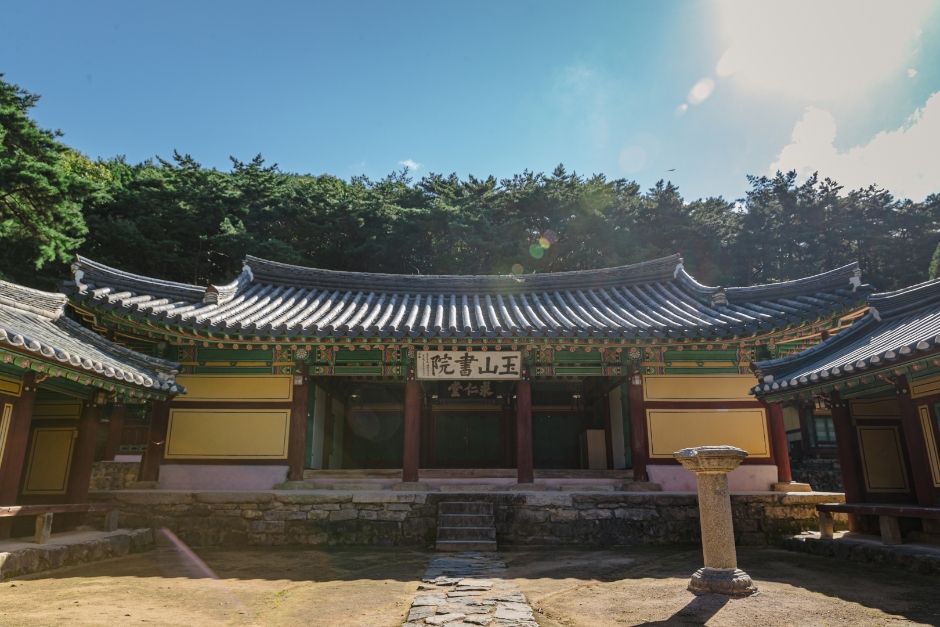
Gyeongju Oksan Seowon is a place dedicated to commemorating the Joseon Dynasty Neo-Confucian scholar Hoejae Lee Eonjeok. Lee Eonjeok’s scholarship was passed down to Toegye Yi Hwang, becoming a pioneer of the Yeongnam School of Neo-Confucianism. This site was first established in the 5th year of King Seonjo’s reign (1572) by Gyeongju governor Lee Jemin and received the name “Oksan” from the king the next year, making it a royal-acknowledged seowon. It follows the front-study, rear-shrine layout with Guindang, the study hall, in front and Cheinmyo shrine at the back. Guindang is a gable-roofed building originally lost to a fire in the 5th year of King Heonjong’s reign (1839) and later reconstructed. The site also includes several buildings such as Yeongnakmun, the main gate; Mubeonru, a two-story building; and Min Gujae and Amsujae, dormitories for male and female students respectively. Numerous books are preserved here, and Oksan Seowon was one of the seowons exempted from the Daewon-gun’s seowon abolition order in the late Joseon period. It conserves the teacher’s writings as well as calligraphy and collected works of various illustrious scholars throughout history.
Dokrakdang is the sarangchae (men's quarters) of the house built by scholar Hoejae Yi Eonjeok (1491–1553) after he retired from public office and returned to his hometown. Built in the 11th year of King Jungjong’s reign (1516), this Dokrakdang is a paljakjip (hip-and-gable roofed house) with 4 bays wide and 2 bays deep, consisting of ondol rooms (1 bay × 2 bays) and a daechung (main hall; 3 bays × 2 bays). The structure employs five beams with central columns and a choikgong (initial bracket) construction featuring one saeseo. The ceiling of the daechung is an exposed rafter lantern ceiling, and the taegong (large bracket) supporting the ridge beam has a distinctive shape. The side wall of Dokrakdang features salchang (lattice windows), allowing views of the front stream from the daechung, showcasing an exceptional spatial composition. Behind Dokrakdang is the gyejeong (stream pavilion), expressing a desire to harmonize with nature. ◎ Travel information to experience the charm of Hallyu – In the drama "Sesak, Maehokdoen Jadeul," important scenes such as Yi In meeting Heesu for the first time while playing Go and cooling Heesu’s injured foot in the stream were filmed at Dokrakdang and the nearby valley, capturing beautiful scenery. Entering the well-preserved Dokrakdang gyejeong feels like stepping back in time.
This is a uniquely shaped stone Buddhist pagoda from the Unified Silla period, erected at the site of Gyeongju Jeonghye-sa Temple. The pagoda consists of a single earthen platform base with thirteen stories above. Its form is unparalleled in the Unified Silla era. The first-story body stone is massive, but from the second story upward, the body stones and roof stones become dramatically smaller, making the upper stories appear as decorative attachments atop the first story. The large first-story body stone features square projecting pillars at each corner, with secondary pillars inside forming door structures. The inclusion of doors expresses an intention to create an open space. The roof stones have their supporting bases separately crafted stones rather than carved directly, and their eaves, which were originally straight, curl up at the four corners. Only the finial base stone remains at the top. Believed to have been constructed in the 9th century during the Unified Silla period, this pagoda’s unusual thirteen stories and unique base design make it a valuable resource for studies of stone pagodas from that time.
Good places to stop and rest after the course

Booking and payment continue on a partner site.
Check rooms & price
Booking and payment continue on a partner site.
Check rooms & priceSign up to feature your channel.
(As a member, you can add your Instagram, YouTube, and blog links in My Page, and we’ll show them with every comment you write.)
““Stayed near Hongdae and did a night café tour. Perfect city views and vibes.””
Guest comments do not display social media links or profile cards.
Share a short tip about this place.
Or leave a quick comment as a guest.
Photo attachments are available after login.
No reviews yet. Be the first to share your experience!
![Gyeongju Yangdong Village [UNESCO World Heritage] 1](https://tong.visitkorea.or.kr/cms/resource/53/3506353_image2_1.jpg)
![Gyeongju Yangdong Village [UNESCO World Heritage] 2](https://tong.visitkorea.or.kr/cms/resource/54/3506354_image2_1.jpg)
![Gyeongju Yangdong Village [UNESCO World Heritage] 3](https://tong.visitkorea.or.kr/cms/resource/55/3506355_image2_1.jpg)
![Gyeongju Yangdong Village [UNESCO World Heritage] 4](https://tong.visitkorea.or.kr/cms/resource/56/3506356_image2_1.jpg)