Trip honoring noble spirits of May eighteen in Gwangju Western · schedule Other · distance 39.3km · 4 stops · highlights National 5·18 Democratic Cemete…

This is a trip reflecting on the painful history of the May 18 Democratic Uprising. The May 18 Democratic Cemetery is a place where the graves of martyrs who died during the uprising and unidentified missing persons are together. It is a sanctuary of the democratic uprising, honoring the noble spirit. After visiting Gwangjuho Ecological Park and Chungjangsa, reflect on the true meaning of democracy while heading to the May 18 Memorial Park.
This course is a sample one-day itinerary. Save it as-is or expand it into an AI itinerary.
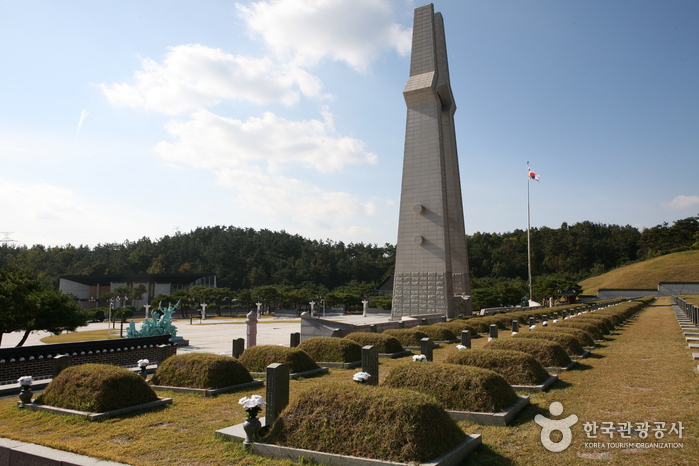
The National 5·18 Democratic Cemetery, also called the 5·18 Burial Site, is a communal cemetery for the victims of the 1980 Gwangju Democratization Movement. As a sacred place of democracy and a representative symbol of Gwangju, the cemetery contains graves of the 5·18 patriots, a memorial plaza, exhibition spaces, symbolic sculptures, and the Gwangju Democratization Movement Memorial Tower. The central square pillar tower, 40 meters tall, modernizes the traditional Korean stone structure called Dangganjiju. The oval shape grasped by hands in the center symbolizes the rebirth of new life, and the light reflected by the sun’s shifting rays represents seeds of hope. The 5·18 Memorial Hall was established to honor the democratic spirits who sacrificed for democratization and to properly inherit their cause. It provides an objective understanding of the 5·18 Democratization Movement, its victims, and the still unrevealed truths, functioning as an experiential space where visitors can actively engage with the realities and spirit of 5·18 rather than merely observe. ※ To maintain a solemn atmosphere for worship, slippers and sleeveless clothing are discouraged.
Gwangjuho (Gwangju Lake) Ecological Park is an ecological park developed on a 184,948m² site near the lakeshore, consisting of theme areas such as a natural observation center, nature learning site, lawn resting plaza, and waterside wetlands. Located about 30 minutes from downtown Gwangju, it is easily accessible for citizens and has been used as a natural ecology learning site for children and a resting space for citizens since its opening in March 2006. The park gives an overall quiet and cool feeling, and unless it is cold weather, visitors can directly observe ecological materials of flowers, animals, and plants. There are 170,000 wildflowers of various colors planted in themed flower zones, including azaleas, forsythias, nandinas, roses, rhododendrons, and hydrangeas, as well as a deciduous plant garden, waterside observation deck, rock garden, and about 3,000 trees such as Styrax japonicus, quince trees, Euonymus japonicus, and maple trees. Additionally, various birds hatch and grow in the marsh area. Wooden stairs have been built between metasequoia-lined streets.
Hwanbyeokdang is a pavilion located on a hill on the Chunghyo-dong side along the upper stream of the Gwangjuho, built by Kim Yoon-je (1501–1572), a former governor of Naju, who retired here and devoted himself to education. The name Hwanbyeok (環璧) literally means a beautiful natural scenery surrounded like a ring of blue. Hwanbyeokdang holds great humanities value in Korean literature history related to poetry and prose, and it is a representative example of a villa garden culture in Honam with excellent value as a byeolseo wonlim (detached garden pavilion). The hall name was given by Yeongcheonja Shin Jam, and it was also called Byeokgandang, as recorded in Gokgyeongmyeong's Yuseoseoknok. The building has three bays in the front, two bays on the side, and a paljak-style roof. The middle two bays are rooms, with a modified layout where the front and right sides have wooden floors. It is believed to have originally been a traditional pavilion format but changed to the current appearance after later expansions. Hanging here are calligraphic plaques written by Wooam Song Si-yeol and poetry plaques by Seokcheon Im Eok-ryeong and Jo Ja-i. There are two poems about Hwanbyeokdang by Jeong Cheol, included in Songgang Sokjip and Gwangjumokji. A legend related to Jeong Cheol tells that one day Kim Yoon-je, napping here, dreamed of a dragon ascending from Jodae. Upon waking, he hurried to the spot and found a boy wrapped in seaweed. Captivated by the boy’s extraordinary appearance, he married his granddaughter to him. This boy was Jeong Cheol, who later became a renowned politician and literary figure. Below Hwanbyeokdang are Jodae and Yongso, a pond said to be where Kim Yoon-je and Jeong Cheol first met. About 250m northeast along Changkyecheon is Sikyeongjeong, and near Hwanbyeokdang is Chwiga-jeong. Nearby are Doksujeong and Sosaewon, revealing this area as the center of Joseon-era villa garden culture. *Relative Kim Yoon-je Kim Yoon-je (1501–1572), from Gwangsan Bon-gwan, was born in Chunghyo-ri. He passed the Jinsa exam in 1528, the civil service exam in 1532, serving in posts including Seungmungyori, Chungrugwan, Hongmungwongyori, Naju governor, and thirteen other local government positions. After retiring, he returned home, built Hwanbyeokdang, and devoted himself to nurturing scholars, among them Songgang Jeong Cheol and Seohadang Kim Seowon. The militia leaders Kim Deok-ryeong and Kim Deok-bo during the Imjin War were his descendants influenced by his scholarship.
5·18 Memorial Park was created to commemorate the May 18, 1980 Gwangju Democratization Movement. When Sangmudae, a military facility at the time of the movement, was relocated, the government provided the park site. Accordingly, in 1998, Gwangju Metropolitan City established the 5·18 Memorial Park over an area of 208,000㎡ to honor the movement and to properly inherit and develop its valuable lessons. The park includes the 5·18 Memorial Culture Center with archives and performance/event facilities, the 5·18 status sculptures and memorial sublimation space consisting of the Citizens’ Army statue and memorial space, Daedong Square featuring a circular fountain symbolizing the spirit of 5·18, and the Student Memorial Tower of the 5·18 Democratization Movement. At the foot of Yeouisang, where the park is situated, is the Gwangju Student Education and Culture Center, and walking paths surround the mountain. At the summit, there is Oweoldae, a pavilion functioning as an observatory. Today, 5·18 Memorial Park serves not only as a place for citizens to commemorate the 5·18 Democratization Movement but also as a pleasant urban resting space. Approximately 45% of the total area, 92,099㎡, is green space with traditional ponds and diverse trees, widely used as a natural learning area for children.
Good places to stop and rest after the course

Booking and payment continue on a partner site.
Check rooms & price
Booking and payment continue on a partner site.
Check rooms & price
Booking and payment continue on a partner site.
Check rooms & price
Booking and payment continue on a partner site.
Check rooms & priceSign up to feature your channel.
(As a member, you can add your Instagram, YouTube, and blog links in My Page, and we’ll show them with every comment you write.)
““Stayed near Hongdae and did a night café tour. Perfect city views and vibes.””
Guest comments do not display social media links or profile cards.
Share a short tip about this place.
Or leave a quick comment as a guest.
Photo attachments are available after login.
No reviews yet. Be the first to share your experience!