
Invitation to eco friendly clean city Gwangju in the metro area in Gyeonggi-do Gwangju City · schedule Other · distance 35.5km · 4 stops · highlights Gy…

Gwangju, Gyeonggi-do, where the spirit of Namhansanseong is present as the gateway to Seoul, has recently been designated a World Cultural Heritage site. With growing interest in ecology, it is emerging as a new well-being travel destination where culture and ecology harmoniously coexist.
This course is a sample one-day itinerary. Save it as-is or expand it into an AI itinerary.
Gyeongan Wetland Ecological Park, where fresh greenery and reeds blend in spring, summer, and autumn, is a place where various migratory birds gather year-round. A few trees visible among the lakeside reed forest add charm to the scenery. This unique site naturally transformed into a wetland after farmlands and lowlands were submerged following the construction of Paldang Dam in 1973. It has become a habitat for diverse aquatic plants, various migratory and resident birds, turning into a place for bird watching and nature learning. Well-maintained walking trails wind through the park, providing a resting spot for families and cyclists. The wetland's excellent natural purification function greatly helps improve water quality, and there are plans to gradually expand its area. This park, serving as a natural learning site for wetland conditions, attracts many individual and group visitors. (Source: Gwangju-si Culture Tourism website)
Cheonjinaam Holy Ground is a historically significant site as the birthplace of Korean Catholicism, housing the remains of the country's founding Catholic ancestors (Ibyeok, Jeong Yak-jong, Gwon Cheol-sin, Gwon Il-sin, Lee Seung-hoon). The site features numerous attractions including a statue of the Virgin Mary, the site of Cheonjinaam Cathedral, and the Virgin Mary Church. On an area of approximately 360,000 pyeong, with 30,000 pyeong set aside for the cathedral construction site, tens of thousands of believers gather annually to hold commemorative events celebrating the founding of the Korean Catholic Church.
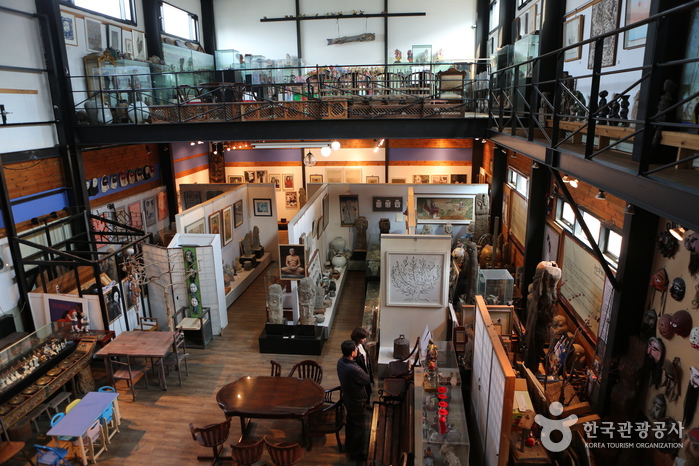
경기도 광주시 남종면 분원리에 있는 박물관 얼굴은 연극 연출가 김정옥이 지난 40여 년간 수집해 온 우리의 옛 사람들이 만든 석인, 목각인형, 도자기 등과 우리나라를 비롯한 세계 여러 나라의 사람의 얼굴을 본 딴 와당과 가면 등 한자리에 모아 [사람과 얼굴]의 공간을 구상함으로서 만들어진 공간이다.
Namhanseong Provincial Park encompasses Namhanseong Fortress, one of the four major fortresses that protected Hanyang (present-day Seoul). The four fortresses surrounded the capital: Gaeseong to the north, Suwon to the south, Ganghwa to the west, and Gwangju to the east, where Namhanseong Fortress is located. It is situated on Namhan Mountain, 24 km southeast of Seoul and 6 km northeast of Seongnam City. The fortress walls extend a total of 12.4 km (main fortress 8.9 km, outer fortress 3.2 km, Sin Nam fortress 0.2 km), with a height of 7.3 meters. Historically, it is recorded as being King Onjo’s royal castle over 2,000 years ago (King Dongmyeong of Goguryeo's son and the founder of Baekje). Also, during the Silla–Tang War in the 13th year of King Munmu of Silla (673), a castle called Jujangseong was built in Hansanju. Utilizing this ancient site, the fortress was repeatedly repaired and rebuilt by later generations, with extensive construction during the reign of King Gwanghaegun of Joseon (1621). The stone walls of Namhanseong are about 12 km in circumference, constructed with natural stones laid with larger stones at the bottom and smaller stones on top. There were four gates and gatepavilions (munru) on each cardinal direction, 16 secret gates (ammun), and four watchtowers (jangdae) built on the east, west, south, and north sides. Inside the fortress, the Suo Office was established alongside government offices, warehouses, and the temporary royal palace (haenggung). The haenggung consisted of 252 rooms in total: 73 in the upper palace, 154 in the lower palace, and 26 in the left quarters. Eighty wells and 45 springs were created, and the administrative office of Gwangju-eup was relocated inside the fortress. The fortress’s importance and its capacity to accommodate residents can be inferred. In the first military exercise after the fortress’s construction (Injo 17th year, 1639), 12,700 troops participated. Currently, only a few buildings remain within the fortress, including the East and South Gates, West Jangdae, Hyeonjeolsa, Yeonmugwan, Janggyungsa, Jisudang, Yeongwoljeong, Chimkwaejeong, Sungnyeoljeon General Yi Seo’s shrine, walls, towers, and ramparts. Among these, the four main gates, Suwojangdae, and parts of the fortress wall near the West Gate are well preserved in their original form. Namhanseong is designated as a historic site and provincial park.
Good places to stop and rest after the course

Booking and payment continue on a partner site.
Check rooms & priceSign up to feature your channel.
(As a member, you can add your Instagram, YouTube, and blog links in My Page, and we’ll show them with every comment you write.)
““Stayed near Hongdae and did a night café tour. Perfect city views and vibes.””
Guest comments do not display social media links or profile cards.
Share a short tip about this place.
Or leave a quick comment as a guest.
Photo attachments are available after login.
No reviews yet. Be the first to share your experience!


![Namhanseong Provincial Park [UNESCO World Heritage] 1](https://tong.visitkorea.or.kr/cms/resource/17/1589317_image2_1.jpg)
![Namhanseong Provincial Park [UNESCO World Heritage] 3](https://tong.visitkorea.or.kr/cms/resource/20/1589320_image2_1.jpg)
![Namhanseong Provincial Park [UNESCO World Heritage] 4](https://tong.visitkorea.or.kr/cms/resource/50/2612850_image2_1.jpg)