Climb Geumosan the Mountain of Golden Crows in Gyeongsangbuk-do Gumi City · schedule Other · distance 9km · 5 stops · highlights Gumi Chaemijeong, Geumo…
Geumosan is a mountain named after the sight of a golden crow flying in the evening glow, as told by Ado Hwasang. With an elevation of 976m, it is not only beautiful but also rich in history, featuring Chaemijeong built to honor the loyalty of Yaeun Giljae, Geumosan Fortress defended by General Jeong Gi-ryong during the Imjin War, Doseongul cave where Monk Doseon is said to have meditated, Yaksaam temple, and the carved standing statue of Bodhisattva located below the summit. Pass through Metasequoia Road and head to Geumosan to meet the golden crow.
This course is a sample one-day itinerary. Save it as-is or expand it into an AI itinerary.
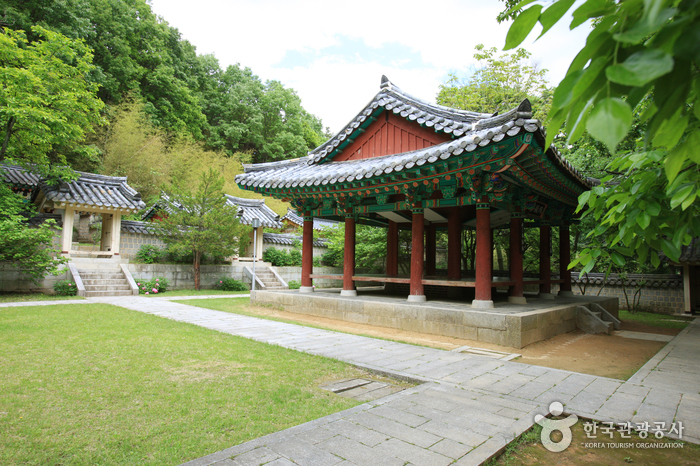
This pavilion was built in the 44th year of King Yeongjo of Joseon (1768) to commemorate the loyalty and scholarship of Yaeun Giljae. Giljae passed the state exam in 1386 during the Goryeo period, served as a scholar at Sungkyunkwan, and became a royal secretary. When the Joseon dynasty succeeded Goryeo, he declined official positions, stating he could not serve both dynasties, and retired to Seonsan, maintaining his integrity. The name 'Chaemi' was coined by comparing Giljae's loyalty to the Goryeo dynasty to the Chinese loyal subjects Bai Yi and Shu Qi gathering bracken. Chaemijeong is a hipped-and-gabled roof house with three bays wide and three bays deep, located on the right after passing Heunggimun. Behind it are the Gyeongmogak honoring Giljae's loyalty with King Sukjong's calligraphic poem 'Eopil Oeongu' and the Yuhyubigak monument, positioned side by side.
Geumosan Fortress is a mountain fortress built with double layers of inner and outer walls made of stone, surrounding the peak and valleys of the rugged Geumo Mountain, which stands at 976m above sea level within Geumosan Provincial Park in Gumi-si, Gyeongsangbuk-do. The exact date of its first construction is unknown due to lack of historical records; however, it is known that during the late Goryeo period, frequent pirate invasions deeply penetrated inland causing casualties and looting. Residents from nearby Seonsan, Indong, Gaeryeong, and Seongju sought refuge at Geumo Mountain and built the fortress for defense, with soldiers assigned to protect it. It is said that military grain and weapons were stored here. The inner fortress, built around the summit in a circular shape, has a circumference of 10 li, and walls were not built on the steep cliffs. The outer fortress encloses the valley with a circumference of 5 li, and together the inner and outer walls measure 6.3 km in length. In the 10th year of King Taejong of Joseon (1410), the fortress was extensively rebuilt as a national project. Its strategic importance was recognized during the Japanese invasions of 1592–1598, and it was repaired again in 1596. In the 17th year of King Injo (1639), expansion work was done to build the outer fortress, completing the double-layered mountain fortress, and it was newly rebuilt in the 5th year of King Gojong (1868). Records indicate that there was one valley, several ponds, wells, warehouses named Daehyechang and Naeseongchang, an armory, and Jinnamsa temple within the fortress. Today, remains of the inner and outer gates, disguised small secret gates (ammun), and building sites remain. Additionally, within the fortress lies the Geumosan Fortress stationed by transport troops, thought to have been built around King Gojong’s 5th year (1868).
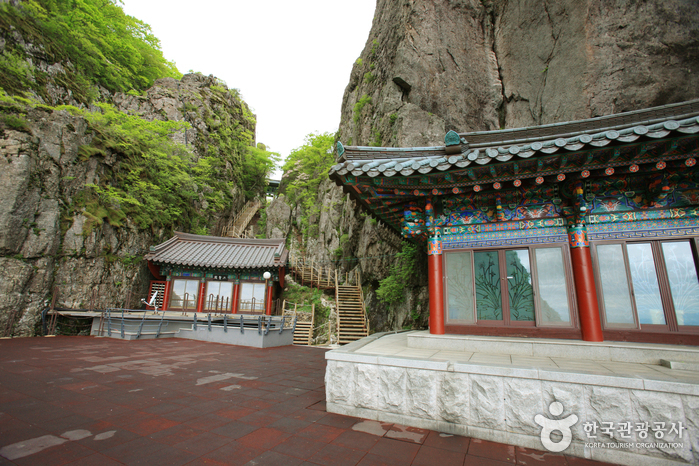
Yeongnam's famous mountain, Geumosan, has many historic sites and temples intertwined with legends and anecdotes that attract visitors all year round. Originally, Geumosan was called Daebonsan, and it was also referred to as Namsungsan because it was considered comparable to Sungsan, one of China's Five Sacred Mountains. The name Geumo (Golden Crow) is said to have come from the monk Ado, who passed by here and saw a golden crow flying through the evening glow, symbolizing the mountain receiving the energy of the sun. Midway up Geumosan lies Haeunsa Temple, where even clouds rest. It is said to have been established in the late Silla period by Doseon (827–898) under the name Daehyeolsa. However, all buildings were destroyed during the Imjin War, and it remained abandoned for a long time until restored by Monk Cheolha in 1925, who renamed it Haeunam. In 1956, the Daeungjeon Hall was newly built, and the temple name was eventually changed back to Haeunsa as restoration continued. Just above Haeunsa is Doseon Cave, which faces Gumi city with a wide-open mouth. At the end of the Goryeo period, Giljae (1353–1419) lived in this temple and Doseon Cave to study Confucianism. After the fall of Goryeo, he hid in Geumosan, Haepyeong-myeon, Seonsan-gun, and deepened his studies, later becoming a cornerstone of the Yeongnam school of Confucianism. Considering Buddhist relics scattered on Geumosan, such as Yaksaram and the Ma-ae Standing Bodhisattva, one can imagine the deep Buddhist practices here. It takes about an hour on foot from the parking lot to Haeunsa, but now the Geumosan cable car connects directly to Haeunsa, making access easy.
Geumosan is a mountain rising from a branch of the Sobaek mountain range and was designated as a provincial park in 1970 with developed tourist facilities. The entire mountain is made of rock, featuring many steep cliffs. A cable car is installed from the foot of the mountain to the waterfall. Since ancient times, it has been one of the Yeongnam 8 scenic spots, with Yaksaam near the summit, Myeonggeum Waterfall (38m tall) halfway up the northern slope, and Haeunsa Temple, built by the Silla monk Doseon. Other attractions include Doseon Cave and the Ma-ae Bodhisattva Standing Statue. The cable car, constructed from the entrance passing Chaemijeong to beside Haeunsa, offers great convenience to visitors. With decks and stairs, it is good for light walks, and the cable car makes it accessible for the elderly. The hiking courses are well developed.
경상북도 구미시 남통동 산24번지 금오산 정상에 자리한 대한불교조계종 제8교구 본사인 직지사의 말사이다. 금오산은 경북 구미시와 김천시, 칠곡군에 걸쳐있는 산으로 특이한 산세를 자랑하고 있다. 정상 일대는 분지를 이루고 있고 그 아래쪽은 칼날같은 절벽이 병풍을 이루고 있으며 산세가 매우 가파른 곳이다. 정상은 월현봉과 약사봉, 보봉으로 이루어져 있고, 정상 부근은 하늘로 비상하려는 새의 모습과 비슷하며 누워있는 사람의 얼굴 모습 같기도 하다. 금오산은 지난 1970년 도립공원으로 지정되면서 관광시설이 골고루 갖추어진 명승지이다. 정상 부근에는 금오산성이 있고 단풍의 명소로 일명 금강이라 불리며 예부터 경북 8경의 하나로 꼽혀왔다.
Good places to stop and rest after the course

Booking and payment continue on a partner site.
Check rooms & price
Booking and payment continue on a partner site.
Check rooms & priceSign up to feature your channel.
(As a member, you can add your Instagram, YouTube, and blog links in My Page, and we’ll show them with every comment you write.)
““Stayed near Hongdae and did a night café tour. Perfect city views and vibes.””
Guest comments do not display social media links or profile cards.
Share a short tip about this place.
Or leave a quick comment as a guest.
Photo attachments are available after login.
No reviews yet. Be the first to share your experience!