
Relaxing trip of rest leisure and history in Gangwon Special Self-Governing Province Goseong County · schedule Other · distance 30km · 3 stops · highlig…
Jinburyeong Art Museum, operated by Goseong-gun, is the highest art museum in South Korea, located at the summit of Jinburyeong (529m), where you can enjoy a panoramic view of the beautiful East Sea.
This course is a sample 2-day itinerary. Save it as-is or expand it into an AI itinerary.
고성군에서 운영하는 진부령미술관은 동해의 수려한 경관이 한눈에 보이는 진부령(529m) 정상에 우리나라에서 가장 높은 미술관이다.
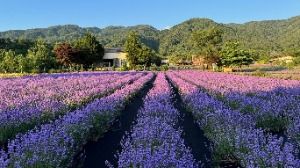
Hanui Lavender Farm is located in a small mountain village at the foot of Geumgangsan in Goseong-gun, Gangwon-do. Every June, the hills turn purple and the scent of lavender fills the village. Lavender, poppies, and rye fields harmonize with the surrounding scenery, while a vintage garden and a metasequoia forest create an exotic spectacle that captivates visitors. Known as the 'Lavender Evangelist,' CEO Ha Deokho planted and cultivated lavender on about 33,000㎡ of land starting in 2006, making this farm a product of his passion. Previously running a herb shop in Uiwang-si, Gyeonggi-do, Ha settled here to grow lavender as a raw material for herb products. The warm climate of Goseong is considered the most suitable in Korea for cultivating lavender.
Geonbongsa Temple in Geumgangsan is an ancient temple located on the southeastern slope of Gamrobong, where the Geumgangsan mountain range begins, enshrining the authentic tooth relic of Sakyamuni. It was once a large-scale temple with 3,183 rooms, but all except the Bulimun gate were destroyed during the Korean War. Restoration work began in 1994 and has led to the current appearance. It is a patriotic temple where monks organized warrior monks during the Imjin War and was a center for anti-Japanese independence movements during the Japanese colonial period. It is said that in the 7th year of King Beopheung of Silla (520), the monk Ado first built a temple here under the name Wongaksa. In the 17th year of King Gyeongdeok of Silla (758), the monk Baljing rebuilt the temple and held a 10,000-day chanting ceremony, which became the origin of Korea’s yeombulmanilhoe (a Buddhist ceremony praying for rebirth in the Pure Land by chanting for ten thousand days). Later, in the 7th year of King Gongmin of Goryeo (1358), monk Naong changed the temple’s name to the current one. In the 2nd year of King Sejo of Joseon (1456), the king visited and made it a royal ancestral shrine praying for the safety of the royal family, building Eosilgak to enshrine memorial tablets of successive kings, making it a grand temple. In the 15th year of King Gojong of Joseon (1878), a fire burned it down completely, and it was rebuilt the following year. In the 10th year of Gwangmu of the Korean Empire (1906), Bongmyeong School was established for enlightenment and new knowledge education, becoming a center of education in the Gwandong region but was forcibly closed by the Japanese. By 1911, it had regained scale as one of the 31 main temples presiding over nine branch temples. During fierce battles lasting about two years around Goseong in the Korean War, all buildings except the Bulimun gate, built in 1920, were destroyed, leaving it in ruins. After the armistice, the Geonbongsa site was located north of the civilian control line and became accessible to civilians from 1989.
Sign up to feature your channel.
(As a member, you can add your Instagram, YouTube, and blog links in My Page, and we’ll show them with every comment you write.)
““Stayed near Hongdae and did a night café tour. Perfect city views and vibes.””
Guest comments do not display social media links or profile cards.
Share a short tip about this place.
Or leave a quick comment as a guest.
Photo attachments are available after login.
No reviews yet. Be the first to share your experience!


