
Specialties from the Land of Cheongpung and Clear Winds in Chungcheongbuk-do Goesan County · schedule Other · distance 22.7km · 3 stops · highlights Yeo…
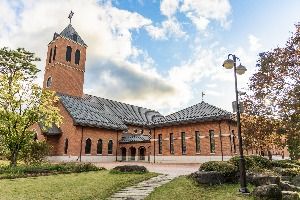
The Catholic Yeonpung Sanctuary is a site sanctified by the Catholic Church since 1974 at the place where believers who lived in seclusion and maintained their faith after the Shinhae Persecution in the 15th year of King Jeongjo of Joseon (1791), including Chu Sunok, Lee Yunil, Kim Byeongsuk, Kim Maldang, and Kim Maru, were executed during the Shinyu Persecution in the 1st year of King Sunjo (1801).
This course is a sample 2-day itinerary. Save it as-is or expand it into an AI itinerary.
Yeonpung Holy Ground of the Catholic Church is the site where believers including Chu Sun-ok, Lee Yoon-il, Kim Byeong-suk, Kim Mal-dang, and Kim Maru lived in seclusion to preserve their faith after the Catholic Persecution of 1791 (Joseon King Jeongjo 15). They were executed at this place during the Catholic Persecution of 1801 (King Sunjo 1). Since 1974, the Catholic Church has sanctified this site. Within the holy ground is the Yeonpung Hyangcheong building and, centered by an 8.5m high cross statue, on the right is a statue and grave of Luka Hwang Seok-du, one of the 103 Korean Catholic Saints. Hwang Seok-du, born in 1813 (King Sunjo 13) in Byeongbanggol, Yeonpung-hyeon, embraced the Catholic faith and devoted his life to religion. He was martyred by beheading at Galmaemot, Chungcheong Province during the Byeongin Persecution alongside Bishop Daeblue, Father Ometre, Father Wiang, and President Jang Joo-gi. On the left side of the holy ground is a monument honoring the martyrs, and the execution stone is displayed as a relic at the entrance. The Yeonpung Hyangcheong building, which had been used as a local government office, military police station, and police substation, was purchased by the Catholic Church and is now used as the Yeonpung chapel's worship place.
Jeokseok-ri Ipseok Village is said to have been established 400 years ago during King Sukjong of Joseon when the ancestors of the Yeonil Jeong family settled here. The ruined temple site called Ipseokam at the mountain pass and Goryeodanggol and Guksadang on the hill behind Ipseok Village suggest it is a village with a long history. Ipseok Pass was a route from Yeongnam past Ihwaryeong (Iyuritjae) or Saejae to Goesan and Seoul, where old scholars rested, an area with a history of sorrow and joy. The pine tree standing at the pass is 21.2m tall with a chest-height circumference of 3.48m, resembling the rank 2 pine of Song Mountain in Sogrisan but with a trunk that leans about 5° diagonally. The upper trunk shows the reddish color characteristic of Jeoksong pines, while the lower part has thick bark. Branches extend evenly in all directions. Estimated to be about 500 years old, it grew at the pass where the Ihwaryeong tunnel entrance is visible before the village existed. Originally it stood with the pine at Guksadang, where village Dongje rituals were held, but only the Ipseok Pass pine remains, serving as the village guardian deity. Until before liberation, a Seonghwangdang was present and rituals were held, but after the Korean War both the shrine and rituals disappeared. This pine, nurtured by ancestors over centuries, has high value as both folk and biological heritage and is designated and protected as a natural monument.
충청북도에서 추진하는 내륙순환 관광도로 명소화 사업의 목적으로 조성한 "조령민속공예촌"은 도자기공예, 한지공예동 등을 중심으로 전통찻집, 전통음식점 등을 갖추어 드라이브 코스와 연결한 관광지이다.
Good places to stop and rest after the course

Booking and payment continue on a partner site.
Check rooms & priceSign up to feature your channel.
(As a member, you can add your Instagram, YouTube, and blog links in My Page, and we’ll show them with every comment you write.)
““Stayed near Hongdae and did a night café tour. Perfect city views and vibes.””
Guest comments do not display social media links or profile cards.
Share a short tip about this place.
Or leave a quick comment as a guest.
Photo attachments are available after login.
No reviews yet. Be the first to share your experience!


