
Traditional Hanji Paper Crafts at the Foot of Joryeongsan in Chungcheongbuk-do Goesan County · schedule Other · distance 9km · 5 stops · highlights Yeon…
Yeonpung-myeon, Goesan-gun, borders Gyeongbuk Mungyeong along Joryeongsan. It is also where Danwon Kim Hong-do served as a county magistrate during the Joseon Dynasty. Sinpung Traditional Hanji Village has an environment suitable for growing the paper mulberry tree, the material for hanji, and offers a chance to try traditional hanji making. The journey also includes visiting notable spots at the foot of Joryeongsan such as Yeonpung-ri Ma-ae-bul, Suok Waterfall, and Joryeongsan Natural Recreation Forest.
This course is a sample one-day itinerary. Save it as-is or expand it into an AI itinerary.
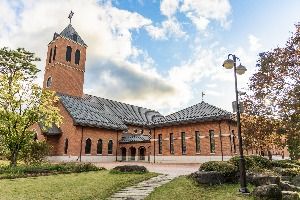
Yeonpung Holy Ground of the Catholic Church is the site where believers including Chu Sun-ok, Lee Yoon-il, Kim Byeong-suk, Kim Mal-dang, and Kim Maru lived in seclusion to preserve their faith after the Catholic Persecution of 1791 (Joseon King Jeongjo 15). They were executed at this place during the Catholic Persecution of 1801 (King Sunjo 1). Since 1974, the Catholic Church has sanctified this site. Within the holy ground is the Yeonpung Hyangcheong building and, centered by an 8.5m high cross statue, on the right is a statue and grave of Luka Hwang Seok-du, one of the 103 Korean Catholic Saints. Hwang Seok-du, born in 1813 (King Sunjo 13) in Byeongbanggol, Yeonpung-hyeon, embraced the Catholic faith and devoted his life to religion. He was martyred by beheading at Galmaemot, Chungcheong Province during the Byeongin Persecution alongside Bishop Daeblue, Father Ometre, Father Wiang, and President Jang Joo-gi. On the left side of the holy ground is a monument honoring the martyrs, and the execution stone is displayed as a relic at the entrance. The Yeonpung Hyangcheong building, which had been used as a local government office, military police station, and police substation, was purchased by the Catholic Church and is now used as the Yeonpung chapel's worship place.
Our ancestors have made paper using various raw materials since ancient times. Representative materials include the bark of the dak tree, bamboo, rice straw, barley straw, and oats, producing papers such as maji, anpiji, and myeonji, each made using methods suited to the characteristics of the raw material. Korean paper is distinguished by primarily using the bark of the dak tree as a raw material. During the off-season of farming, from November to December, one-year-old dak tree branches are harvested and processed through boiling - peeling the bark - drying - soaking to soften the white bark - re-boiling the sufficiently soaked white bark - bleaching - refining fibers - making dak paste - and papermaking to produce hanji. Sinpung Hanji uses purely domestic dak tree bark to produce hanji. To cherish traditional values, the museum operates hands-on classes such as traditional hanji papermaking, wildflower paper making, hanji wish-making, hanji cup coaster making, wildflower paper making experience, and tearing hanji for decoration. Visitors can experience the unique beauty of Korean tradition by visiting with a reservation. The museum, managed by intangible cultural heritage master An Chi-yong, the only hanji museum in the world, displays a thousand-year history of hanji, hanji production tools, and related artifacts. Nearby pottery workshops also allow the purchase of ceramics and accessories.
The Wonpung-ri Ma-ae Buddha Statues are rock carvings created by hollowing out a large 12-meter-high rock and placing two Buddha statues side by side, which is a rare example in Korea. The broad yet strong faces with thin, long eyes and broad mouths appear mostly flat without much volume, but a smile spreads across the faces, giving a firm yet consistently compassionate feeling. The figures have straight shoulders and flat chests, with little body curvature and a formalized style. The robes cover both shoulders, and the folds of the robes are represented with blunt lines in a stylized manner. On the halo symbolizing the light emanating from the bodies, a small Buddha is engraved, but finer details are worn away and hard to discern. Other examples of two Buddhas carved side by side include the Jukryeong Ma-ae Buddha and bronze seated Buddha statues excavated from Daejeon Temple Site, which are believed to reflect the story of Prabhutaratna and Shakyamuni Buddhas from the Lotus Sutra. According to legend, the statues were either created by the high monk Yeosangjosa of Beomeosa Temple in the late Silla period or by Naong Daesa in the Goryeo period, but they are estimated to be works from the 12th century during the mid-Goryeo period.
Suokjeong Tourist Site is a tourist destination embracing the natural scenery of Suok Waterfall and Yeonpung Saejae, surrounded by famous mountains such as Joryeongsan, Mapaebong, and Sinseonbong. It is home to Yeonpung Holy Ground, Joryeongsan Recreational Forest, Ocheon Bicycle Path, and Saejae Bicycle Path, attracting many visitors year-round. Located near a reservoir, it features Yeonpung Saejae Waterside Ecological Park and an outdoor water playground. There are deck roads, observatories, and waterside walking trails, with nighttime scenic lighting installed for evening strolls. Suok Waterfall flows down from Joryeong's 3rd Gate towards Sojoryeong, beside which stands the pavilion called Suokjeong. From Suokjeong, it is possible to walk to Mungyeong Saejae 3rd Gate, with a gentle slope and scenic views all the way to Mungyeong 1st Gate. In summer, the outdoor water playground at Suokjeong operates using water from Joryeongsan.
This recreation forest is located at the foothills of Joryeongsan, which stands 1,025m above sea level on the border of Chungcheongbuk-do and Gyeongsangbuk-do. The forest is densely populated with colonies of old pines and oaks, as well as various rare trees, preserved in their natural state. Spectacular rocky formations connect Sinseonbong Peak (967m) and Mayeokbong Peak (927m), and the Suok Waterfall cascades down a 15m cliff of dramatic rock faces. There are several hiking trails of varying lengths leading up to Joryeongsan. Facilities in the recreation forest include forest houses, a forest bath, gazebos, an outdoor stage, playgrounds, and forest playgrounds, with a water play area open in July and August. Additionally, there are rope play facilities, a sand play area, hammocks, and swings. The Baekdudaegan Ecological Education Center below the playground offers education and exhibitions on forests, and free woodcraft experiences. Nearby tourist attractions include Suanbo Hot Springs, Mungyeong Saejae Provincial Park, Joryeong Samgwanmun built to block Japanese invaders during the Imjin War, Mayeokbong, Suok Waterfall, Mireuk Temple Site, and Songgye Valley.
Good places to stop and rest after the course

Booking and payment continue on a partner site.
Check rooms & price
Booking and payment continue on a partner site.
Check rooms & priceSign up to feature your channel.
(As a member, you can add your Instagram, YouTube, and blog links in My Page, and we’ll show them with every comment you write.)
““Stayed near Hongdae and did a night café tour. Perfect city views and vibes.””
Guest comments do not display social media links or profile cards.
Share a short tip about this place.
Or leave a quick comment as a guest.
Photo attachments are available after login.
No reviews yet. Be the first to share your experience!


