
Tour of four major religious sacred sites under Mount Moak in Jeonbuk Special Self-Governing Province Gimje City · schedule Other · distance 17.8km · 4…
Moaksan, standing on the boundary between Gimje and Wanju, embraces everything like a mother's warm embrace. Under Moaksan, there remain religious sites of Buddhism, Protestantism, Catholicism, and Jeungsanism. These include Geumsansa and Gwisin Temple representing Buddhism, Geumsan Church for Protestantism, Suryu Cathedral for Catholicism, and Donggok Pharmacy of Jeungsanism. Each religion offers distinctly different feelings and landscapes when visited. Removing religious prejudices and exploring these sites makes for an exceptionally beautiful journey.
This course is a sample one-day itinerary. Save it as-is or expand it into an AI itinerary.
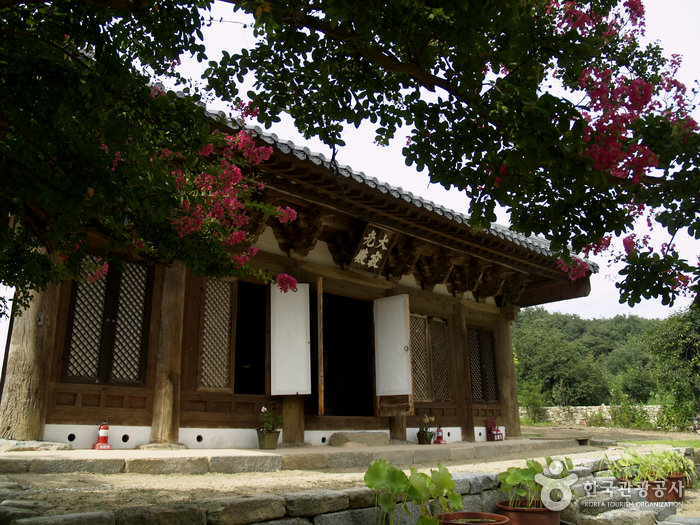
Gwisinsa is a branch temple of Geumsansa, the head temple of the 17th district of the Jogye Order of Korean Buddhism, located in Cheongdo-ri, Geumsan-myeon. It is known to have been established by Uisang Daesa in 676 (the 16th year of King Munmu), but there is also a claim that it was first founded as the royal Naewonsa during the Baekje King Beopwang era. The original name was Guksinsa. Later, it was renovated by Doyun in the late Unified Silla period and renamed Gwisinsa. In the Goryeo era, it was reconstructed by Wonmyeongguksa (1090–1141) and was called Gusunsa around that time. After several partial repairs and major reconstructions, including the restoration of Daejeokgwangjeon in 1934, the name was changed back to Gwisinsa. Originally, Gwisinsa was a large temple overseeing Geumsansa; during the late Goryeo period, about 300 Wako invaders were stationed there. Now it has declined and remains a small, quaint temple. Its main cultural assets include the National Treasure Daejeokgwangjeon, a three-story stone pagoda, a Buddhist stupa (budo), and stone guardians. The three-story stone pagoda is presumed to have been made at the time of the temple's founding, representing exquisite Silla-era aesthetics. The budo is located in a rice field at the entrance to Cheongdowon village, indicating that the temple grounds once extended to that area. The Gwisinsan stone guardian features a unique style, with a phallic-shaped stone pillar prominently placed on the back of the seated guardian. This distinctive stone structure combines Buddhist philosophy and phallic worship beliefs, with theories that it was erected either to suppress the land or as a wish for blessings by the Baekje royal family.
Geumsan Church is a hanok church built in 1908 by missionary Lewis Boyd Tate of the Jeonju line. According to the historical records of the Joseon Jesus Presbyterian Church, the original church was built in 1905 with five kan, but it was moved and rebuilt at its current location in 1908. Next to Geumsan Church, a new church building and parsonage were constructed in 1988. The building is five kan long in the north-south direction, with two additional kan extended eastward, forming an inverted L shape. The interior is open with a pulpit installed where the five-kan north-south section meets the two-kan east section, separating seating for men to the south and women to the east. This layout is a unique feature of early Korean church architecture, addressing traditional Korean social gender separation by providing separate worship spaces within an L-shaped building. The church harmoniously combines traditional Korean architectural styles with Western church features, serving as an important structure for studying the indigenization process of early Korean church architecture. The preservation status of each structure is good, and it is designated and conserved as a cultural asset.
Geumsansa Temple was founded during the Baekje period and has a history of over 1,400 years, keeping its Buddhist light shining to this day as a historically significant temple. It is located on the western foothills of Moaksan Mountain, which rises prominently in the Honam Plain. The temple suffered hardships such as complete destruction of all buildings and about 40 hermitages inside the mountain due to arson by Japanese troops during the Imjin War. However, many cultural properties have been established thereafter and are preserved to the present day. (Source: Geumsansa homepage)
Geumpyeong Reservoir is an agricultural irrigation reservoir located in Geumsan-ri, Geumsan-myeon, known for never drying up due to water flow from Moaksan Mountain. It is situated on the road from Geumsan-myeon office heading toward Geumsansa Temple. The area around Geumpyeong Reservoir, called Orialteo, features a wildflower complex and well-developed walking trails. The name Orialteo was given following a prophecy by Doseon, a geomancer from the late Silla period, who predicted it would become a place where ducks lay eggs. As part of the Moaksan mountain beautification project, facilities like the Geumpyeong Side Path Trail have been constructed, making it both a sightseeing spot and a resting area. The total 3.5 km Geumpyeong Side Path Trail consists of three courses (Section 1, Section 2, Section 3) and an embankment path, with a total walking time of about one hour. Section 1 includes a 1 km waterside deck road and waterside ecological forest, Section 2 a 0.8 km waterside deck road, Section 3 a 1.2 km waterside deck road and natural forest road, and the embankment path is a 0.5 km concrete paved road. A pavilion by the waterside allows visitors to rest and cool down in the shade of lush trees. The reservoir has clean water due to few pollution sources nearby and is also famous as a winter migratory bird site in Korea.
Sign up to feature your channel.
(As a member, you can add your Instagram, YouTube, and blog links in My Page, and we’ll show them with every comment you write.)
““Stayed near Hongdae and did a night café tour. Perfect city views and vibes.””
Guest comments do not display social media links or profile cards.
Share a short tip about this place.
Or leave a quick comment as a guest.
Photo attachments are available after login.
No reviews yet. Be the first to share your experience!


