
Romance and Memories at Yeongnam Only Public Observatory in Gyeongsangnam-do Gimhae City · schedule Other · distance 10.8km · 3 stops · highlights Chosu…
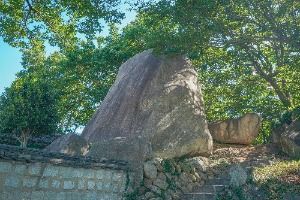
While admiring Choseondae Maaebul, crafted by a truly skilled artisan, you can feel as if a celestial being has descended. Follow Eunha Temple to find traces of Garak Buddhism. The delicate and ancient scenery makes it a perfect quiet date spot. The next course leads to Gimhae Observatory. It is also nice to enjoy the night view overlooking all of Gimhae city while discovering which constellation you belong to.
This course is a sample one-day itinerary. Save it as-is or expand it into an AI itinerary.
The Chosundae Ma-ae Buddha Seated Statue is a rock-carved Buddha located on the cliff of Chosundae at Geumseonsa Temple in Gimhae-si. Chosundae means "inviting immortals" and is also called Chohyeondae, meaning "inviting sages." According to legend, King Gedeung of Garakguk invited an immortal residing on Chiljeomsan Mountain to Chosundae, where they enjoyed playing the geomungo and baduk. Because of this legend, this rock-cut Buddha is also said to be a portrait of King Gedeung. It shows the regional style of Goryeo period rock-carved Buddhas with a shaved head, narrow and long eyes, a broad nose, and thick, wide lips. The body is simply depicted with lines, lacking volume and appearing flat, and the halo is separated by lines with no patterns, making it plain. The overall atmosphere well represents the large-scale rock-carved Buddha style frequently made during the Goryeo period. (Source: National Heritage Agency)
Eunhasa is a mountain temple located halfway up Sineosan in Sambang-dong, Gimhae-si, and is said to be named after Eunhasan, the old name of Sineosan. It is believed that Eunhasa was founded by Jangyuhwa, the older brother of Heo Hwang-ok, the queen of King Suro, the founder of Garakguk, and was originally called Seorimsa. The buildings existing before the mid-Joseon period were destroyed by fire during the Japanese invasions of 1592–1598, and the Daeungjeon was reconstructed in 1629 (7th year of King Injo) and restored twice more in 1649 (1st year of King Hyojong) and 1801 (1st year of King Sunjo). The Daeungjeon Sumidan of Eunhasa, designated as a Gyeongsangnam-do Tangible Cultural Property, features a twin fish pattern presumed to be related to Heo Hwang-ok and is constructed in a single-story Dapo style with a three-bay front and three-bay side. The building is uniquely almost square in shape, with similar lengths on the front and side, differing from other architectures. Lotus carvings adorn the metal support tops outside, and dragon and phoenix heads are intricately carved on the inner and outer Salmi beams. Inside, nine bo-gai (jeweled canopies) are installed above the Buddha statue, along with 32 murals, including the Samsebul and Arhat figures, which are also designated as a Gyeongsangnam-do Tangible Cultural Property. Eunhasa is also known as a filming location for the movie "Dalmaya Nolja."
Opened on February 1, 2002, as part of the 1998 Millennium project to satisfy the public's curiosity about celestial bodies and space, inspire dreams and hope in growing youth, and provide romance and memories for citizens. The observatory's shape resembles an egg, originating from the legend that King Suro, the founder of Garakguk formed in the Gimhae area before the Common Era, was born from an egg. King Suro's queen, Heo Hwang-ok, is known as a princess from Ayuta Country in India, and it is reasonably assumed she navigated by the stars on her voyage to Garakguk without advanced navigation tools. Additionally, there is a historic record that a prince of Garakguk built an ancient astronomical observatory called 'Bibidan' on the Jinrye Toseong mound for star observation. Considering these historical facts, the Gaya confederacy centered around Gimhae had a deep relationship with the stars. Thus, the establishment of Gimhae Observatory is significant not only as a public observatory but also for continuing the astronomical culture of Gaya in the modern era. From the summit of Bunseong Mountain, where the observatory is located, visitors can enjoy a panoramic view of Gimhae city, with the night view being especially beautiful. Gimhae Observatory offers celestial observation, various experiential programs, and attractions, serving as a science and culture space to appreciate the mysteries of the universe and the beauty of the night sky.
Good places to stop and rest after the course

Booking and payment continue on a partner site.
Check rooms & priceSign up to feature your channel.
(As a member, you can add your Instagram, YouTube, and blog links in My Page, and we’ll show them with every comment you write.)
““Stayed near Hongdae and did a night café tour. Perfect city views and vibes.””
Guest comments do not display social media links or profile cards.
Share a short tip about this place.
Or leave a quick comment as a guest.
Photo attachments are available after login.
No reviews yet. Be the first to share your experience!


