
Meeting Gaya, the Iron Age Powerhouse in Gyeongsangnam-do Gimhae City · schedule Other · distance 11.6km · 4 stops · highlights Eunhasa, Gimhae Daeseong…
Gimhae is the region of Gaya, which preserves a lost history. After King Suro founded the Garak Kingdom in the Gimhae area in 42, it grew greatly based on a rich iron culture until it was annexed by Silla in 532. You can enjoy the history of Gaya centered around Gimhae city, including the Tomb of King Suro and the Tomb of Queen Suro, which reveal the founding history of the Garak Kingdom, the Daeseong-dong Ancient Tombs showing traces of Gaya as a central nation, and the Bonghwang-dong Site reflecting Gaya’s history as a maritime power based on iron culture.
This course is a sample one-day itinerary. Save it as-is or expand it into an AI itinerary.
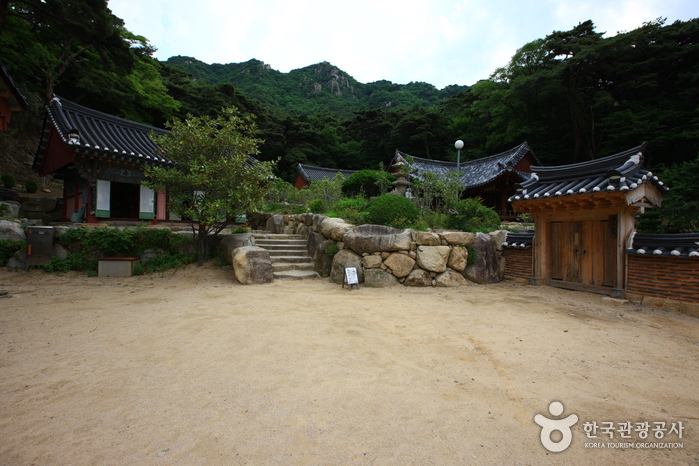
Eunhasa is a mountain temple located halfway up Sineosan in Sambang-dong, Gimhae-si, and is said to be named after Eunhasan, the old name of Sineosan. It is believed that Eunhasa was founded by Jangyuhwa, the older brother of Heo Hwang-ok, the queen of King Suro, the founder of Garakguk, and was originally called Seorimsa. The buildings existing before the mid-Joseon period were destroyed by fire during the Japanese invasions of 1592–1598, and the Daeungjeon was reconstructed in 1629 (7th year of King Injo) and restored twice more in 1649 (1st year of King Hyojong) and 1801 (1st year of King Sunjo). The Daeungjeon Sumidan of Eunhasa, designated as a Gyeongsangnam-do Tangible Cultural Property, features a twin fish pattern presumed to be related to Heo Hwang-ok and is constructed in a single-story Dapo style with a three-bay front and three-bay side. The building is uniquely almost square in shape, with similar lengths on the front and side, differing from other architectures. Lotus carvings adorn the metal support tops outside, and dragon and phoenix heads are intricately carved on the inner and outer Salmi beams. Inside, nine bo-gai (jeweled canopies) are installed above the Buddha statue, along with 32 murals, including the Samsebul and Arhat figures, which are also designated as a Gyeongsangnam-do Tangible Cultural Property. Eunhasa is also known as a filming location for the movie "Dalmaya Nolja."
The Daeseongdong Tumuli site is located between Gujibong, where the founding myth of Gaya resides, and Hoihyeon-ri shell mound known for Gimhae shell mounds, with King Suro's tomb adjacent to the east. It was discovered when part of a relic was exposed while plowing a field and excavated by Kyungsung University Museum from 1990, revealing two royal tombs from Geumgwan Gaya from the late 4th to early 5th centuries, and 37 various tombs including numerous queen tombs from the late 3rd to early 5th centuries. On well-situated hill ridges are tombs of kings and corresponding ruling class, while the slopes hold graves of lower-status commoners. The cluster has 136 tombs including wooden coffin tombs, wooden chamber tombs, jar coffin tombs, stone chamber tombs, and horizontal stone chamber tombs, with wooden chamber tombs being predominant. Artifacts found include garments possibly from the Buyeo state and horse-riding equipment and armor dating to after the 5th century found in mid-4th century tombs, indicating horseback riding spread to the Gaya region by mid-4th century. Other relics also show northern cultural elements. Since July 2001, a tomb exhibition hall and open-air exhibition hall have displayed burial styles and artifacts, and in August 2003, the Daeseongdong Tomb Museum opened to showcase Gaya-era artifacts and lifestyle, developing the site as a historical destination.
The tomb of King Suro, the founder of Geumgwan Gaya, located in Seosang-dong, Gimhae-si, is designated as a historic site. It is a round-shaped mound approximately 5 meters high, with buildings such as Sungsunjeon (where the spirit tablet is enshrined), Anhwangak (for storing incense and sacrificial tools used in spring and autumn rites), Jeonsacheong, and Jegigo. There are also stone structures like the spirit monument and the merit monument. Major historic sites of Suro Royal Tomb include Sungsunjeon, Anhwangak, Nambyeong main gate (the main gate of the royal tomb), and Gujibong, which is a formation of ten turtles grouped together. King Suro ascended the throne as the founder of Garakguk in 42 AD, married Princess Heo Hwang-ok from the Indian Yautya Kingdom in 48 AD, and is the progenitor of the Gimhae Kim clan. In the 13th year of Seonjo's reign (1580), Yeongnam Governor Heo Yeop reportedly renovated the tomb into its current form. Inside the tomb are spirit tablets of King Suro and Queen Suro; spirit tablets are places where the soul of the deceased rests, referring to a portrait or document of the deceased. The tombstone in front of the tomb was erected in the 25th year of King Injo's reign (1647), and the name Sungsunjeon was bestowed by the king in the 21st year of King Gojong's reign (1884).
Sureungwon is a space dedicated to commemorating King Suro, the founder of Gaya. It symbolizes an elegant forest connecting King Suro's tomb and the Daeseong-dong tomb complex, envisioned as a garden where King Suro and Queen Heo once walked together. Sureungwon is a 39,600㎡ ecological park themed on the meeting of King Suro and Queen Heo. The walking path to the east honors King Kim Suro, the founder of Garak-guk, with straight trees such as Korean nutmeg yew, hawthorn, and sawtooth oak, giving a masculine feel. The west side, passing the Daeseong-dong tomb complex, is dedicated to Queen Heo, with fruit-bearing trees like wild persimmon, Korean pear, apricot, and peach. The garden pond symbolically represents the maritime kingdom of Gaya and features plants like spiny lotus and yellow waterlily, presumed to have inhabited the wetlands of the ancient Gaya period. Key facilities include areas dedicated to King Suro and Queen Heo, a main courtyard, Gayaru, the Garden of Memory, the Garden of Contemplation, a pond-stream-spring, and a folk museum. Nearby are King Suro's tomb and the Daeseong-dong tomb complex, with the Gimhae Folk Museum and Gimhae Hanok Experience Center adjacent, offering a comprehensive view of the history, culture, and lifestyle of the Gaya era.
Good places to stop and rest after the course

Booking and payment continue on a partner site.
Check rooms & priceSign up to feature your channel.
(As a member, you can add your Instagram, YouTube, and blog links in My Page, and we’ll show them with every comment you write.)
““Stayed near Hongdae and did a night café tour. Perfect city views and vibes.””
Guest comments do not display social media links or profile cards.
Share a short tip about this place.
Or leave a quick comment as a guest.
Photo attachments are available after login.
No reviews yet. Be the first to share your experience!


