Meeting a Thousand Year Old Temple Hidden on Rugged Mountain Slopes in Gyeongsangbuk-do Gimcheon City · schedule Other · distance 46.1km · 5 stops · hig…
Gimcheon is a large city but also an area characterized by rugged mountain ranges exceeding 1,000 meters in elevation. On the slopes of Hwangaksan, the millennium-old temple Jikjisa founded by monk Adohwa is preserved. On Sudosan, Cheongamsa, where Queen Inhyeon is said to have stayed after her deposition, and the scenic Sudouam are located. Near the entrance of Jikjisa, it is also good to visit Jikji Cultural Park, ideal for walking, as well as the World Ceramic Museum and Baeksu Literary Museum.
This course is a sample one-day itinerary. Save it as-is or expand it into an AI itinerary.
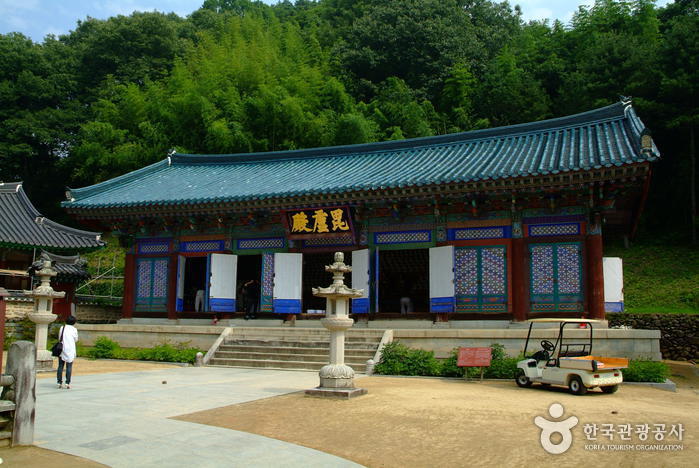
Jikjisa Temple, located at the foot of Hwangaksan Mountain, is the head temple of the 8th district of the Jogye Order of Korean Buddhism. It was founded in 418 (2nd year of King Nulji of Silla) by Monk Ado along with Dorisa Temple. Later, it was restored by Jajang in the 14th year of Queen Seondeok's reign (645) and by Cheonmuk in the 4th year of King Gyeongsun's reign (930). In 936 (19th year of King Taejo of Goryeo), Neungye rebuilt it with royal assistance. It was destroyed during the Japanese invasions but was restored over 60 years starting from 1610 (2nd year of King Gwanghaegun’s reign). The name Jikjisa either refers to Hwangaksan Mountain, meaning “there is a good temple site over there,” or comes from the theory that during the early Goryeo period monk Neungye measured the temple site using his own hands instead of a ruler. During the Joseon Dynasty, Monk Hakjo served as head monk, and Monk Yujeong began his monastic life here. Existing buildings include Daeungjeon (Main Buddha Hall), Birojeon (housing 1,000 baby Buddhas), Geungnakjeon, Eungjinjeon, Gwaneumjeon, Namwollyo, Myeongbujeon, Yaksajeon, Seolbeopjeon, Mandeokjeon, Josajeon, Jehadang, Myeongwollyo, Cheongpungryo, Samyeonggak, and Beomjonggak. There is also an Iljumun gate made of a thousand-year-old kudzu root and a Robinia wood pillar, Geumgangmun gate, and Sacheonwangmun gate. In 2002, it was the first temple in Korea to officially host a temple stay program for foreign ambassadors, offering meditation and relaxation experiences.
Jikji Cultural Park, located at the entrance of Hwangaksan Jikjisa, was established to prevent indiscriminate development around the area, preserve the traditional temple, develop tourism resources, and provide a resting space for citizens. Centered around a musical fountain sculpture, the park features three plazas, a large waterfall, a comprehensive children's playground, acupressure footpaths, walking trails, pavilions and shade tents, benches, and various convenience facilities. The park contains numerous sculptures and poetry monuments scattered throughout, resembling an outdoor exhibition space. Additionally, there are large jangseung (traditional Korean totem poles), a traditional fence, and various plants including pine trees. Visitors can enjoy viewing the sculptures and walking during the day, and at night there is a refreshing fountain show with nighttime lighting. Next to Jikji Cultural Park are the Gimcheon World Ceramic Museum and Samyeongdaesa Park.
35년간 산채요리를 전문으로 취급하고 있다. 산채를 구입하여 각종 산채회, 무침 등을 만들고 있으며 계절에 따라 메뉴가 변경된다. (봄-산채종류, 가을-버섯종류) 탑라이스 브랜드 쌀로 밥을 지어 손님상에 내고 있다. 1979년 모범업소 1호로 지정되었으며, KBS 에도 참가한 바 있다.
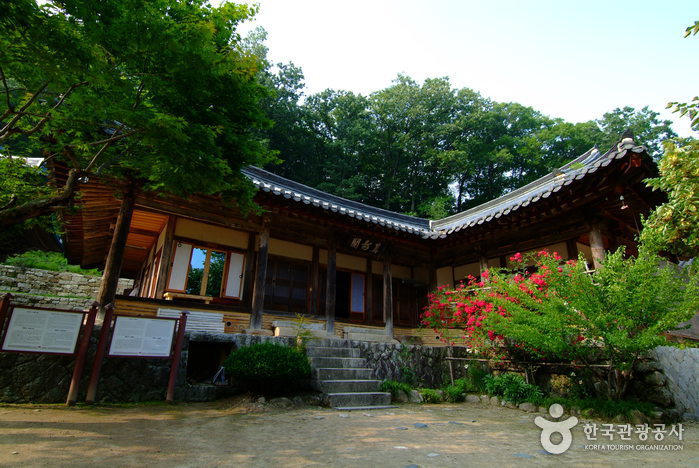
Cheongamsa Temple is located on Bulyongsan Mountain and is a branch temple of Jikjisa Temple, the 8th district of the Jogye Order of Korean Buddhism. It is an ancient temple established by Doseon Guksa in the 3rd year of King Heonan of Silla (859). According to historical records, it was completely destroyed by fire in the 25th year of King Injo of Joseon (1647), but upon hearing this, monk Byeokam Gakseong ordered monk Heojeong Hyewon to rebuild it, and Hyewon devoted great effort to reviving Cheongamsa Temple. Later, during the time Queen Inhyeon, wife of King Sukjong, was associated with the Seoin faction, she performed special prayers at the temple's Geukrakjeon Hall, establishing a close connection with the royal family. The red pine forest of Bulyongsan was designated a national protected forest, and weapons and other items were bestowed from the royal court. Cheongamsa Temple was also famous as a place where royal concubines practiced their faith until the late Joseon period.
Sudoam is a temple located in the upper area of Sudosan Mountain (1,317m). Together with Cheongamsa, it was founded as a branch temple of Ssanggyesa by Doseon Guksa. Although its early history is unknown, it was burned down by the peasant army during the Donghak Revolution in 1894 and rebuilt by Po-eun Hwasang in 1900. Since 1969, Beopjeon Hwasang has repaired the buildings and established a Seonwon (meditation center), achieving many Buddhist constructions. Currently, it has the main hall Daejeokgwangjeon, Yakgwangjeon, Nahanjeon, Gwaneumjeon, and a Seonwon. Sudoam houses designated cultural properties such as the Stone Seated Vairocana Buddha Statue (treasure), the East and West Three-story Stone Pagodas (treasure), and the Stone Bodhisattva Seated Statue (treasure).
Sign up to feature your channel.
(As a member, you can add your Instagram, YouTube, and blog links in My Page, and we’ll show them with every comment you write.)
““Stayed near Hongdae and did a night café tour. Perfect city views and vibes.””
Guest comments do not display social media links or profile cards.
Share a short tip about this place.
Or leave a quick comment as a guest.
Photo attachments are available after login.
No reviews yet. Be the first to share your experience!