
Resting place loved by Dasan in Jeollanam-do Gangjin County · schedule Other · distance 6.61km · 4 stops · highlights Gangjin Baegundong Byeolseo Garden…
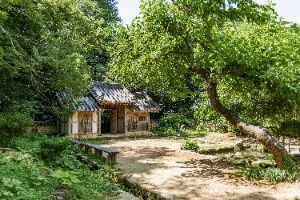
Baegundong Byeolseo Garden, located in Gangjin, is the most beautiful place in autumn and is one of the three major private gardens in Honam. It is a private garden created and where the mid-Joseon scholar Idamro lived in seclusion.
This course is a sample one-day itinerary. Save it as-is or expand it into an AI itinerary.
Baegundong Byeolseo Garden was designed and established by the mid-Joseon scholar Idamro (1627~1701), who inscribed 'Baegundong' (literally 'White Cloud Valley') on a rock beside the valley. It is a villa garden where nature and artificial elements are harmoniously combined with a well-organized layout, preserving the original form of traditional Korean gardens. The name Baegundong means 'a village where water flowing down from Wolchulsan becomes mist and rises as clouds,' historically the site of Yaksam and Baegunam hermitages. Situated with views of the jagged rocks of Wolchulsan ridges, it exhibits the typical style of traditional Honam gardens. This location also lies along the Samnam Trail starting from Haenam. The current structures reflect the 1812 visit of scholar Dasan, who, enchanted by the scenery, had his disciple Seonsa Choi paint 'Baegundongdo' and composed poems about Baegundong's twelve scenic spots, which served as the basis for restoring the historic villa garden appearance. Idamro created an elegant curved watercourse with nine bends from Okpanbong’s flowing water and built a pavilion. The harmonious mix of flowers and trees in the valley invites lingering gaze, shifting to the peaks for a profound appreciation of the scenery. The Baegundong valley is designated as a Gangjin local cultural heritage and, along with Soswaewon in Damyang and Seoyeonjeong in Bogildo, Wando, is counted among Honam’s three major gardens, an important cultural asset reflecting the mid-Joseon scholars’ hermit culture. [Source: Gangjin County Cultural Tourism website]
Wolchulsan, counted among the three great rocky mountains along with Seoraksan and Juwangsan in Cheongsong, spans north to Yeongam-gun and south to Gangjin-gun along its main ridge. Among the many valleys of Wolchulsan, the Geumneung Gyeongpodae valley in Wollam-ri, Seongjeon-myeon, Gangjin-gun is famous for its beauty. Named because the stream flowing from Cheonhwangbong and Gujeongbong on Wolchulsan looks like a long strip of unbleached cotton fabric, this valley has clear water winding between large and small rocks. Compared to other valleys on Wolchulsan, it generally has a gentle slope and cold water, making it perfect for summer retreats. The course from Gyeongpodae Exploration Support Center along the Gyeongpodae valley to Baramjae and then to Cheonhwangsa takes about 4 hours. Nearby, Seollok Tea Garden Gangjin, tea fields, and Baegundong Garden are also nice to visit.
According to the historical records of Muwisa, the first major reconstruction was carried out in 875 (Heon-gangwang 1) by Dosun Guksa, who founded it as Garoksa Temple. Shortly after, in 905 (Hyogongwang 9), Seongak Guksa Hyeongmi (864–917), a Seon master of the Gajisanmun lineage, stayed at Muwigapsa at the request of Goryeo's founder King Taejo Wang Geon, reconstructing the temple and widely spreading teachings gaining popular support. Thus, Muwisa was founded as Muwigapsa before the early 10th century when Hyeongmi resided there. However, the records state that in 946 (Jeongjong 1), Hyeongmi renamed the temple Moyoksa during a third reconstruction, but 946 was 30 years after Hyeongmi's death and the year the stele for the Goryeo State Muwigapsa Seongak Dae-sa Pyeon-gwang Yeong-tap was erected, making this unlikely. This is probably a later misunderstanding of Hyeongmi's major reconstruction with Wang Geon's support and his propagation of Buddhism. It is clear that Muwisa was founded before the early 10th century, reconstructed by Hyeongmi, and was a Seon temple of the Gajisanmun branch.
Gangjin Dawon is a tea plantation operated by 'Taepyeongyang Dawon,' a leader in Korea's tea production industry, covering an area of 33.3 hectares. The plantation features gentle curves and vibrant greenery, creating a perfect harmony with the towering rocks of Wolchulsan. Wolchulsan is known for its mountain range surrounded by large rocks resembling folding screens, and tea trees have been cultivated here since ancient times around various temples. The renowned scholar Dasan Jeong Yak-yong once praised the tea from Wolchulsan as the second best in the world. Each early May, the foothills of Wolchulsan are painted a dazzling blue-green. In May, Gangjin Dawon has become a tourist attraction not only for tea ceremony enthusiasts but also for general visitors. Guests can enjoy more than sightseeing and photography—they can indulge in the subtle aroma of tea and try a unique experience of picking green tea leaves. While the lush green tea fields are beautiful, the winter scenery of Dawon also offers a new perspective for appreciating the tea fields.
Good places to stop and rest after the course

Booking and payment continue on a partner site.
Check rooms & price
Booking and payment continue on a partner site.
Check rooms & price
Booking and payment continue on a partner site.
Check rooms & priceSign up to feature your channel.
(As a member, you can add your Instagram, YouTube, and blog links in My Page, and we’ll show them with every comment you write.)
““Stayed near Hongdae and did a night café tour. Perfect city views and vibes.””
Guest comments do not display social media links or profile cards.
Share a short tip about this place.
Or leave a quick comment as a guest.
Photo attachments are available after login.
No reviews yet. Be the first to share your experience!


