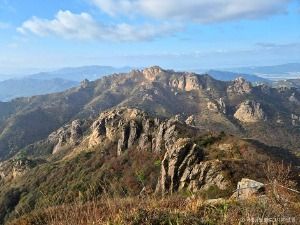
Unchanging scenery seen from Wolchulsan and Baengnyeonsa in Jeollanam-do Gangjin County · schedule Other · distance 41.9km · 4 stops · highlights Baekry…

The dense pine and fir trees of Wolchulsan and the clear blue of Baengryeonsa Temple embody a consistent strength and beauty that remain unchanged even upon seeing them again. The scenery of Baengryeonsa itself is incomparably beautiful. If you visit the historically significant Wolnamsaji Site and also tour Muwoisa Temple and Wolchulsan National Park, you can truly appreciate the mountain terrain of Gangjin.
This course is a sample one-day itinerary. Save it as-is or expand it into an AI itinerary.
Baekryeonsa Temple is said to have been founded during the reign of Munsung of Silla by the monk Muyeom (801–888) under the name Mandeoksa, following the mountain’s name. It later declined but was rebuilt on the old site in the 7th year of King Huijong of Goryeo by the monk Wonnyeom Yosae, gaining fame through the Baekryeon Order and becoming known as Baekryeon Temple. In the Joseon era, it was well-known as a place where Dasan Jeong Yak-yong, exiled to Gangjin, communicated and exchanged ideas beyond religion and age with the monk Am Hyejang. Mandeoksan, where Baekryeon Temple and Dasan Chodang are located, has many wild tea plants and has long been called Dasan (Tea Mountain). Jeong Yak-yong adopted the pen name 'Dasan' to represent his time in exile here. Another pride of Baekryeon Temple, important in the late Joseon tea culture revival, is the natural monument No. 151, a 1,500-tree camellia forest. The flowers begin blooming from late November and reach full bloom around late March, with fallen flowers coloring the ground red again in April. Baekryeon Temple offers various templestay programs such as relaxation, group experience, and tea ceremony experiences, with Dasan Chodang and Dasan Museum nearby.
Wolnamsaji is a temple site located on the flatland of Wollnam village below the south of Wolchulsan, covering a total area of 10,000 pyeong with a frontage of 175m and a side length of 185m. It is said to have been founded by Jin-gak Guksa Hyesim (1178–1234) during the Goryeo Dynasty. It is presumed to have been larger than the nearby Muisa in terms of scale and terrain, but now only two relics remain: the three-story stone pagoda (Treasure No. 298) and the Jin-gak Guksa memorial monument (Treasure No. 313). According to Muisa’s historic record, all surrounding temples were burned during the Japanese invasions of Imjin, so it is assumed that Wolnamsaji was closed at that time. Excavations confirmed that the three-story stone pagoda at Wolnamsaji consists of two towers of the same size placed at the center of the main hall, a form mostly typical of the late Unified Silla period, making Wolnamsaji, established in the Goryeo Dynasty, of very high academic value. After excavation, the site was reburied overall, the presumed building locations were raised with additional soil, and foundation stones and core stones were laid where pillars once stood to clearly indicate the building's shape. Nearby are Seollok Tea Garden Gangjin, Baegundong Garden, and Geumneung Gyeongpodang, where visitors can enjoy a tranquil atmosphere.
According to the historical records of Muwisa, the first major reconstruction was carried out in 875 (Heon-gangwang 1) by Dosun Guksa, who founded it as Garoksa Temple. Shortly after, in 905 (Hyogongwang 9), Seongak Guksa Hyeongmi (864–917), a Seon master of the Gajisanmun lineage, stayed at Muwigapsa at the request of Goryeo's founder King Taejo Wang Geon, reconstructing the temple and widely spreading teachings gaining popular support. Thus, Muwisa was founded as Muwigapsa before the early 10th century when Hyeongmi resided there. However, the records state that in 946 (Jeongjong 1), Hyeongmi renamed the temple Moyoksa during a third reconstruction, but 946 was 30 years after Hyeongmi's death and the year the stele for the Goryeo State Muwigapsa Seongak Dae-sa Pyeon-gwang Yeong-tap was erected, making this unlikely. This is probably a later misunderstanding of Hyeongmi's major reconstruction with Wang Geon's support and his propagation of Buddhism. It is clear that Muwisa was founded before the early 10th century, reconstructed by Hyeongmi, and was a Seon temple of the Gajisanmun branch.
월출산은 “달 뜨는 산”이라는 이름에 걸맞게 아름다운 자연경관과 유수한 문화자원, 그리고 남도의 향토적 정서가 골고루 조화를 이룬 한반도 최남단의 산악형 국립공원이다. 소백산맥이 목포 앞 바다로 흘러가다 평지에 돌출된 잔구 형태의 월출산은 천황봉(809m)을 중심으로 산 전체가 수석의 전시장이라 할 만큼 기암괴석으로 이루어져 있다.
Sign up to feature your channel.
(As a member, you can add your Instagram, YouTube, and blog links in My Page, and we’ll show them with every comment you write.)
““Stayed near Hongdae and did a night café tour. Perfect city views and vibes.””
Guest comments do not display social media links or profile cards.
Share a short tip about this place.
Or leave a quick comment as a guest.
Photo attachments are available after login.
No reviews yet. Be the first to share your experience!