Field Trips at Cheongok Cave and a Cozy Autumn Sea in Gangwon Special Self-Governing Province Donghae City · schedule Other · distance 24.7km · 5 stops…

Designated as Gangwon-do Tangible Cultural Property No. 63 on May 30, 1979. It is managed by the Samcheok Sim clan (三陟沈氏) clan association. It is a pavilion built in 1361 (10th year of King Gongmin of Goryeo) by Sim Dong-ro (沈東老), the progenitor of the Samcheok Sim clan, after retiring to the countryside.
This course is a sample 2-day itinerary. Save it as-is or expand it into an AI itinerary.
This pavilion, built on the coast of Nopyeong-dong, Donghae-si, offers outstanding scenery with a harmony of surrounding oddly shaped rocks and the sea. Haeamjeong Pavilion was originally founded by Sim Dong-ro in the 10th year of King Gongmin of Goryeo (1361), but was lost. It was rebuilt in 1530 (the 25th year of King Jungjong of Joseon) by Sim Eon-gwang, the 7th generation descendant, who served as the Gangwon-do Chief Inspector, and once again renovated in 1794 (the 18th year of King Jeongjo) to become what it is today. The building is a pavilion style with a low single-tiered stone foundation, three bays wide in front and two bays deep on the side, topped with a hipped roof. All four sides have only pillars without walls. Behind it is a rock mountain slightly higher than the roof, adding to the charm. The sunrise view seen here is said to be spectacular.
Chuam Candle Rock, a famous spot in Donghae-si, is a breathtaking place where unusual underwater rock formations blend with the sea backdrop. The candle-shaped, strange and exquisite rocks rise like a group piercing the sky, creating a truly spectacular sight. The sea surrounding Candle Rock and nearby bizarre rock clusters constantly changes its appearance. On stormy days, waves hide the rocks in white foam, resembling a dragon ascending; on calm days, the sea gives the impression of a deep lake. The sunrise here is very well-known, attracting many travelers and photographers. It is said that scholar Song Si-yeol of the Wooam era once visited this site and was reluctant to leave. The sunrise over Candle Rock and Brother Rock is frequently featured in the background of the first verse of the national anthem.
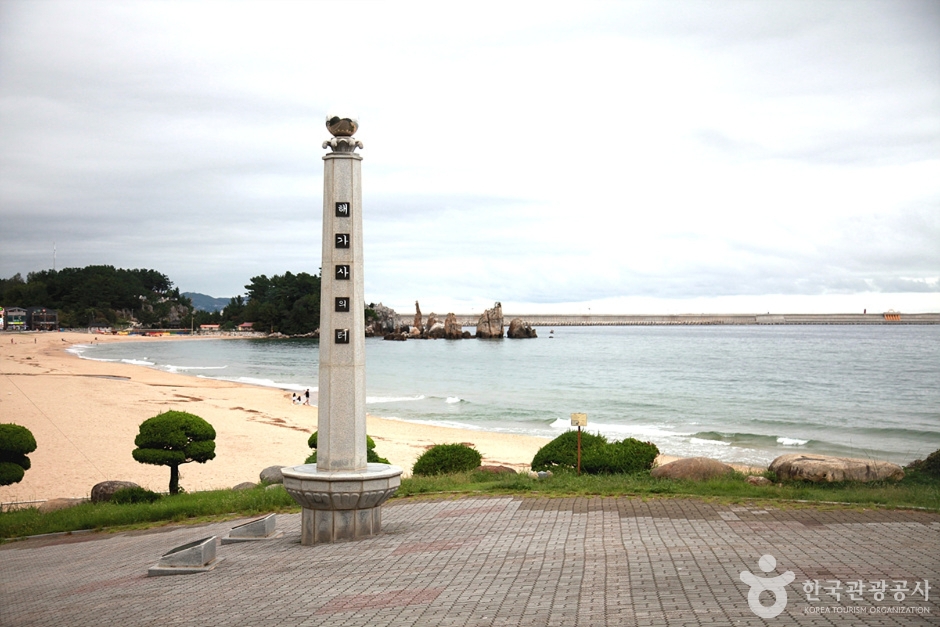
Imhaejeong, the site of Haegasa Temple, was restored based on the Haega legend from the Surubu-in chapter of Samguk Yusa. The exact location is unknown in historical records but is presumed to have been at the end of Wausan north of Samcheok Beach. The original site is now a military protection zone and cannot be developed, so it was created on the scenic nearby Jeungsan-dong beach. The beaches around Imhaejeong form a magnificent view, and it is the only pavilion in Samcheok facing the sea. According to legend, during the reign of King Seongdeok of Silla, Sunjeonggong was having lunch at Imhaejeong when a sea dragon appeared, capturing his wife and taking her into the sea. Sunjeonggong gathered villagers, struck the hill with sticks, and sang the Haega song, causing the dragon to return Surubu-in. Based on this legend, Imhaejeong and the Haegasa memorial monument were built, with Surubu-in Park and parking nearby. In April 2006, the Love Yeui-ju Dragon Ball was installed, becoming a tourist spot for love and wishes. It is also famous as a photo spot offering the most beautiful views of sunrise at Chuam Beach on the East Sea.
Buheung Raw Fish Restaurant is a representative raw fish restaurant in Mukho Port boasting a 50-year tradition. It offers a variety of seafood menus including mulhoe (cold raw fish soup), assorted sashimi, and sashimi bibimbap, with mulmangchi spicy fish stew being especially popular. Side dishes such as squid and seaweed stems are neat and delicious, and fresh seafood can be enjoyed at reasonable prices. It has been featured on various broadcasts including 'Gourmet Heo Young-man's Baekban Journey' and 'Live Tonight.' It is also popular among travelers for its dining experience along with the nearby sea scenery.
This is the only limestone cave located in the middle of an urban area in Korea. Situated in the center of Donghae-si, Gangwon-do, the cave was accidentally discovered during apartment construction in 1991 and has been open to the public since 1996. It is known to be home to the golden bat, a globally endangered species. The golden bat, which has a deep orange color, is a rare species designated as both first-class endangered wildlife and a natural monument. The cave is 1,510 meters long, but only 810 meters are open to visitors, with the rest preserved for conservation. Visitors can see extraordinary cave formations such as large stalactites hanging from the ceiling, stalagmites rising from the floor, and pillars formed by stalactites and stalagmites connecting. The ceiling also features Korea's largest ceiling corrosion gully. The adjacent nature experience park adds to the educational value. A 785-meter doline trail (a funnel-shaped limestone depression formed by water erosion) allows easy understanding of cave formation, and visitors can rest at a wildflower experience park blooming with over 100 species.
Good places to stop and rest after the course

Booking and payment continue on a partner site.
Check rooms & priceSign up to feature your channel.
(As a member, you can add your Instagram, YouTube, and blog links in My Page, and we’ll show them with every comment you write.)
““Stayed near Hongdae and did a night café tour. Perfect city views and vibes.””
Guest comments do not display social media links or profile cards.
Share a short tip about this place.
Or leave a quick comment as a guest.
Photo attachments are available after login.
No reviews yet. Be the first to share your experience!