
Okporo road and Duryu Park course in Daegu Dalseong-gun · schedule Other · distance 35.7km · 6 stops · highlights Yongyeonsa Temple, Mabijeong Mural Vil…
In Daegu, cherry blossoms bloom abundantly every April. Whether in the city or in the mountains, areas such as Palgongsan Circuit Road, Suseong Amusement Park, Apsan Park, Okpo-ro, and Duryu Park Road are filled with cherry blossoms. Among these, the cherry blossom trees lining Okpo-ro stand out with their exceptional beauty, and the cherry blossom path in Duryu Park is a beloved resting place for Daegu citizens and travelers alike. Walking under the densely blossomed cherry trees where you can't see the sky, a breeze brings a shower of petals like a painting. Centered on this cherry blossom tunnel, pedestrian-only paddy field paths and detour roadside flower paths run side by side. The nighttime cherry blossom festival, where the 83 Tower of E-World is highlighted by lighting along with colorful illuminations, is a spectacular sight.
This course is a sample 2-day itinerary. Save it as-is or expand it into an AI itinerary.
Yongyeonsa Temple's name originates from a legend that a dragon ascended to heaven from a pond at the temple entrance. The temple was founded by Boyang Guksa in 914 (Silla, King Shindeok's 3rd year) and rebuilt by Cheonildaesa in 1419. Several buildings destroyed during the Imjin War were successively restored. Currently, it is a branch temple of Donghwasa, the main temple of the 9th district of the Jogye Order of Korean Buddhism. Yongyeonsa is widely known as the temple enshrining the Buddha's true relics (sarira). Its history began when the monk Jajang, after diligent prayer at Wudang Mountain in China, returned with the golden robe and the Buddha's true relics. Jajang enshrined relics at several temples, including Bongjeongam in Seoraksan, Beopheungsa on Sajasan, Jeongamsa in Taebaeksan, Woljeongsa in Odaesan, and Tongdosa in Yeongchuksan, which are called the five great Jeokmyeolbogung. During the Imjin War, the Yongyeonsa relics were moved to Mount Myohyang to avoid the war. Later, Cheongjin, a disciple of St. Saimdang, enshrined one relic here at Yongyeonsa while transporting sarira back to Tongdosa. Since then, along with Geonbongsa and Dorisa, Yongyeonsa has been recognized as one of Korea's eight major Jeokmyeolbogung temples. The Geumgang Gyedan within the temple is a sacred site where the Buddha's relics are enshrined and precepts are conferred, symbolizing that the Buddha is always present. In front of Geumgang Gyedan stands the Jeokmyeolbogung hall, notable for not enshrining any Buddha statues, as the enshrined Buddha relics themselves are the object of worship. Additionally, Yongyeonsa’s Geumgang Gyedan, three-story stone pagoda, Geungnakjeon Hall, wooden Amitabha Buddha triad statue, and buried relics have been designated cultural assets. The path leading to Jeokmyeolbogung is surrounded by dense forest, offering a refreshing atmosphere akin to forest bathing and serves as a hiking trail to Mt. Biseulsan.
Mabijeong Village (馬飛亭) in Bonri 2-ri, Hwawon-eup, Dalseong-gun, Daegu, which holds a sad legend about horses, has recently transformed into a 'mural village' through the Green Rural Experience Village Project, becoming a prominent tourist attraction not only in Daegu but nationwide. It is also known as a filming location for the popular SBS variety show Running Man, drawing many domestic and international visitors. The entire village is decorated with murals depicting the nostalgic rural landscape of the 1960s and 70s, using earthen walls and stone walls. Visitors can enjoy murals while experiencing nature, including the nation's only connected tree + intertwined tree love tree, the oldest lacquer tree in Korea, bamboo tunnel paths, and ipap tree tunnel paths.
The entry of the descendants of Samudang (三憂堂) Mun Ik-jeom (文益漸), known as the progenitor of the Nampyeong Mun clan, to Daegu is said to have occurred roughly 500 years ago. They settled in this area of Inheung during the time of his 18th descendant, Insanjae (仁山齋) Mun Gyeong-ho (文敬鎬, 1812~1874). He planned to create a village solely for the Mun clan, establishing it on the site of the original Inheungsa, a great Goryeo temple. The first building constructed in the ancestral home area was Yonghojae (龍湖齋), a study room built around 1820, located now where Gwanggeodang stands. The residence buildings began in the late 1800s, initially with thatched roofs, and the present settlement took shape over the following 100 years. Currently, more than 70 tile-roofed houses are neatly arranged within the village. Although the architecture is less than 200 years old, it preserves the traditional framework of Yangban houses in the Yeongnam region. This village is notable for its unique composition and harmony with the surrounding landscape, rarely seen elsewhere.
Daegu Arboretum is a representative case of environmental restoration that transformed a site where Daegu citizens' household waste of 4.1 million tons was buried from 1986 to 1990 into a natural ecological space on an area of about 74,000 pyeong. Construction began in 1997, and it opened in May 2002, becoming an urban arboretum that restores natural ecological environments and offers citizens a space for rest and learning. The arboretum consists of 21 zones, including coniferous forest, broadleaf forest, flower and tree garden, wildflower garden, medicinal plant garden, and dye garden. It planted about 60,000 trees of over 400 species and about 130,000 herbaceous plants of 800 species across 1,100 flower beds. Additionally, it exhibits around 300 bonsai pieces of 40 species, 2,000 cacti of 200 species, and about 300 unique stones, providing visitors with diverse opportunities to appreciate plants. Currently, about 1,750 species of plants are displayed. Composed of 25 themed gardens and located close to the city center, this arboretum is cherished as an urban arboretum where citizens can observe nature, participate in tours and learning, and enjoy leisure.
Duryu Park is located in Dalseo-gu, the center of Daegu Metropolitan City, and is the largest park in Daegu. In 1977, Daegu city created this 500,000-pyeong park, which features a large outdoor concert hall, a cultural arts center, library, sports facilities such as a baseball stadium, tennis courts, and a swimming pool, as well as memorial facilities like the 2.28 Memorial Tower and the Person Hill. The 83 Tower, located at the summit of Duryusan, is a landmark of Daegu with an observation deck 200 meters high offering panoramic views of Daegu city. Seasonal events include a cherry blossom festival in spring, cooling amenities such as fountains and a swimming pool in summer, autumn foliage viewing spots in fall, and an ice skating rink within the park for winter enjoyment. From the north entrance, Duryu Station on Subway Line 2 is about 500 meters away, and from Seobu Jeongryujang Station on Line 1, it is about 600 meters to Seongdang Pond in the southwest edge of the park, making accessibility excellent.
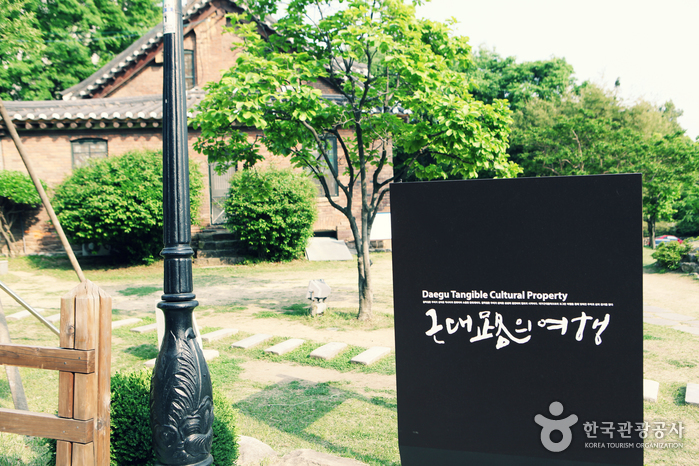
Modern Culture Alley was selected as a Korean Tourism Star in 2012 and has been listed in Korea's Top 100 Tourist Attractions for three consecutive years, making it one of the most popular spots that led alley tours to become a nationwide tourism content. This alley has many photogenic points at key locations, and travel reviews are actively shared through internet blogs and SNS. It is recognized as a representative tourist attraction that introduced the concept of tourism to Daegu, which was once a tourism desert. When visiting Modern Culture Alley, you can encounter the coexistence of Daegu's past, present, and future and experience a special journey where dialogue, understanding, communication, and empathy between generations occur.
Good places to stop and rest after the course

Booking and payment continue on a partner site.
Check rooms & price
Booking and payment continue on a partner site.
Check rooms & priceSign up to feature your channel.
(As a member, you can add your Instagram, YouTube, and blog links in My Page, and we’ll show them with every comment you write.)
““Stayed near Hongdae and did a night café tour. Perfect city views and vibes.””
Guest comments do not display social media links or profile cards.
Share a short tip about this place.
Or leave a quick comment as a guest.
Photo attachments are available after login.
No reviews yet. Be the first to share your experience!


