Restful scenery in the middle of the city in Daegu Jung-gu · schedule Other · distance 10km · 6 stops · highlights Daegu Gyesan-dong Catholic Church, Is…
Daegu's modern alleys retain stories from 100 years ago intact. Below Cheongna Hill, where the missionaries' houses from a century ago still stand, Gyesan Cathedral, the Lee Sanghwa House, and Jin Alley are faintly connected. The lively energy of the market and Kim Kwang-seok Street, found at the edge of the city center, soothe the weary hearts of travelers with the nostalgic songs of the old singer.
This course is a sample 2-day itinerary. Save it as-is or expand it into an AI itinerary.
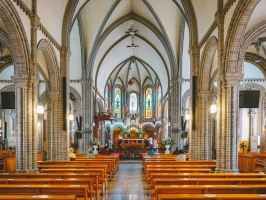
Gyesan Catholic Church is located at Gyesan Five-way Intersection in Jung-gu and, together with Beomeo Cathedral, serves as a co-cathedral of the Catholic Archdiocese of Daegu. The patron saint of the parish is Our Lady of Lourdes. The parish was established in 1898 under the direction of Father Pwaneel, who built Myeongdong Cathedral and designed Jeonju Jeondong Cathedral. Notably, the stained glass was imported directly from France. It is situated close to the city center and features nighttime lighting, allowing visitors to enjoy a beautiful night view. There are well-maintained walking paths around the church, attracting many who visit for relaxation in the downtown area. An interesting fact is that Daegu’s first Catholic church, Gyesan-dong Catholic Church, and Daegu First Presbyterian Church, the city's first Protestant church, face each other across the street. This area, including Gyesan-dong and Dongsan-dong, represents the starting point of Christian history in Daegu across denominations. During construction, there was a debate about the location between the current site and Cheongra Hill to the west, but at the request of elderly parishioners, the church was built at the current site. Originally, the building was a traditional Hanok-style similar to the Anglican Ganghwa Church, but after it burned down in 1901, a new Gothic-style church was built. It is the first Western-style church built in Gyeongsang Province and is managed by the Cultural Heritage Administration. Along with the Carmel Convent in Daemyeong-dong, Nam-gu and the Anglican Seoul Cathedral, Gyesan Catholic Church is one of the few places in the urban area where the bells are rung. Thus, hearing the bells during the Angelus can evoke the atmosphere of traveling in Europe.
Isanghwa Old House, located in Jung-gu, Daegu, is the former residence of the independence activist and poet Isanghwa, who resisted Japanese rule. At this house, he mainly worked on translating works such as Chunhyangjeon into English and devoted himself to reading and research. To honor his achievements, a citizen movement to preserve the house began in 1999. The Military Mutual Aid Association purchased and renovated the house while constructing nearby mixed-use apartments, and the Citizen Movement Headquarters for Preservation of the Old House installed exhibition items within the house using raised funds. Isanghwa Old House commemorates the spirit of the anti-Japanese nationalist poet Isanghwa and serves as an educational site to inherit his noble patriotic spirit and literary accomplishments to future generations.
Daegu Yakryeongsi Oriental Medicine Museum is an exhibition and cultural space where you can see and experience the history of Yakryeongsi, a 350-year-old tradition, and the origin of Yakjeon Alley at a glance. To preserve, inherit, and develop the traditional Oriental medicine culture of Daegu Yakryeongsi and to solidify its status as the birthplace of herbal medicine distribution, a permanent herbal medicine exhibition hall was established on September 25, 1985. The museum introduces the origin and development of Yakryeongsi through graphics and animations and displays over 300 items related to Oriental medicine, including rare herbal medicines, Donguibogam and other Oriental medicine texts, and herbal medicine tools such as yakjaktu. It is a space where visitors can directly see, feel, and experience the lives and atmosphere of the old Yakryeongsi people, blending various exhibitions, education, culture, and tourism.
Jin Golmok is an alley formed around the Daegu Jongno area, stretching from Jungang-daero to Hongbaegwon, where you can encounter old history and culture in the city center. Jin Golmok originates from the Gyeongsang dialect term for long alleys, 'jilda,' meaning long. It extends along the right side about 50 meters into Jongno after passing the intersection of the old Daenam Hospital, where the south gate of Daegu Eupseong was located. Jin Golmok was a clan village of the Dalseong Seo family, local powers in Daegu from the Gyeongsang Gamyeong era until before liberation. By passing through Jin Golmok, one could reach the Gamyeong and Jungyeong buildings without going through Jongno, which was a military and administrative road at that time. From the late 19th century, overseas Chinese began settling here, and it became the site of Daegu's first furniture stores. Currently, centered around Namseong-ro intersection, shops selling traditional items such as traditional tea, tea utensils, herbal medicine, and antiques are located here. It corresponds to Course 2 of the Daegu Jung-gu Alley Tour, the Modern Culture Alley, where traditional culture breathes alive. Additionally, stylish and uniquely interior-designed restaurants and cafes have been established along both sides of Jin Golmok.
Seomun Market, formerly known as Daegu Big Market, was relocated to its current location by reclaiming Cheonhwangdangji in the 1920s and has a long history. During the Joseon Dynasty, the three major markets were said to be in Daegu, Pyongyang, and Ganggyeong. Named Seomun Market because it was located on the west side of the Daegu fortress, the original market was about 300 meters from the fortress, around the current Sijangbuk-ro Bonjeon Coffee Shop area and the motorcycle alley nearby, opening on the 2nd and 7th of every month. The names Hongdukkye Jeon and Chicken Jeon alleys remain to this day. The market is large, dominated by textile-related items such as silk, cloth, knitwear, crafts, men’s and women’s clothing, dishes, and dried seafood. It is known for its warm hospitality and is conveniently equipped with heating, cooling facilities, and a large parking lot.
Kim Gwangseok Street is a mural street themed around the life and music of the late Kim Gwangseok, located in the alleys near Bangcheon Market in Daebong-dong where he lived. It was created starting November 2010 as part of the 'Bangcheon Market Munjeonseongsi Project.' Jung-gu Office and 11 artist teams participated. Along the 350m-long wall, murals depict Kim Gwangseok sculptures, him serving noodles at a street food stall, and him looking out to the sea, along with various images and lyrics of his songs. Every autumn, the 'Kim Gwangseok Singing Contest' is held around Bangcheon Market and Dongseong-ro to commemorate him. ◎ Travel info to experience the charm of Hallyu – The drama featured Kim Gwangseok Street, a favorite dating spot for Robin and Hana before their breakup. It is a street where visitors can stroll along the alleys next to Bangcheon Market, viewing various murals themed on Kim Gwangseok's life and songs. The alleys have many cafes and restaurants popular on SNS, making it a favorite dating spot for couples.
Good places to stop and rest after the course

Booking and payment continue on a partner site.
Check rooms & priceSign up to feature your channel.
(As a member, you can add your Instagram, YouTube, and blog links in My Page, and we’ll show them with every comment you write.)
““Stayed near Hongdae and did a night café tour. Perfect city views and vibes.””
Guest comments do not display social media links or profile cards.
Share a short tip about this place.
Or leave a quick comment as a guest.
Photo attachments are available after login.
No reviews yet. Be the first to share your experience!