Stories of Everyday Life in Chungju’s Traditional Market in Chungcheongbuk-do Chungju City · schedule Other · distance 67km · 6 stops · highlights Chung…

Along the Chungjucheon, which joins the Namhan River running through downtown Chungju, three traditional markets stand side by side—Muhak Market, Jayu Market, and Gongsul Market—offering a charming market exploration experience. At a corner of the market filled with people and life, one of the few remaining blacksmith shops nationwide stands out. The Samhwa Blacksmith Shop, run by a blacksmith whose life is reflected in the years of heating and hammering iron, provides an enjoyable visit. [Source] From the 30 Best Travel Spots in Chungju
This course is a sample one-day itinerary. Save it as-is or expand it into an AI itinerary.
This is a regular traditional market held every 5 days in the Chungui-dong area of Chungju-si, Chungcheongbuk-do. As one of the pungmul markets, there is a permanent market of about 600 stores on weekdays, and every 5 days the folk 5-day market blends in, making various stores rich with food and attractions. It is held near Chungju Gongseol Market and Chungju Muhak Market along Gyohyeoncheon every month on the 5th, 10th, 15th, 20th, 25th, and 30th. The market stretches about 500m along Gyohyeoncheon. In the 1960s, street vendors naturally formed the 5-day market near Yesung Park in Gyohyeon-dong due to convenient transportation and accessibility to citizens. In March 2001, Chungju-si forcibly relocated street vendors from Yesung Park to the current location, establishing the Pungmul Market.
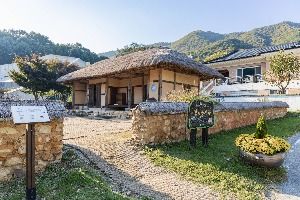
반기문 유엔사무총장 생가마을인 행치마을은 보덕산이 좌우에서 감싸안고 있으며, 온화하고 정겨운 느낌을 주는 마을로 생가, 기념관, 평화랜드 및 선영과, 사당, 돌로 만든 세계도(족보), 기념시비, 연못 등이 있다. 초가삼간 흙벽집이었는데, 1970년대 새마을 사업시 스레트지붕으로 개조되었고, 2002년 3월경에 철거되었다. 생가는 예전의 사진자료를 바탕으로 2010년 복원되었다.
올뱅이(올갱이)는 예로부터 위장에 좋다고 하며 우리 옛 선인들이 즐겨 먹던 음식으로 운정식당에서는 올뱅이를 재료로 한 올뱅이해장국, 올뱅이무침과 육개장, 된장찌개 등 다양한 메뉴를 제공한다.
This is a traditional market located at the site of the north gate of Chungju Eupseong. It was a venue for a five-day market and naturally evolved into a permanent market as the city developed. Shops along the roadside mainly sell clothing and precious metals, while alley shops inside the market deal in silk, clothing, and textiles. In the past, other alley shops primarily sold red peppers, garlic, and rice, so much so that the area was known as Gochujeon and Ssajeon for its bustling trade. However, most merchants moved to the Chungju Agricultural and Marine Products Wholesale Market, which opened in 1995. At night, the Chungju Nuri Night Market operates, offering various food options as well as traditional Chungju performances, busking shows, and other attractions. Nearby tourist spots include Chungju Literature Museum, Chungju Hyanggyo, and Hoam Art Hall.
This is an early Joseon Dynasty government office building located in Gwana Park in Chungju city. It was also used as a reception hall for welcoming VIPs. In the 7th year of King Gojong (1870), it burned down along with Cheongryeongheon but was rebuilt by the Chungju magistrate Jo Byeong-ro at that time. It served as the office of the Jungwon county head and was restored to its original form in 1983. The building is 7 kan wide and 3 kan deep, with a hipped-and-gabled roof in the shape of a Korean letter pal (八) and decorated with wing-shaped brackets in the Ikko style. The central 2 kan are a large open hall (daecheong), and the right 2 kan and left 3 kan rooms are Ondol-heated and wooden-floored rooms. Nearby are the Chungju Fortress Historical Monument, Chungju Museum, and Chungju Cultural Center.
Chungju Danhosa Temple is a branch temple of the Taego Order of Korean Buddhism and was reconstructed during the reign of King Sukjong in the late Joseon Dynasty. It was called 'Yaksa' at the time of reconstruction and renamed Danhosa in 1954, continuing to the present. Existing buildings include the main hall (Daeungjeon), Yaksa Hall, Yongwang Hall, and the monk's quarters, built as three-bay gabled houses. Inside Yaksa Hall is a seated iron Buddha statue designated as a treasure in 1976, estimated to have been made in the 11th century. This iron Buddha is a precious cultural artifact from the Goryeo period and aids in the study of regional artistic schools. Additionally, various cultural properties can be found, such as the Chungju Danhosa three-story stone pagoda, the seated statue of Avalokitesvara (a tangible cultural property of Chungcheongbuk-do), and the standing Maitreya Buddha. At Danhosa, regular Dharma meetings are held on the first and third Sundays of every month, as well as on the first and fifteenth days of the lunar month.
Good places to stop and rest after the course

Booking and payment continue on a partner site.
Check rooms & price
Booking and payment continue on a partner site.
Check rooms & priceSign up to feature your channel.
(As a member, you can add your Instagram, YouTube, and blog links in My Page, and we’ll show them with every comment you write.)
““Stayed near Hongdae and did a night café tour. Perfect city views and vibes.””
Guest comments do not display social media links or profile cards.
Share a short tip about this place.
Or leave a quick comment as a guest.
Photo attachments are available after login.
No reviews yet. Be the first to share your experience!